

I Asked the CEO of PMI One Question, He Edited His Response, Accused Me of Self-Promotion, and Removed My Comment
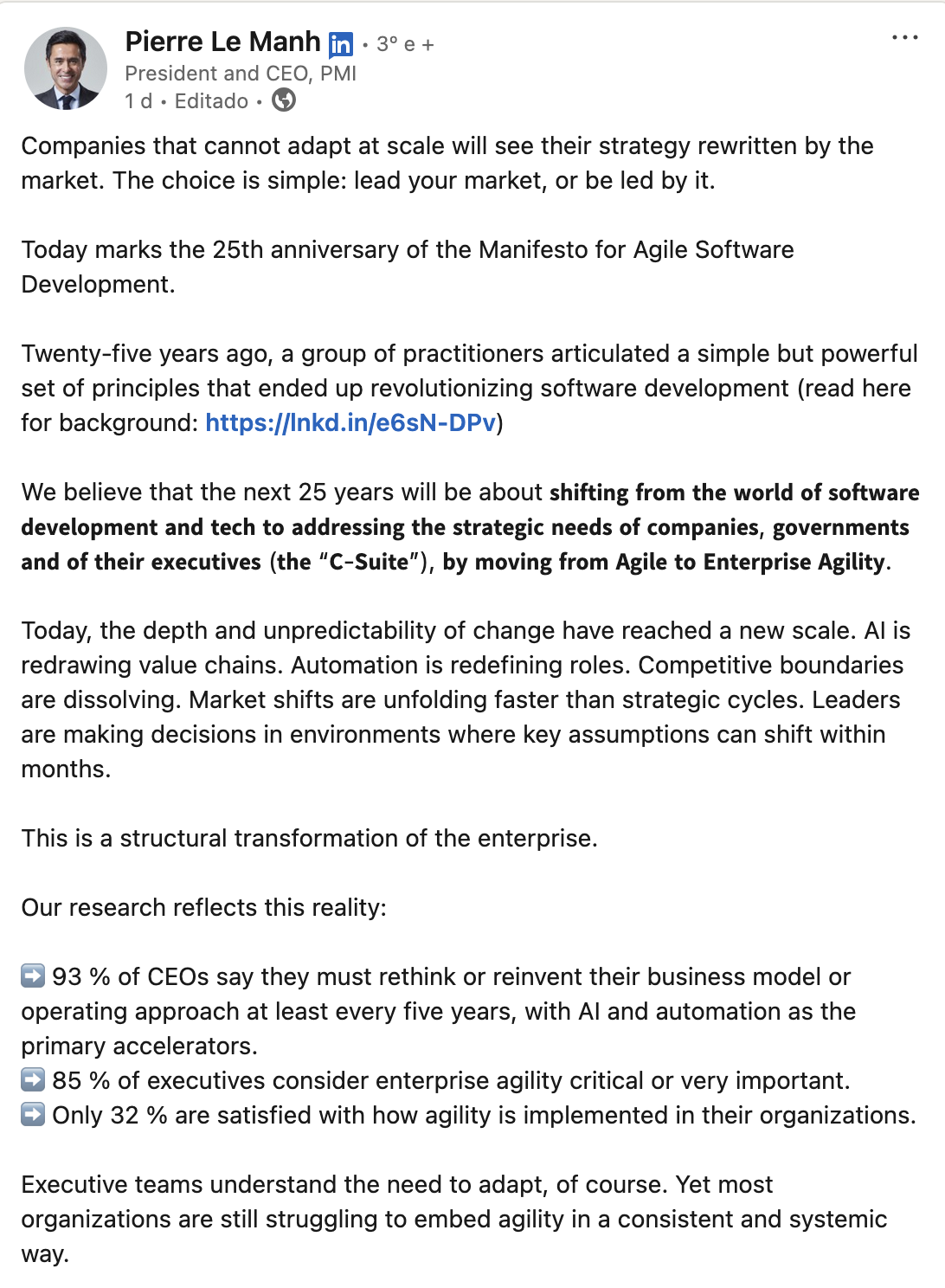
Yesterday was the 25th anniversary of the Agile Manifesto. LinkedIn was flooded with celebration posts. Among them, Pierre Le Manh — President and CEO of the Project Management Institute — published a post marking the occasion.
The post was well-written. He celebrated the original manifesto, acknowledged that organizations are struggling to implement agility, shared some compelling statistics, and announced a new product: the Manifesto for Enterprise Agility, coming March 3rd.
I read the entire post. Then I left a comment.
What happened next told me more about the Agile industrial complex than decades of articles, certifications, and conference keynotes ever did.
The Post
Pierre Le Manh's post opened by celebrating the "Manifesto for Agile Software Development" and how a group of practitioners "ended up revolutionizing software development." He described how the next 25 years will be about "shifting from the world of software development and tech" to something broader.
He shared three statistics:
- 93% of CEOs say they must rethink their business model every five years
- 85% of executives consider enterprise agility critical or very important
- Only 32% are satisfied with how agility is implemented
That last number stood out. An 85-to-32 gap. More than half of executives say agility matters but isn't working.
His proposed solution: a new manifesto. Built from 700 CEO voices. Co-created with original Agile Manifesto authors. Releasing March 3rd through PMI.
The post ended with: "Stay tuned."
The Comment
I have a LinkedIn page called AgileLie. At the time, it had 5 followers. I write about the gap between what Agile promises and what it delivers in practice. I don't sell certifications. I don't run workshops. I don't coach. I have no product linked anywhere on the page.
I left this comment:
"85% of executives consider agility critical. Only 32% are satisfied with how it's implemented."
That's a 53-point gap. And the proposed solution is another manifesto.
25 years ago the original Manifesto fit on a single page because simplicity was the point. Now we have the Agile Manifesto, the Scrum Guide, SAFe, DAD, LeSS, and soon the Manifesto for Enterprise Agility — built by the same organization that sells the certifications, training, and conferences around it.
At some point we have to ask: is the gap between "agility is critical" and "we can't implement it" caused by a lack of manifestos? Or by an industry that profits from keeping organizations in a permanent state of transformation?
700 CEO voices went into building this. I'd be curious how many of them can describe what their engineering teams actually do in a sprint.
No links. No mentions of my blog. No CTA. Just a question built from the data in his own post.
The comment got 138 impressions. For a page with 5 followers, that's significant.
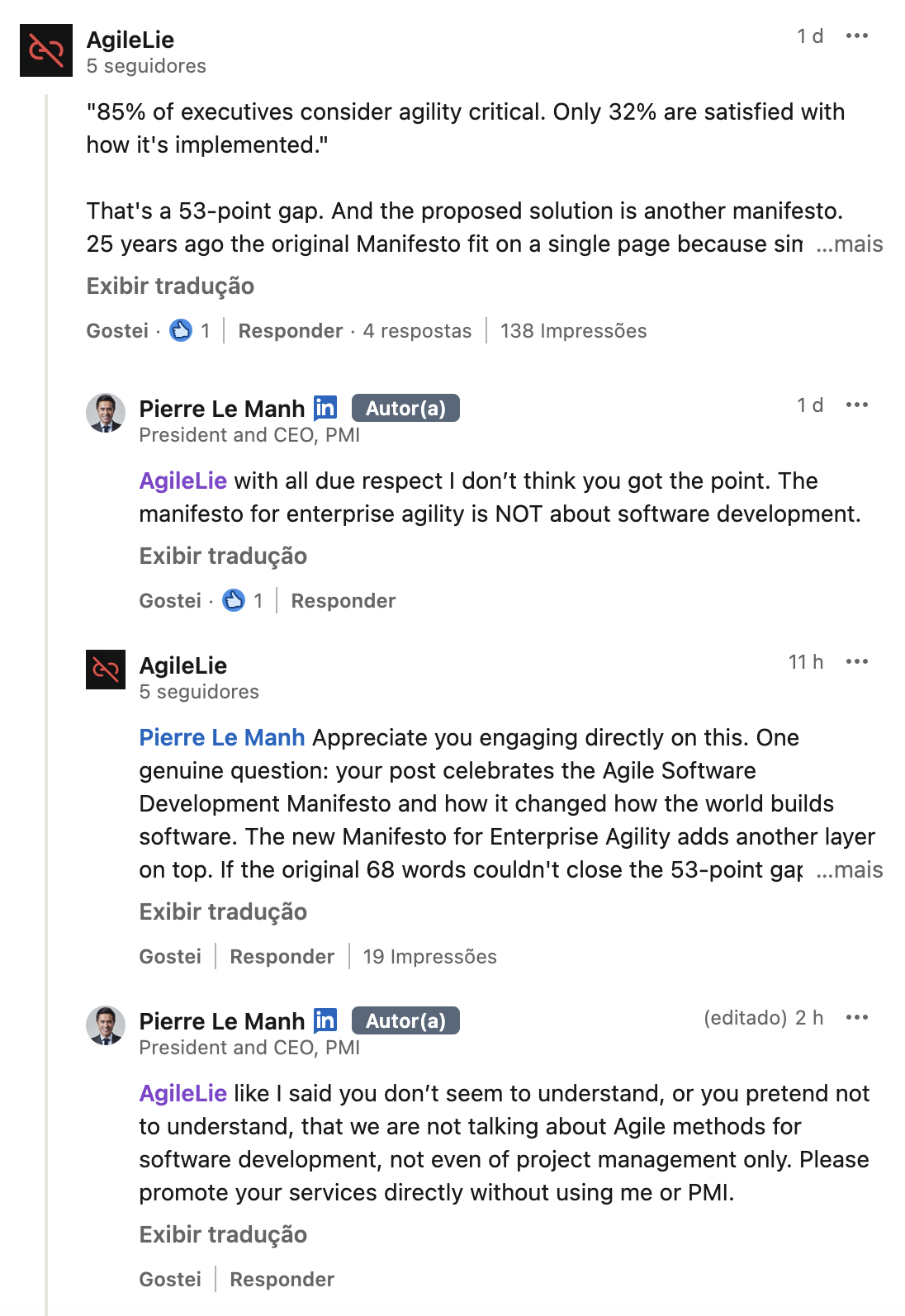
Response #1: "You Don't Get the Point"
The CEO of PMI responded personally:
"AgileLie with all due respect I don't think you got the point. The manifesto for enterprise agility is NOT about software development."
This was interesting for one reason: his own post explicitly opened by discussing the Manifesto for Agile Software Development, celebrating how it revolutionized software development, and describing a shift from the world of software development and tech.
The software context wasn't something I introduced. It was the foundation of his post.
I responded:
"Appreciate you engaging directly on this. One genuine question: your post celebrates the Agile Software Development Manifesto and how it changed how the world builds software. The new Manifesto for Enterprise Agility adds another layer on top. If the original 68 words couldn't close the 53-point gap in 25 years, I'd love to understand why more words will."
Still no links. Still no promotion. Just a follow-up question using his own words.
Response #2: The Escalation
His second response was edited before posting. LinkedIn shows the "(edited)" tag. He chose his words carefully:
"AgileLie like I said you don't seem to understand, or you pretend not to understand, that we are not talking about Agile methods for software development, not even of project management only. Please promote your services directly without using me or PMI."
Let's break this down.
"You don't seem to understand, or you pretend not to understand." That's not an argument. That's a dismissal. When the CEO of the world's largest project management organization can't answer a question about his own data, the response shifts from addressing the argument to attacking the person making it.
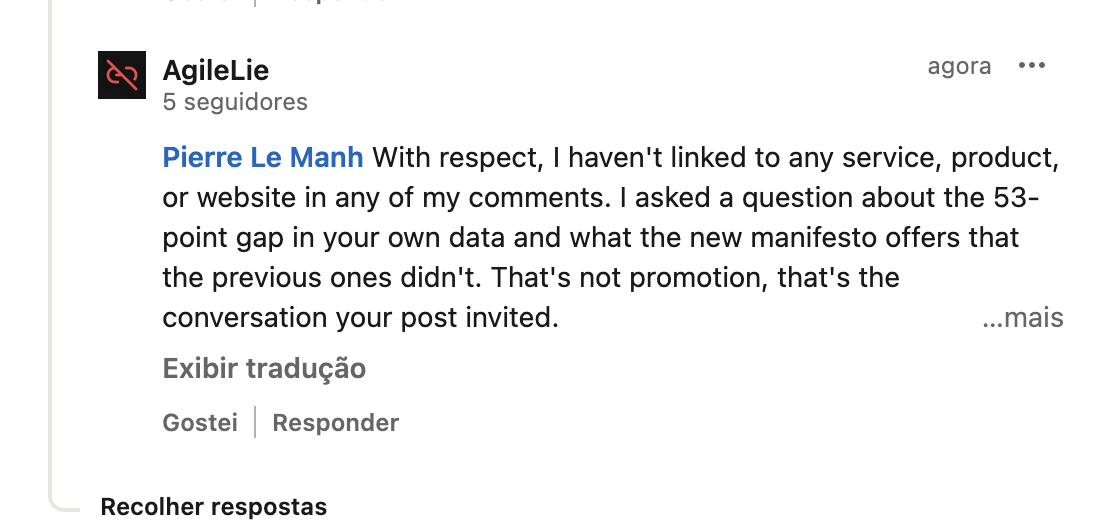
"Please promote your services directly without using me or PMI." This is the part that matters most. I have no services. I linked to nothing. I promoted nothing. My page had 5 followers. I asked a question about a 53-point gap in data that he published publicly, on a post that he made visible to the entire internet.
The CEO of an organization that generates billions in certification revenue accused a 5-follower page of self-promotion. For asking a question.
What This Actually Reveals
I want to be clear: I'm not writing this because I'm offended. I'm writing this because what happened in that thread is a perfect microcosm of how the Agile industrial complex operates.
The pattern:
-
Publish data that reveals a problem. 85% say agility is critical. Only 32% are satisfied. That's the industry's own data admitting something isn't working.
-
Propose more product as the solution. Not less framework. Not fewer certifications. A new manifesto. Another layer. More words to close a gap that 25 years of words couldn't close.
-
When someone questions the logic, change the subject. "It's NOT about software development" — except the post was explicitly about software development.
-
When the subject change doesn't work, attack the person. "You don't seem to understand, or you pretend not to understand." Classic dismissal. Reframe the questioner as confused or dishonest instead of engaging with the question.
-
When the attack doesn't work, delegitimize the motive. "Please promote your services directly." Zero links. Zero services mentioned. Zero promotion. But the accusation doesn't need to be true. It just needs to give permission to dismiss the question.
-
Remove the evidence. My first response — the one pointing out the contradiction — was removed from the thread. A question asked on a public post, using the author's own data, was deleted.
This is the immune system of the Agile industrial complex operating in real time. It doesn't engage with criticism. It pathologizes it. The person asking the question becomes the problem, not the 53-point gap in the data.
The Irony
The Agile Manifesto's first value: "Individuals and interactions over processes and tools."
An individual interacted with the CEO of PMI on a public post. The interaction was a respectful question about the effectiveness of a new process tool (the manifesto). The CEO's response was to dismiss the individual, question their motives, and remove their comment.
Individuals and interactions over processes and tools. Unless the individual questions the process. Then the tools come out.
The Numbers
Let's put this in context.
PMI is not a small organization. It has over 370,000 members worldwide. It generates significant revenue from certifications (PMP, PMI-ACP, and others), training, conferences, and publications. The Agile Alliance, which PMI absorbed, was founded by some of the original manifesto authors.
The new Manifesto for Enterprise Agility is a product launch. It will be followed by training programs, certification tracks, conference sessions, and consulting frameworks. This is how the machine works. Every new manifesto creates a new ecosystem of products around it.
When someone asks "what does this new manifesto offer that the previous ones didn't?" — that's not a hostile question. That's the exact question any executive should ask before investing their organization's time and money in another framework.
The CEO of PMI couldn't answer it. Not because he didn't want to. Because the answer is uncomfortable: the new manifesto offers a new revenue stream for PMI. And saying that out loud isn't an option when you're the CEO.
What I Learned
I spent the day commenting on LinkedIn posts from the biggest names in the Agile industry. Jeff Sutherland, the inventor of Scrum. Mike Cohn, co-founder of the Scrum Alliance. Certified coaches, SAFe practitioners, Agile consultants.
Most of them engaged thoughtfully. Some agreed. Some pushed back with substance. One coach admitted he makes his living from this and acknowledged the tension. That's honest discourse.
The only person who couldn't handle a question was the one with the most to lose from the answer.
That's not a coincidence. That's a business model protecting itself.
The Question Still Stands
If the original 68 words couldn't close the gap between "we need agility" and "this isn't working" in 25 years, what does the new manifesto offer that the previous ones didn't?
The CEO of PMI had two chances to answer this question. He used both of them to attack the person asking it.
Draw your own conclusions.
The screenshots of the complete interaction are published below. Nothing has been edited, cropped, or altered. The post is public. The responses are public. This is a factual account of what happened.
Benjamim Castell writes about the distance between process as promised and delivery as practiced.
Most of them were trapped in what I call Risk Management Theater and didn't even know
Keep reading

The Architect Who Asked Me What a REST API Is
There's a guy on my project with architect in his title who asked me to explain what a REST API is during a call last month.
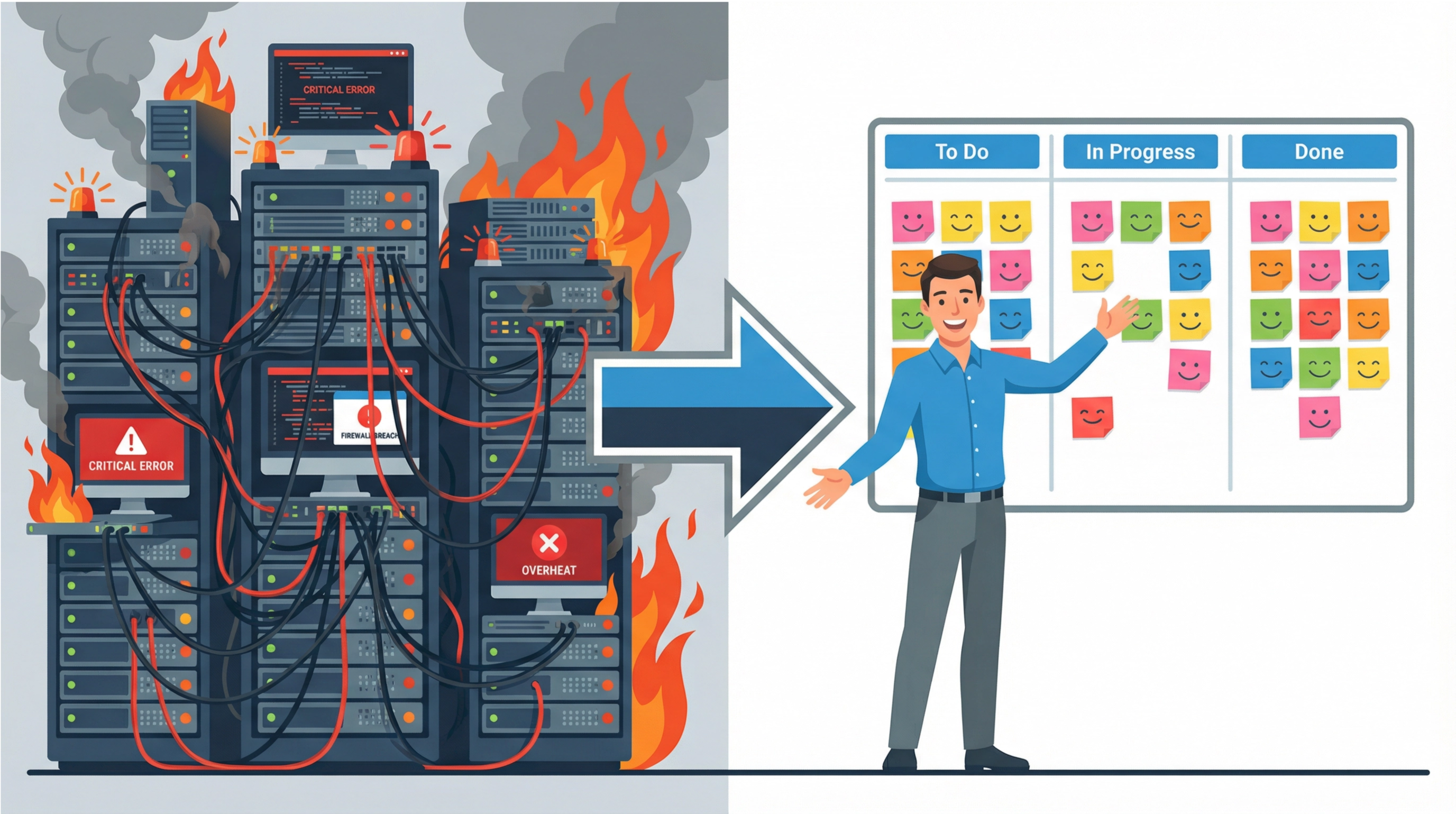
We Paid $150k/Year for an Agile Coach Who Had Never Written a Line of Production Code
A non-technical Agile coach spent two years redirecting every engineering problem into a process conversation. Here`s what happened, what it cost us, and what actually makes engineering teams effective.

Mike Cohn Asks Who Should Cancel a Sprint, he's Asking the Wrong Question
When executives cut your timeline in half, Scrum won't save you. Here's how I started protecting my team with data instead of arguments.
Get the next war story in your inbox
Independent essays and practical models about what the process claims versus what actually ships. Published under a protected pen name. Free, no spam, unsubscribe anytime.
No certifications sold. No process religion. Unsubscribe anytime.