
Scripts for Suggesting Standup Alternatives to Your Manager
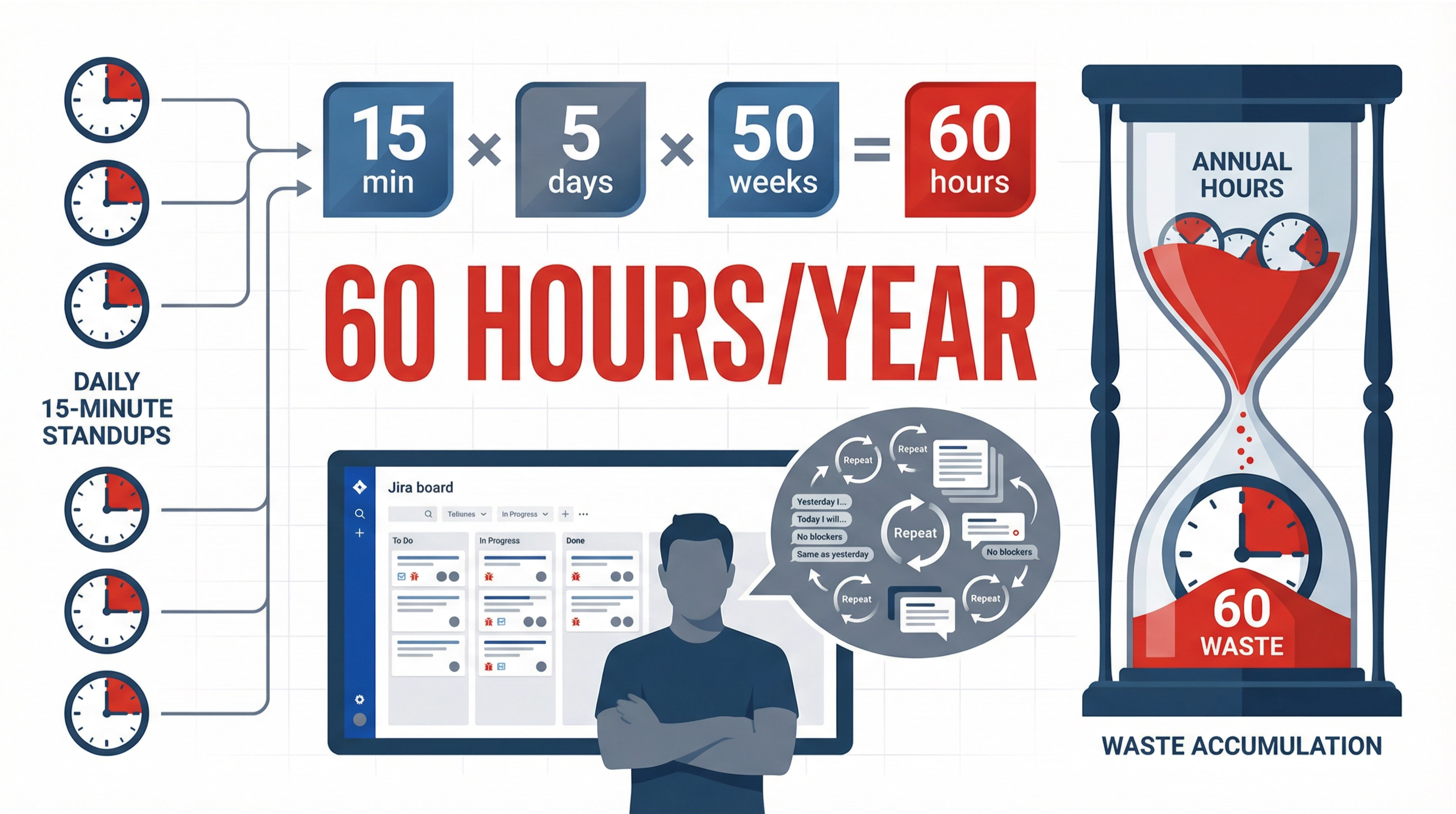
Fifteen minutes times five days times fifty weeks. Sixty hours a year—minimum—spent announcing what you typed into Jira yesterday.
That number gets worse when you count the context switch. The morning momentum you lose. The twenty minutes before the meeting where you can't start anything deep. The twenty minutes after where you're clawing back focus.
If you are going to have this conversation, walk in with your team's number and not mine. The standup calculator works it out and shows every assumption on the page, which matters more than the total: a manager who can argue with your inputs is engaging, a manager who can dismiss your total is finished with you.
You know this is broken. Knowing isn't the problem.
The problem is that the moment you say "I think standups aren't working," your manager hears something else. They hear "I don't want accountability." They hear "I'm not a team player." They hear "I'm questioning your judgment."
None of that is what you mean. But it's what lands.
This post isn't about convincing you that standups need to change. You're already past that. This is about the exact words that have worked for other developers—tested scripts for the 1:1, the retro, and the carefully-worded Slack message.
Bookmark this. Come back when you need it.
Before You Open Your Mouth: Two Minutes of Prep
Scripts work better with thirty seconds of reconnaissance. Before your conversation, answer three questions:
1. What does your manager actually care about?
Visibility into progress? Team cohesion? Looking good to their manager? Understanding their real concern helps you frame alternatives in terms they value.
2. What specific problem are you solving?
Vague complaints die fast. "Standups feel unproductive" loses to "I lose 45 minutes of deep work context every morning." Be specific about the cost.
3. What are you proposing instead?
Don't just remove. Replace. Async updates? Twice-weekly syncs? Manager 1:1s? Have a concrete alternative ready or you're just complaining.
Script 1: The 1:1 Opener (Low Stakes)
When to use this: Your first mention of the topic. Testing the waters. You have a decent relationship with your manager and want to plant a seed.
The setup: You're in a regular 1:1. The agenda is light. There's an opening.
The Script:
"Hey, I wanted to get your thoughts on something. I've been tracking my focus time lately, and I noticed that morning meetings—including standup—tend to fragment my first few hours. By the time I'm in flow, it's almost lunch.
I'm not saying standups aren't valuable. But I've been wondering if there's a way to get the same visibility without breaking up the morning for everyone. Have you seen any teams experiment with async updates or different timing?"
Why this works:
- Opens with personal data, not ideology
- Doesn't attack the meeting—questions the timing and format
- Asks for their perspective, making them a collaborator
- Uses "visibility" as the value frame
What you're listening for: Curiosity? Defensiveness? "Actually, I've wondered about that too"? Their response tells you how hard this will be.
Script 2: The Retrospective Suggestion (Team Context)
When to use this: Retros are officially "safe spaces" for process feedback. This is where format suggestions belong.
The setup: It's retro time. Someone asks what isn't working. This is your moment.
The mini-scenario: The team is gathered around a virtual Miro board. Someone has written "too many meetings" on a sticky note. Half the team has upvoted it. No one wants to say which meeting.
You can say it.
The Script:
"I want to add some specifics to the 'too many meetings' note. For me, daily standup is the one that hits hardest—not because it's long, but because of when it happens. I lose context switching to it, then again switching back.
I know we need visibility into what everyone's working on. But I've been reading about teams that do async standups—like a Slack bot that collects updates—and they apparently get the same information without the calendar interrupt.
Would anyone be open to trying that for a sprint? Just to see if it works for us?"
Why this works:
- Builds on existing team sentiment
- Specific about the cost (context switching, not laziness)
- Proposes a time-boxed experiment, not a permanent change
- Invites team buy-in rather than forcing a decision
Pro tip: Get one other person to co-sign before the retro. The suggestion lands twice as hard.
Script 3: The Slack Message (Async Proposal)
When to use this: You want something in writing. Your manager prefers async. You need time to compose your thoughts without real-time pressure.
The setup: You're writing a DM to your manager. Keep it short. Managers skim.
The Script:
Subject line: Quick thought on standup format
Hey [Name],
I've been thinking about our morning standup and wanted to run something by you.
The meeting itself is short, but the timing costs me more than 15 minutes—it breaks my morning into two fragments and I lose momentum on deep work.
I know visibility is important to you (and to me). What would you think about experimenting with async standups for a week or two? Something like a daily Slack thread or bot that collects the same three questions.
Happy to own the experiment and report back on whether the team still feels connected and informed.
Let me know what you think—no pressure either way.
Why this works:
- Short and scannable
- Acknowledges their concern (visibility)
- Offers to own the work
- Gives them an easy out
- Asks for a trial, not a policy change
What NOT to do: Don't send a five-paragraph essay about the history of Agile dysfunction. That's not a Slack message. That's a manifesto.
Script 4: The Pushback Response (When They Say No)
When to use this: Your manager has concerns. They're not dismissing you, but they're not convinced. This is where most people give up.
Don't.
The mini-scenario: You're in a 1:1. You've pitched async standups. Your manager's face does that thing where they're already forming a "but." They say:
"I hear what you're saying, but I feel like standups are one of the few times the team actually sees each other. I'm worried we'd lose that connection."
Here's how you respond:
The Script:
"That makes sense. Team connection matters to me too—I don't want us to feel like isolated contractors.
What if we separated those two things? Async updates for the status part—what did you do, what are you doing, any blockers—but a weekly team sync that's actually about connection. Coffee chats, a Friday wins thread, or even one standup per week as a live check-in.
That way we're not losing the connection piece. We're just not using status updates as a proxy for it."
Why this works:
- Validates their concern instead of dismissing it
- Separates "status" from "connection"—two different needs, two different solutions
- Offers a hybrid model rather than all-or-nothing
- Shows you've thought about what they care about
The key move: Don't argue. Reframe. They said "connection." You said "let's do connection better." Now you're on the same team.
Script 5: The Trial Period Pitch (Getting to Yes)
When to use this: Your manager is skeptical but not opposed. They need a risk-free way to say yes.
The setup: The conversation is going okay. They're not shutting you down, but they're hesitant to commit. This is the closing move.
The Script:
"What if we tried it for two weeks? Just a limited experiment.
Async updates every morning—same three questions, posted by 9:30—and we skip the live standup. At the end of two weeks, we check in: Did you have the visibility you needed? Did the team feel disconnected? Did blockers get missed?
If it doesn't work, we go back. No harm done. But if it does work, we've found an extra hour and a half of focus time for the team every week.
I'm happy to facilitate—set up the channel, remind people, track how it's going. You'd just need to give it the green light."
Why this works:
- Time-boxed experiment reduces perceived risk
- Specific success criteria (visibility, connection, blockers)
- Quantifies the upside (90 minutes/week)
- You're doing all the work—they just approve
The psychology: Managers are trained to say no to permanent changes. They're not trained to say no to "let's try it for two weeks."
Script 6: The Team-Wide Proposal (When You're Not Alone)
When to use this: You've talked to teammates. Others feel the same way. There's power in numbers—but you need to wield it carefully.
The setup: You want to propose this as a team initiative, not a personal complaint. Maybe you bring it up in a team meeting. Maybe you write a proposal doc.
The mini-scenario: Three of you have been complaining about standups in a group chat for weeks. One day, Priya says: "Why don't we actually do something about this?"
You agree to bring it up at the next team meeting.
The Script:
"A few of us have been talking about meeting overhead lately, and we wanted to bring a specific suggestion to the team.
We've noticed that daily standup, while well-intentioned, ends up costing more than 15 minutes for most of us—once you factor in context switching and scheduling constraints.
We'd like to propose a two-week experiment: async standups via Slack, posted before 9:30 each morning. Same information, just written instead of spoken. We've sketched out how it would work: [share doc]. We'd keep one live sync per week for anything that needs discussion.
We're not saying synchronous standups are bad. We're saying we'd like to test whether async works better for our specific team. Would people be open to trying it?"
Why this works:
- "A few of us" signals this isn't one person's grievance
- Frames it as a team decision, not a manager decision
- Has a concrete plan ready
- Asks for buy-in rather than demanding change
Caution: Don't make it feel like an ambush. Your manager should have heard this idea before the team meeting. Surprise proposals create defensive reactions.
Script 7: The Escalation (When Your Manager Won't Budge)
When to use this: You've tried everything. Your manager has said no, keeps deferring, or won't engage. You believe this matters enough to go around them.
The setup: This is risky. Only use it if you have political capital, if the dysfunction is significant, or if you're willing to accept the relationship cost.
The Script (to skip-level or leadership):
"I wanted to raise something I've been trying to address at my level without success.
Our team's daily standup is taking more time than it should—not just the meeting, but the context-switching impact on deep work. I've proposed alternatives to [Manager] a few times, including a two-week trial of async updates, but they've preferred to keep the current format.
I'm not trying to go around anyone. But I know you care about engineering productivity, and this feels like low-hanging fruit. Other teams at [Company] have moved to async standups with good results.
Would you be willing to encourage our team to experiment with it? Or should I let this one go?"
Why this works:
- Honest about the chain of events
- Doesn't badmouth the manager—states facts
- Ties to something leadership cares about (productivity)
- Offers them an out
The reality: This might work. It might also damage your relationship with your manager. Know the stakes before you send.
Quick Reference: Phrases That Work (and Phrases That Don't)
SAY THIS:
- "I've been tracking my focus time..."
- "I know visibility is important..."
- "What if we tried it for two weeks?"
- "Same information, different format"
- "I'm happy to own the experiment"
- "Would the team be open to testing...?"
NOT THIS:
- "Standups are a waste of time"
- "Nobody likes this meeting"
- "This is Agile theater"
- "Studies show that..."
- "I read that async is better"
- "Other companies don't do this"
The first list sounds collaborative. The second sounds combative. Same idea. Different outcome.
Your Checklist Before the Conversation
Before you use any script, run through this:
- I know what my manager specifically cares about (visibility, alignment, face time, etc.)
- I can articulate the cost of the current format in concrete terms
- I have a specific alternative ready, not just a complaint
- I'm proposing a trial, not a permanent change
- I'm offering to do the work, not create work for my manager
- I've thought about their likely objections and have responses
- I've talked to at least one teammate to see if they'd support this
- I'm in a calm headspace, not venting frustration
Check most of these and your odds go up significantly.
Final Thought
Most developers who hate standups never say anything. They sit through them, zone out, resent the interruption, and complain to their friends.
You're past that.
These scripts won't work in every culture or with every manager. But they shift the odds. They help you say the thing you want to say without triggering the defenses that kill productive conversation.
Use them. Adapt them. And when your manager finally says yes to a trial, make sure it succeeds. The best argument for async standups is a team that ships better without the daily interrupt.
You've got the words. Make the ask.
Benjamim Castell writes about the distance between process as promised and delivery as practiced.
Most of them were trapped in what I call Risk Management Theater and didn't even know
Keep reading

The Standup Tax: Why Your Daily Meeting Is a Hidden Financial Liability
Daily standups consume scheduled team time. Model that loaded cost with explicit inputs, then test whether the meeting creates enough value to justify it.

The Psychology of the 9:00 AM Standup: Performance Theater Over Progress
Daily standups optimize for visible activity, not meaningful progress. Here`s why your 9 AM ritual is about social pressure, performance anxiety, and subtle surveillance, not alignment.

My Manager Leaves Every Technical Discussion And It Took Me a Year to Understand Why
My manager drops off every architecture review and technical deep-dive. It took me a year to realize he doesn't leave because he's busy. He leaves because he doesn't understand. And he writes my performance review.
Get the next war story in your inbox
Independent essays and practical models about what the process claims versus what actually ships. Published under a protected pen name. Free, no spam, unsubscribe anytime.
No certifications sold. No process religion. Unsubscribe anytime.