

Code Quality Is a C-Suite Problem: How Agile Ceremonies Became Executive Cover
Your CEO just blamed engineering for another production outage. Here's why that's actually a resource allocation failure—and how the entire Agile apparatus helps executives avoid that conversation.
On August 1, 2012, Knight Capital Group lost 440 million dollars in 45 minutes. Not from a cyberattack. Not from market manipulation. Old code that should have been removed years earlier got pushed to production under deadline pressure, and nobody in leadership had invested in the infrastructure to prevent it.
Eighteen years building a trading empire, gone in less than an hour. The company was sold to a competitor within months.
The SEC investigation didn't blame the developers. The report pointed to "lack of proper risk controls" and "inadequate technology governance"—executive functions, not engineering functions.
Yet somehow, when your production system crashes at 2 AM, the first question in the morning standup is always the same: "What did the team do wrong?"
This isn't an accident. It's a feature of how we've designed accountability in software organizations.
The Trillion-Dollar Problem Nobody Wants to Own
Technical debt in the United States costs an estimated 1.52 trillion dollars annually, according to the Consortium for Information & Software Quality. That's not a typo. Trillion with a T.
McKinsey's research tells the same story from a different angle. Their surveys show that CIOs estimate technical debt amounts to somewhere between 20 and 40 percent of the entire value of their technology estate. Companies pay an additional 10 to 20 percent on top of every project just to work around existing debt. And organizations with severe technical debt are 40 percent more likely to have incomplete or canceled IT modernization efforts.
Here's the part that should make you angry: every single piece of technical debt traces back to a business decision.
Someone approved the deadline that didn't include time for testing. Someone rejected the hiring request that would have prevented the knowledge silo. Someone cut the refactoring budget because users don't see infrastructure work.
Those decisions weren't made in sprint planning. They were made in budget meetings, headcount approval processes, and executive strategy sessions. Yet when the consequences arrive—outages, security breaches, developer turnover—the postmortem happens in a retrospective where the only people in the room are the ones who never had the authority to prevent the problem in the first place.
The Agile Theater
Let me be clear about something: Agile principles, properly applied, can produce excellent software. The problem is that "Agile transformation" in most organizations means adopting the ceremonies while ignoring the cultural prerequisites.
The result is what I call Delivery Theater—the appearance of agility without the substance.
Consider the daily standup. "What's blocking you?" sounds like a reasonable question. It's also a masterclass in misdirection. When a developer says they're blocked waiting for the API team, the conversation immediately becomes about that developer's workaround. Nobody asks why two teams need to coordinate through async communication instead of working together. Nobody asks why the API team is underwater. Nobody asks who decided to staff that team at 60 percent of needed capacity.
The standup creates a paper trail of individual blockers. It never creates a paper trail of the leadership decisions that made those blockers inevitable.
Sprint planning has the same problem. It's supposed to be where the team commits to deliverable work. In practice, it's where technical investment goes to die. Watch what happens when an engineer says "We need to refactor the authentication module before adding this feature." The product owner—whose incentives are tied to feature delivery, not system health—asks if that can wait until next sprint.
Next sprint never comes.
The 2024 Stack Overflow Developer Survey found that technical debt is the number one cause of developer frustration. Not salary. Not work-life balance. The codebase itself. According to Stripe's Developer Coefficient study, developers spend approximately 33 percent of their time dealing with technical debt and maintenance instead of building new features. That's one-third of your engineering budget going to interest payments on decisions made above their pay grade.
Retrospectives suffer from the same structural flaw. "What can we do better next sprint?" presupposes that the team is the appropriate unit of improvement. But most problems engineers raise in retrospectives aren't solvable at the team level. When someone says "We keep getting pulled into production support," that's a staffing decision. "Requirements changed mid-sprint" is a stakeholder management failure at the leadership level. "We don't have time for proper code review" is deadline pressure from above. "Our testing environment is unreliable" is an infrastructure investment decision.
You cannot retrospective your way out of systematic under-resourcing. But the ceremony creates the impression of continuous improvement while the root causes remain untouched in a conference room the team doesn't have access to.
Risk Management Theater
Delivery Theater has a cousin that's even more dangerous: Risk Management Theater.
This is what happens when organizations go through the motions of identifying and mitigating risk without actually doing anything about it. Risk registers get filled out. Heat maps get color-coded. Quarterly reviews happen where everyone nods seriously at slides showing "medium" and "high" risk items. And then nothing changes.
The ceremony of risk management becomes a substitute for the substance of risk management.
I've seen teams where a critical system dependency was flagged as "high risk" for eighteen months straight. Every quarter, same risk, same rating, same mitigation plan that never got funded. When that system finally failed and took down production for six hours, leadership acted surprised. But the surprise was theater too—the risk had been documented, presented, and ignored in meeting after meeting.
Risk Management Theater serves the same function as Delivery Theater: it creates plausible deniability. When the inevitable happens, executives can point to the risk register and say "We knew about this, we were managing it." But knowing about a risk and managing a risk are different things. If your mitigation plan has been "unfunded" for a year, you're not managing anything. You're just maintaining documentation.
The tell is when risk discussions focus on categorization rather than action. Hours spent debating whether something is a "3" or a "4" on the impact scale, zero hours spent on whether to actually allocate budget to fix it. Sophisticated risk matrices that would impress an auditor, zero authority for the people who maintain them to actually reduce risk.
Real risk management requires executives to make uncomfortable tradeoffs—to delay a feature, to fund infrastructure, to slow down. Risk Management Theater lets them skip the tradeoff while still checking the governance box.
Knight Capital had risk management processes. Equifax had risk management processes. Southwest had risk management processes. What they didn't have was leadership willing to act on what those processes surfaced.
The Numbers Don't Lie
If Agile ceremonies actually solved the problems they're supposed to solve, we'd expect to see improving outcomes over two decades of adoption. We don't.
A 2024 study by Engprax found that 65 percent of projects adopting Agile requirements engineering practices fail to be delivered on time and within budget. Kainos research shows that 90 percent of companies struggle to deliver enterprise-wide Agile transformation. The 2018 State of Agile survey found that 96 percent of Agile transformations fail to generate the capability to adapt to changing market conditions—which is the entire stated purpose of adopting Agile in the first place.
What do these failures have in common? Leadership.
The Standish Group has been collecting data on IT projects for decades, covering over 500,000 projects. Their numbers show that 41.62 percent succeed, 46.92 percent come in late or over budget, and 11.46 percent fail completely and deliver nothing. As Jeff Sutherland, co-creator of Scrum, has pointed out, these numbers haven't meaningfully improved despite all the methodology adoption, all the certifications, all the consultants.
The reason is straightforward: methodology can't fix incentive misalignment. When executives are measured on quarterly delivery and engineers are measured on sprint completion, nobody is measured on system health over a three-year horizon. The thing that actually determines whether your software is maintainable, secure, and reliable has no owner.
83 Percent of Developers Report Burnout
Let's talk about what this dysfunction does to the people who live inside it.
A Haystack Analytics study found that 83 percent of software developers suffer from workplace burnout. The top reasons were high workload at 47 percent, inefficient processes at 31 percent, and unclear goals and targets at 29 percent.
Notice what's not on that list. Nobody said code is too hard or technology is too complex.
Developers aren't burning out because software development is inherently difficult. They're burning out because they're asked to deliver unrealistic outcomes with inadequate resources while taking blame for failures that were predictable from the moment the budget was set.
The 2024 Global CTO Survey found that 91 percent of CTOs named technical debt as one of their biggest challenges. These are the people closest to the problem, and they're telling us directly: this isn't a coding problem. It's a leadership problem.
When leadership doesn't lead, the cost isn't just dollars. Engineering teams with significant technical debt experience 25 to 35 percent higher turnover rates. When you factor in recruiting, onboarding, and productivity ramp-up, replacing a senior developer costs somewhere between 50,000 and 100,000 dollars.
The executives who saved money by cutting refactoring time are paying for it in recruiting fees. They just don't see the connection because it shows up in a different budget line, managed by a different VP, discussed in a different meeting.
What Executive Accountability Actually Looks Like
This isn't about blame. It's about correctly assigning ownership so problems can actually get solved.
Every technical debt item should trace back to the business decision that created it. When a production outage happens because the team was forced to skip testing to meet a deadline, the correct accountability question isn't "Why didn't you catch this in code review?" The correct question is "Who approved the deadline that made testing impossible, and what are we changing about how we set deadlines?"
Most executive dashboards track velocity, sprint completion, and feature delivery. These are output metrics. They tell you how much work shipped, not whether that work created value or whether the system can sustain that pace. A team burning out to hit velocity targets will show great numbers right up until half of them quit.
Executives should be tracking mean time to recovery, deployment failure rate, percentage of time spent on unplanned work, and engineering turnover. They should know the ratio of feature work to maintenance work and whether that ratio is sustainable. They should have visibility into developer satisfaction scores and understand what's driving the trends.
If your executives can't tell you these numbers, they're flying blind. They're optimizing for appearances while the foundation erodes underneath them.
Case Studies That Should Keep Your CEO Awake
Knight Capital in 2012 lost 440 million dollars in 45 minutes because old code that should have been removed was accidentally activated during a deployment. The system started buying stocks at massive scale without authorization. By the time anyone understood what was happening, the damage was catastrophic. The root cause was years of deferred maintenance, inadequate deployment controls, and no circuit breakers—all investment decisions made by leadership. The outcome: company sold to a competitor.
Equifax in 2017 exposed personal data of 147 million people. A known vulnerability in the Apache Struts framework was disclosed in March with a patch available immediately. Equifax didn't apply the patch. Attackers exploited it from May through July. The breach wasn't discovered until late July. The root cause was security investment deferred, patch management deprioritized, and no accountability for technical hygiene. The outcome: over 700 million dollars in fines and settlements, executive resignations, permanent reputation damage.
Southwest Airlines in December 2022 had to cancel over 16,000 flights when a winter storm triggered widespread disruptions. Unlike other airlines, Southwest couldn't recover because their decades-old crew scheduling system collapsed under the load. Leadership had been warned for years about the legacy system. Modernization was repeatedly deferred. The outcome: over 600 million dollars in refunds, 140 million in fines, and a masterclass in what happens when executives ignore technical warnings.
In every case, developers didn't make the decisions that created the risk. Executives did. And in every case, the warning signs were visible for years before the crisis.
What You Can Do Tomorrow
If you're an engineering leader reading this, you already understand the problem. The question is what leverage you have.
Start documenting the decision chain. Every time a technical investment gets cut, every time a deadline gets set without engineering input, every time a hiring request gets denied—write it down. Include dates, names, and the projected consequences you warned about at the time. This isn't about building ammunition for blame. It's about creating visibility. When the consequences arrive, and they will, you need to show that this was a predicted outcome of a specific decision, not an engineering failure.
Learn to translate technical risk into business language. "We have technical debt" means nothing to most executives. "Every new feature takes 30 percent longer than it should because of codebase quality, and that's costing us X dollars per year in delayed revenue" gets attention. "We have a 40 percent chance of a significant outage in the next six months, and if we go down during peak season, the revenue impact is Y dollars" gets budget. Connect system health to numbers executives already track.
Push for a technical health review at the executive level. Not a sprint review where execs watch demos. A quarterly meeting where engineering presents current technical risk posture, trends in system health metrics, projected costs of deferred maintenance, and specific investment requests with business case justifications. Make it recurring. Make it unavoidable. Make executives own the numbers.
The Bottom Line
Code quality is not an engineering problem. It's a resource allocation problem. Resource allocation is an executive function.
When executives set impossible deadlines, cut technical investment, reject hiring requests, and then blame engineering for the predictable consequences—that's not a failure of Agile methodology. That's a failure of leadership accountability.
Technical debt isn't something engineering teams can fix by working harder or running better retrospectives. It requires executive commitment to sustainable resource allocation, and it requires executives to own the outcomes of their decisions rather than hiding behind ceremonies designed to push accountability downward.
The 1.52 trillion dollar annual cost of technical debt isn't a bug in how we build software. It's a feature of how we've structured accountability to protect the people with power from the consequences of their decisions.
Until that changes, the developers will keep burning out, the systems will keep failing, and the executives will keep asking "What did the team do wrong?" in their next all-hands meeting.
Next Steps
Suspect your organization is performing risk management instead of practicing it? The Risk Management Theater Diagnostic helps you identify whether your risk processes are actually reducing risk or just generating documentation that protects executives when things go wrong.
If you're frustrated with the state of software development, you're not alone and you're not crazy. Twenty-five years of methodology adoption hasn't fixed the problem because methodology was never the problem.
Read AGILE: The Cancer of the Software Industry →→
This article is part of the Anti-Agile series, examining why software development is broken and what we can actually do about it.
References
CISQ, "The Cost of Poor Software Quality in the US: A 2022 Report," Consortium for Information & Software Quality, 2022.
McKinsey & Company, "Breaking technical debt's vicious cycle to modernize your business," McKinsey Digital, April 2023.
McKinsey & Company, "Tech debt: Reclaiming tech equity," McKinsey, October 2020.
Sonar, "Estimating the Cost Attributable to Code-Level Technical Debt," SonarSource, July 2023.
Stack Overflow, "2024 Developer Survey Results," Stack Overflow, 2024.
Stripe, "The Developer Coefficient: Software engineering efficiency and its $300 billion impact on global GDP," Stripe, 2018.
Haystack Analytics, "83% of Developers Suffer From Burnout," Haystack, July 2021.
STX Next, "2023 Global CTO Survey," STX Next, 2023.
Engprax, "268% Higher Failure Rates for Agile Software Projects, Study Finds," Engprax, June 2024.
Kainos, "How organisations fail in Agile transformation," Kainos, 2021.
Scrum Inc., "Why 47% of Agile Transformations Fail," Jeff Sutherland, March 2021.
SEC, "Administrative Proceeding File No. 3-15570: Knight Capital Americas LLC," Securities and Exchange Commission, October 2013.
CAI, "Developer's dilemma: When technical debt stifles innovation and productivity," CAI, 2025.
Benjamim Castell writes about the distance between process as promised and delivery as practiced.
Most of them were trapped in what I call Risk Management Theater and didn't even know
Keep reading
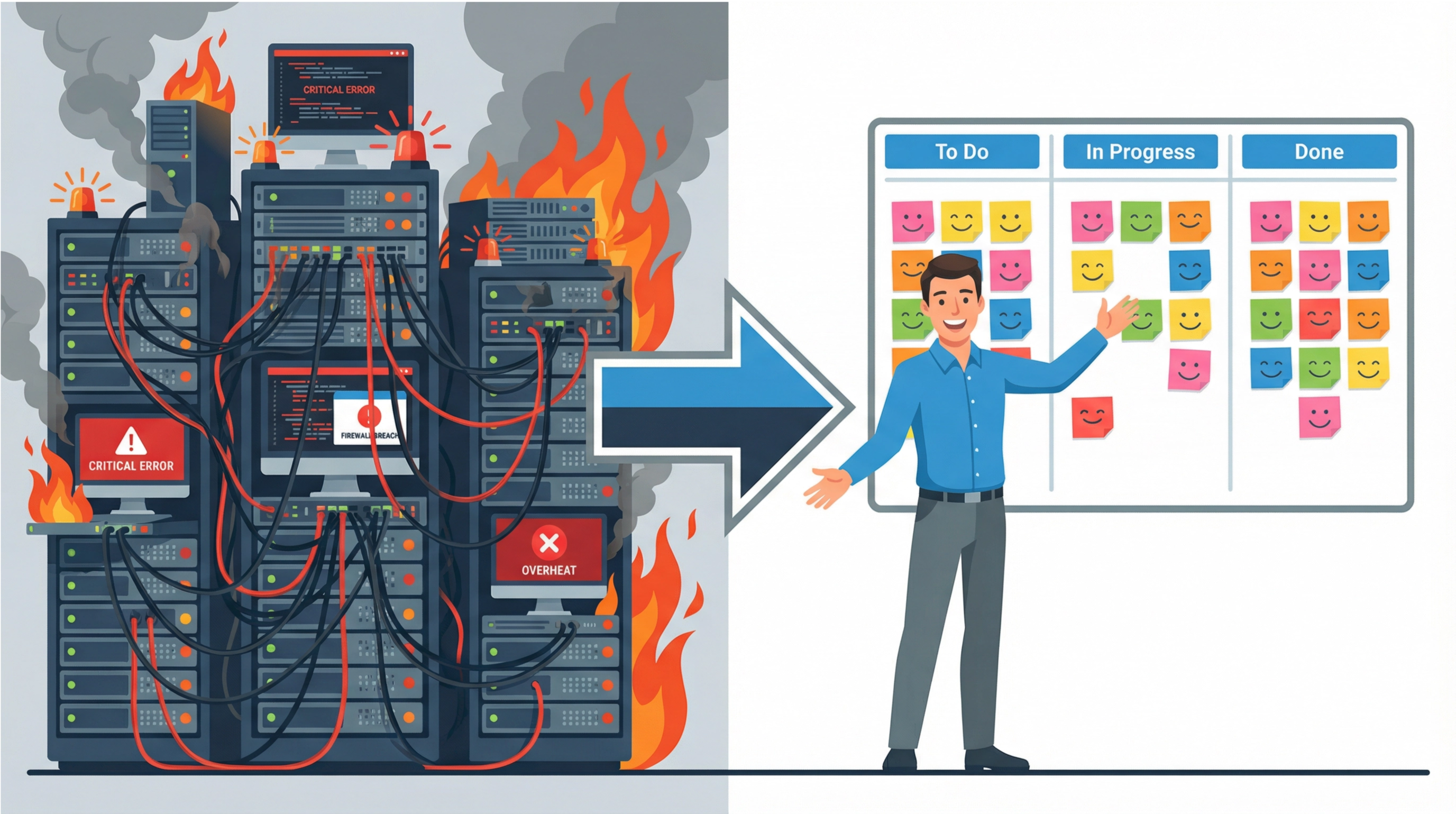
We Paid $150k/Year for an Agile Coach Who Had Never Written a Line of Production Code
A non-technical Agile coach spent two years redirecting every engineering problem into a process conversation. Here`s what happened, what it cost us, and what actually makes engineering teams effective.

The Death of Architectural Design in Agile: How Design as You Go Became Collapse as You Scale
Agile`s evolutionary design promised flexibility but delivered fragile architectures. Why up-front design still matters and how to bring it back.
Why Agile Estimation Is Theater: The Case Against Story Points
Story points and estimation ceremonies waste 1,600+ hours per team annually. Stop training developers to predict the unpredictable and embrace uncertainty.
Get the next war story in your inbox
Independent essays and practical models about what the process claims versus what actually ships. Published under a protected pen name. Free, no spam, unsubscribe anytime.
No certifications sold. No process religion. Unsubscribe anytime.