
The Consultant Industrial Complex: Why Agile Transformations Never End
You hired consultants to fix your Agile problems three years ago. They're still there. Your retrospectives now debate which framework to adopt next. Your teams attend more training than they ship features. If you are the developer stuck inside that, there is a way to survive it.
Welcome to the consultant industrial complex, where transformation is the product and completion kills revenue.
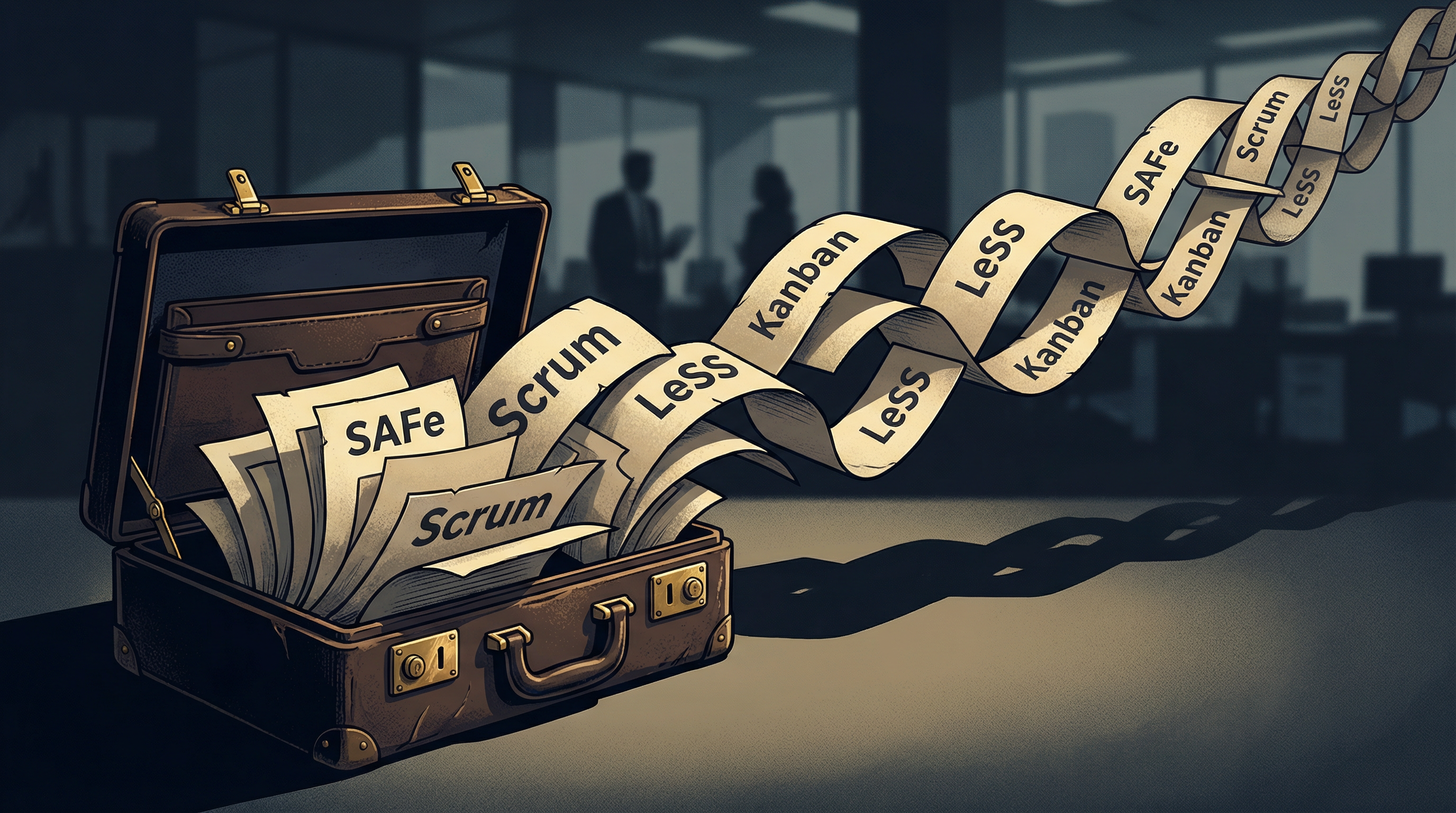
Agile consulting thrives on sustained dysfunction. The business model demands it. A successful transformation means consultants work themselves out of a job. So they don't. Instead, they deliver transformation theater—new terminology, updated ceremonies, revised org charts. Everyone stays busy enough to feel productive, confused enough to need more help.
The Perpetual Motion Machine
The playbook is elegant: diagnose problems, prescribe frameworks, implement ceremonies, measure adoption (not outcomes), identify new problems, repeat.
Notice what's missing? Actually fixing anything.
The diagnostic phase always finds the same issues—siloed teams, unclear priorities, poor communication, technical debt. These are symptoms of organizational dysfunction, not Agile problems. But treating them as Agile problems means selling Agile solutions.
SAFe consultants see coordination issues and prescribe Program Increments. Scrum coaches see planning dysfunction and add more ceremonies. LeSS evangelists see scaling problems and recommend descaling (which somehow requires lengthy engagements to achieve).
Each diagnosis is accurate enough to feel valid. Each prescription addresses symptoms just enough to feel helpful. Each implementation creates new dependencies on consultant expertise.
It's perpetual motion fueled by hope and budget.
Scenario One: The SAFe Industrial Complex
Your VP of Engineering returns from a conference inspired. SAFe will solve everything. Within weeks, consultants arrive with binders, wall posters, and a multi-quarter transformation roadmap.
Phase one introduces new roles. You now have RTEs, Product Management, and System Architects as distinct functions. People who shipped software last month now attend Role Clarity Workshops.
Phase two implements ceremonies. PI Planning becomes a quarterly spectacle requiring room rentals, catered lunches, and two full days. Teams that coordinated via Slack now wait 8 weeks for formal planning sessions.
Phase three focuses on metrics. Consultants introduce Program Predictability Measures—tracking whether teams hit their PI objectives. Of course teams miss them. The objectives were fantasy estimates made in a room full of people trying to fill out a planning board. But missing objectives proves you need more coaching.
Phase four identifies gaps. The retrospective (now an Inspect and Adapt event, because new names justify new training) reveals communication problems between teams. The solution? More roles, more ceremonies, more coaching.
Two years later, your consultant spend is 7-figures annually. Delivery velocity is lower than before—weighted down by coordination overhead. But you have impressive program boards and everyone can explain what an ART is.
The consultants nod sympathetically. "Transformation takes time. We should discuss our maturity model and plan the next phase."
The Certification Racket
Certifications create artificial scarcity (only certified people can do Agile properly), manufactured obsolescence (certs expire), and vendor lock-in (each framework has its own).
Consider the economics: a two-day Certified ScrumMaster course costs around $1,500. The material could be absorbed in a few hours of reading. The certification proves you sat through two days and passed a trivial exam. It expires in two years.
But organizations require them. Job postings demand CSMs, SAFe Agilists, ICPs. Not because certification correlates with competence—it doesn't. Because HR needs filters and consultants have successfully marketed certs as the filter.
The flywheel:
- Consultants convince orgs that certified people are necessary
- Orgs require certifications in job postings
- Individuals pay for certifications to qualify
- Consultants profit from training, maintain framework relevance
- Certifications expire, ensuring repeat purchases
Meanwhile, the best engineers you've ever worked with probably don't have a single Agile certification. They just ship working software.
Scenario Two: The Coach Who Never Leaves
You hired an Agile coach six months ago to help three teams. She's excellent—empathetic, knowledgeable, helpful. Retrospectives improve. Teams appreciate her facilitation. Standups become more focused. Whether that ritual still earns its slot at all is a separate question.
Then month six arrives. Her contract is ending. You expect a final report, knowledge transfer, sustainability docs.
Instead, she presents a deck titled "Coaching Roadmap: Phase Two."
The new phase addresses "embedding practices" and "organizational change management." Another six months, possibly twelve. She's identified new problems: team dependencies, product owner maturity, stakeholder alignment.
These are real issues. They existed before she arrived. They'll exist after she leaves. But now they're framed as coaching opportunities requiring her continued engagement.
You push back gently. "Can we handle this internally?"
"Of course. But you'll need someone trained in organizational facilitation. Have you considered sending your engineering managers through coaching certification? I can recommend a program."
You realize the trap. She's not trying to make herself unnecessary. She's making her expertise indefinitely necessary—either via her continued presence or via training programs that spread dependency across your organization.
The best consultants work themselves out of a job. Most work themselves into permanence.
Why Smart People Fall For It
Most consultants genuinely believe they're helping. The dysfunction is structural, not individual.
Why smart leaders keep buying:
Hope in a box. Transformation promises are seductive. Your org is struggling. Consultants arrive with frameworks that worked elsewhere (allegedly). Safer than figuring it out yourself.
Diffused responsibility. If the transformation fails, you hired experts who followed industry best practices. No one gets fired for buying SAFe. You might get fired for trying something unconventional that fails.
Complexity as credential. The more complex the framework, the more substantive it feels. Simple advice ("talk to each other," "ship smaller things") sounds too obvious to justify budget. But a multi-tier dependency management system with color-coded swimlanes? That looks serious.
Sunk cost reinforcement. Once you've invested 18 months and $2M, abandoning it feels like admitting failure. Easier to invest another 6 months to "get it right."
Metric manipulation. Consultants measure adoption, not outcomes. "85% of teams completed PI Planning" sounds impressive. Doesn't mean you shipped better software faster. But it sounds like progress.
The market optimizes for prolonged engagement, not rapid improvement.
The Missing Incentive
Imagine you're a consultant. Your income depends on billable hours or multi-month contracts. A client hires you to improve their delivery.
You could:
Option A: Identify the three things actually blocking them (usually: unclear strategy, absent product leadership, technical neglect). Recommend specific, uncomfortable changes (fire the indecisive VP, hire senior ICs, pay down the database migration debt). Stick around for 6 weeks to ensure follow-through. Leave.
Option B: Conduct a thorough assessment (6 weeks). Propose a comprehensive framework adoption (12-week implementation). Train teams in new ceremonies (ongoing). Measure adoption via maturity models (quarterly). Identify new improvement areas (annual planning). Recommend advanced coaching (multi-year engagement).
Option A solves problems quickly. It also ends your contract quickly and makes you unpopular with executives who don't want to hear their strategy is incoherent.
Option B creates sustainable revenue and makes everyone feel productive without demanding difficult organizational changes.
Which option pays your mortgage?
The market rewards Option B. Not because consultants are evil—because the incentive structure optimizes for prolonged engagement over rapid resolution.
Scenario Three: Transformation Theater
Your company announces an Agile transformation. Town halls explain the vision. Executives attend Leading SAFe training. An entire floor gets outfitted with whiteboard paint and sticky notes.
Consultants facilitate the launch. Workshops, team charters, working agreements. Everyone attends. Everyone nods. The energy feels positive.
Three months later, you're in a PI Planning session. Your team is supposed to estimate 24 stories for the next increment.
Except:
- The stories aren't actually written yet
- The product owner is in three simultaneous planning sessions
- Platform team dependencies can't be resolved because they're underwater
- The business objective contradicts last quarter's OKRs
But everyone fills out cards anyway because the ceremony must be completed. Consultants circulate, ensuring proper formatting. The RTE photographs the board for the leadership report.
You ship roughly what you would have shipped without the ceremony. But now you've burned two days of everyone's calendar and produced artifacts that look impressive in slide decks.
This is transformation theater: the performance of improvement without the substance of change.
The consultants aren't concerned. At the retrospective, they capture "improvement opportunities" for next quarter's coaching focus. The show must go on.
How to Spot the Game
If you're hiring consultants or evaluating an ongoing engagement, here's your bullshit detector:
Red Flags That Predict Prolonged Dependency
1. Proprietary frameworks over principles. If consultants spend more time explaining their methodology than discussing actual problems, they're selling process dependency. Real improvement focuses on outcomes, not framework compliance.
2. Certification requirements. If their model requires your people to get certified in their methodology, they're building lock-in. Good practices don't require proprietary training.
3. Maturity models without outcome metrics. "You're at level 2, we'll get you to level 4" is meaningless unless levels correlate with measured business outcomes. Adoption metrics (ceremony attendance, artifact completion) are vanity metrics.
4. No exit criteria. If consultants can't clearly articulate what success looks like and when they'll leave, they're not planning to leave. Ask explicitly: "What does done look like, and when do you expect to achieve it?"
5. Blame-shifting language. "The transformation would work if leadership were more committed / if teams were more disciplined / if the organization were more mature." This sets up indefinite engagement—there's always another maturity gap.
6. Solution before diagnosis. If consultants know the answer (SAFe, Scrum@Scale, LeSS) before understanding your context, they're selling a product, not solving your problem.
7. Training as primary deliverable. If most of their value comes via training rather than direct improvement of your systems, they're creating credential dependency, not capability.
8. Expanding scope over time. Consultants who initially focus on teams but gradually expand to coaching executives, redesigning org structures, and advising strategy are building permanence, not fixing problems.
Green Flags That Suggest Genuine Help
1. Specific problem focus. "We're going to fix your deployment pipeline so you can ship daily instead of monthly" is concrete, measurable, completion-ready.
2. Transfer of ownership. Consultants who insist on pairing with your people, documenting decisions, and explicitly training internal folks to continue the work are planning their exit.
3. Outcome metrics. Success measured by business results (cycle time, defect rates, customer satisfaction) rather than process adoption means you're hiring for impact.
4. Willingness to challenge you. Consultants who tell you what you want to hear stick around. Consultants who tell you your VP is the problem might piss you off, but they're being honest.
5. Fixed scope, fixed timeline. "We'll spend 8 weeks diagnosing, 12 weeks implementing, then we're done" is dramatically different from "ongoing coaching engagement."
6. Skepticism toward frameworks. Consultants who admit frameworks are contextual tools, not universal solutions, are thinking critically rather than selling dogma.
What Actual Improvement Looks Like
Real improvement is boring. It doesn't involve rebranding your teams or learning new terminology.
It looks like:
- Identifying the three biggest bottlenecks in your delivery process and eliminating them
- Empowering teams to make decisions without approval theater
- Hiring people who can actually do the work instead of managing the work
- Simplifying your process by removing ceremonies that don't produce decisions
- Paying down technical debt that slows everything down
- Firing bad managers instead of sending them to leadership training
- Saying no to projects that dilute focus
None of this requires consultants. It requires courage, clarity, and willingness to make uncomfortable organizational changes.
Consultants are rarely hired to do uncomfortable things. They're hired to make change feel structured and safe. That's why transformation so often means rearranging furniture instead of fixing foundations.
Breaking Free
If you're trapped in a prolonged transformation:
1. Demand outcome metrics. Stop measuring adoption. Start measuring delivery speed, quality, and team morale. If those aren't improving, the transformation is failing—regardless of ceremony compliance.
2. Set expiration dates. Every consulting engagement should have a defined end. If you're extending repeatedly, you're addicted, not improving.
3. Insist on knowledge transfer. Consultants should be teaching your people to continue the work. If they're the only ones who can facilitate your ceremonies, you've outsourced capability instead of building it.
4. Challenge framework dogma. When consultants cite framework rules, ask: "What problem does this solve for us specifically?" If they can't articulate value beyond "it's part of SAFe," skip it.
5. Trust your engineers. The people writing code often know exactly what's broken. They don't need a consultant to discover that your deployment process is manual and terrifying. They need permission and support to fix it.
6. Fire consultants who become fixtures. If someone has been "coaching" for more than a year without measurably improving your delivery, they're not coaching. They're billing.
The Alternative
You don't need Agile transformation. You need to remove obstacles, clarify priorities, and let competent people do their jobs.
The original Agile Manifesto—before it became an industry—said something useful: value working software over comprehensive documentation, customer collaboration over contract negotiation, responding to change over following a plan.
Notice what it didn't say: hire consultants to implement a proprietary framework, send everyone to certification training, restructure your organization into ARTs and value streams.
The manifesto was written by people who wanted less process, not different process. A reaction against heavyweight methodology. Then consultants turned it into heavyweight methodology with better branding.
If you want to improve, ignore the industrial complex. Talk to your teams. Find out what's blocking them. Fix those things. Repeat.
No certification required.
The consultant industrial complex isn't a conspiracy. It's an economic inevitability.
When you create a market for process improvement, you incentivize people to sell process rather than improvement. Consultants who genuinely fix problems work themselves out of contracts. Consultants who sustain dependency create recurring revenue. The market rewards the latter.
This doesn't make individual consultants bad people. Many are talented, well-intentioned professionals doing what the market incentivizes. But approach Agile transformation with the same skepticism you'd apply to any vendor promising salvation through their product.
Ask hard questions. Demand concrete outcomes. Set expiration dates. Measure results, not adoption.
And remember: if your transformation never seems to finish, that's not a bug in the plan. It's the business model working exactly as designed.
The best Agile transformation is the one you don't need because you fixed the actual problems instead of hiring someone to rename them.
Benjamim Castell writes about the distance between process as promised and delivery as practiced.
Most of them were trapped in what I call Risk Management Theater and didn't even know
Keep reading
The Developer`s Guide to Surviving Agile Transformation
With 47-84% of Agile transformations failing, this isn`t a guide to embracing change, it`s a practical survival manual for developers weathering the corporate storm while protecting their time, sanity, and ability to ship actual code.

The Burnout Industrial Complex: How Companies Profit From Your Exhaustion
Burnout isn`t a personal failing—it`s a predictable outcome of broken systems. Here`s how the wellness industry protects companies from fixing toxic workplaces.
SAFe Doesn`t Need to Work: The Business Model Behind Agile`s Most Profitable Framework
Private equity paid ~$300M for Scaled Agile Inc. PE doesn`t buy methodologies, it buys recurring revenue. Follow the incentives and SAFe`s failure rate stops being a mystery.
Get the next war story in your inbox
Independent essays and practical models about what the process claims versus what actually ships. Published under a protected pen name. Free, no spam, unsubscribe anytime.
No certifications sold. No process religion. Unsubscribe anytime.