
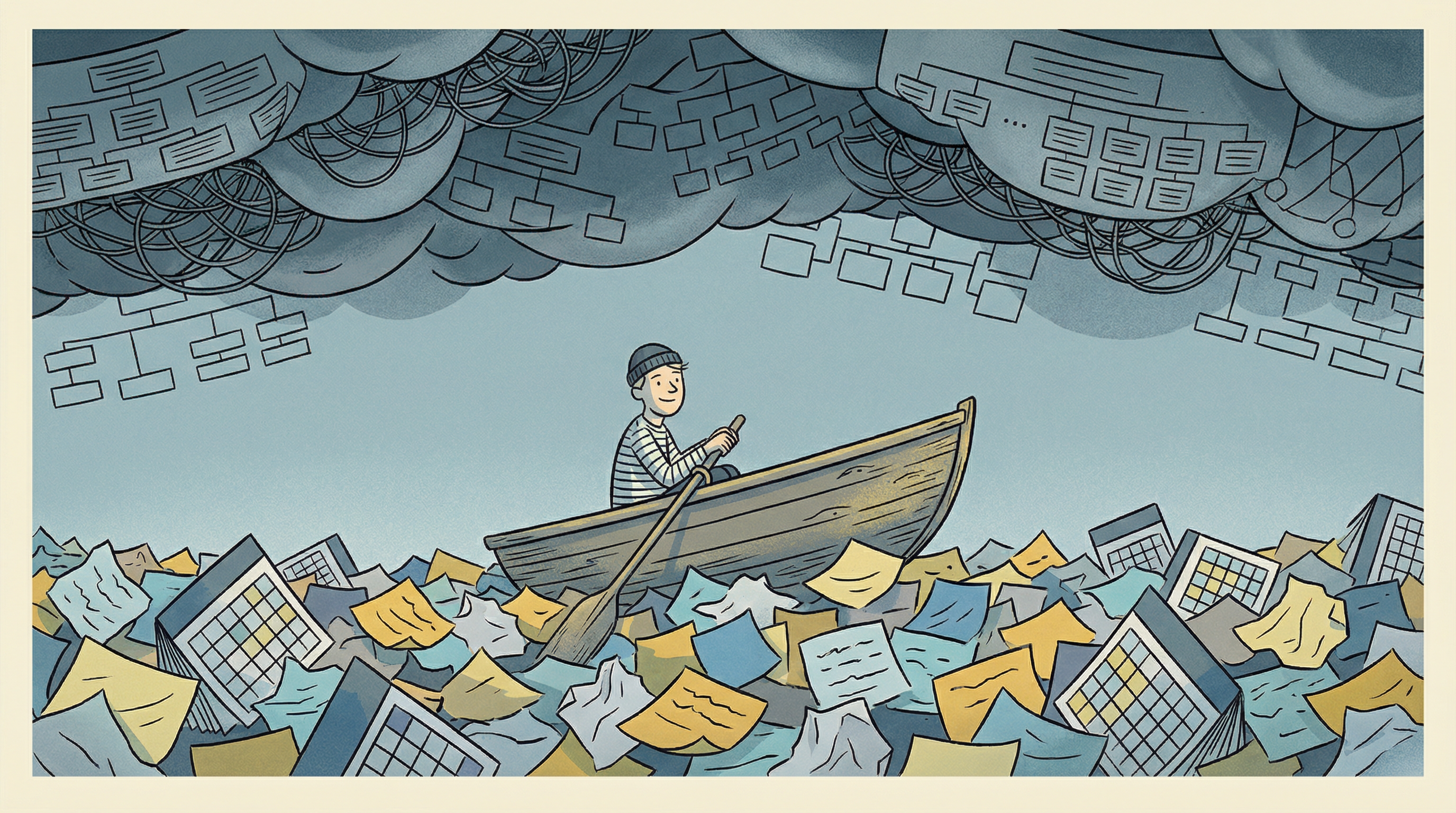
The Developer`s Guide to Surviving Agile Transformation
Somewhere, right now, a developer is sitting in a meeting called "Transformation Kickoff" watching a consultant click through slides about "the journey to organizational agility." Their Slack is piling up. Their pull request is waiting for review. A production bug is quietly festering. But here they are, learning about "value streams" and "inspect and adapt cycles" like it's the first time anyone has ever suggested that software teams should communicate.
The statistics your transformation consultants won't show you: between 47% and 84% of Agile transformations fail to achieve their stated objectives. Worse, an estimated 67% of failed transformations are "terminal"—the organization never recovers the ground it lost. They don't return to baseline. They end up worse.
Those aren't odds I'd bet my career on. And neither should you.
This isn't a guide to embracing the transformation. I'm not going to tell you to "be the change" or "lean in" or any of that hollow motivational garbage. This is a survival manual—practical, cynical, and hard-won from years of watching smart developers lose their minds to corporate Agile theater.
The Weather Analogy You Need to Internalize
Here's the mental model that will get you through: treat Agile transformation like weather.
You don't argue with a hurricane. You don't write blog posts about how rain is philosophically wrong. You prepare, you shelter what matters, and you wait for it to pass.
Agile transformations are corporate weather events. They blow through organizations with tremendous force, rearrange the furniture, knock down some trees, and then—usually within 18 to 24 months—they lose energy. The consultants leave. The executive who championed it gets promoted or moves to another company. The daily standups quietly shift from 15 minutes to 30 to eventually just... not happening.
Your job is not to stop the hurricane. Your job is to still be standing, still productive, and still sane when the skies clear.
What Transformations Are Actually About
Let me disabuse you of a comforting fiction: Agile transformations are almost never about empowering developers.
I know. The kickoff slides say otherwise. They talk about "autonomous teams" and "servant leadership" and "removing impediments." It sounds beautiful. It's also, in the vast majority of cases, a lie—not necessarily a malicious one, but a lie nonetheless.
Agile transformations are corporate initiatives designed to create the illusion of control and predictability. They're a response to executive anxiety. The business doesn't know when things will ship. They can't forecast accurately. They feel out of control. Someone at a conference told them that "going Agile" would fix it.
So now you're getting a transformation. Not because it will help you write better code or ship faster. Because someone with budget authority felt anxious and decided to do something about it.
Once you understand this, everything else makes sense. The obsession with velocity metrics. The demand for granular estimates. The ceremonies that multiply like rabbits. It's all in service of a reporting need, not a delivery need.
Your survival depends on understanding whose needs are actually being served.
Scenario One: The All-Hands Kickoff
Picture this. It's 2 PM on a Tuesday. The entire engineering organization has been summoned to a company-wide Zoom call that's already running five minutes late because the CEO's audio isn't working.
Finally, things get started. The VP of Engineering introduces "Marcus," a Transformation Lead from a consultancy whose name sounds like it was generated by an AI trained on TED talks. Marcus is wearing a Patagonia vest over a button-down. He seems very excited.
The slide deck begins. There's a slide about "the current state" that makes everything you've built sound broken. There's a maturity model with five levels, and somehow your organization is at level one. There's a timeline showing "quick wins" in Quarter 1 and "sustainable transformation" by Quarter 4. There's that same damn Spotify diagram everyone uses, even though Spotify themselves have said it doesn't work the way people think.
You glance at Slack. Your teammate has posted a GIF of a dumpster fire. Fourteen people have reacted with the "100" emoji.
Here's what's actually happening: the transformation has been sold to leadership based on promises that have almost no connection to what your team needs. The timeline is fictional. The "quick wins" will create chaos. Marcus will be long gone before anyone has to deal with the consequences.
Your move: Attend. Stay quiet. Take notes on the specific timeline promises—you'll want them later when reality diverges. Don't volunteer for pilot programs. Don't ask clarifying questions that make you visible. Be forgettable. The transformation will wash over you and move on to more enthusiastic targets.
The Jargon Survival Dictionary
One of the most exhausting aspects of transformation is the sudden influx of vocabulary that means nothing and everything simultaneously. You'll be expected to use these terms correctly while understanding that their definitions are negotiable.
Here's what the jargon actually means in practice:
"We need to be more Agile" — Something is late and someone is upset about it.
"This will increase our velocity" — This will add meetings to your calendar.
"Let's take this to the retro" — I don't want to deal with this now and I'm hoping everyone forgets.
"We're focusing on outcomes over outputs" — We're going to argue about metrics instead of shipping.
"Cross-functional teams" — Everyone's responsible, which means no one's responsible.
"Self-organizing" — No one will tell you what to do, but everyone will tell you what you did wrong.
"Story points are not hours" — Story points are hours and everyone knows it. They're just hours wearing a fake mustache.
"Technical debt is a first-class citizen" — It's not, but we'll pretend until the next deadline.
"Servant leadership" — The manager wants you to like them while still making you work weekends.
"Transformation fatigue" — Rational exhaustion being pathologized as resistance.
Learn the vocabulary. Use it correctly in meetings. Never forget you're participating in a language game, not a meaningful communication system.
The Meeting Triage Matrix
Transformations breed meetings like wet cardboard breeds mold. Suddenly your calendar looks like a game of Tetris played by a sadist. Every hour has a ceremony. Every ceremony has a ceremony to plan it.
You cannot attend everything. You will burn out trying. So you need a triage system.
Never Skip:
- Sprint planning (your commitments will be made with or without you)
- Demos (visibility matters for promotion and protection)
- Any meeting where your manager's manager will be present
Attend Partially:
- Retrospectives (arrive late, leave after you've spoken once)
- Backlog refinement (show up when your stories are being discussed)
- "Community of practice" sessions (15 minutes establishes presence)
Skip Freely:
- "Optional" transformation update meetings
- Coach-led training sessions after the first one
- Any meeting with "sync" in the title that has more than four attendees
- Working groups that haven't produced anything in three sprints
The Calendar Block Defense:
Block two-hour chunks labeled "Deep Work" or "Architecture Review" or "Technical Investigation." These are not meetings. They are defensive structures. Most people won't schedule over labeled time. The transformation cannot consume hours that are already claimed.
Scenario Two: Spot the Certification-Mill Graduate
You're three weeks into the transformation. The company has hired—sorry, "engaged"—an Agile Coach named Jennifer. Jennifer will be "embedded" with your team for the next six months. She's here to help.
The first meeting is revealing. Jennifer asks the team to "check in" by sharing one word that describes how they're feeling. (You say "curious." It's a safe word.) She then spends twenty minutes explaining what a user story is, despite the fact that your team has been writing user stories for four years. She uses the phrase "safe to fail" three times.
When your tech lead asks about the team's specific challenge with inter-service communication latency, Jennifer suggests they "put it on a sticky note for the parking lot."
The parking lot never gets emptied.
This is a certification-mill graduate. Someone who took a two-day course, passed a multiple-choice exam, and is now billing $200 an hour to recite frameworks at you. They have never shipped software. They cannot help you ship software. They are here because someone decided "coaching" was a budget line item.
Signs you have a real coach:
- They ask questions about your actual codebase and architecture
- They admit they don't know things
- They've written production code within the last decade
- They push back on management, not just developers
- They're skeptical of their own methodology
- They focus on removing obstacles rather than adding ceremonies
Signs you have a certification-mill graduate:
- Every answer is a framework or a model
- They can't explain why something works, just that it's "best practice"
- They've never heard of the technologies you use
- They treat the Scrum Guide like religious text
- They respond to technical problems with process solutions
- They have strong opinions about sticky note colors
If you have a real coach, engage genuinely. They're rare and valuable. If you have a certification-mill graduate, nod politely and protect your time. They'll move to another team in a few months.
Protecting Deep Work When Everything Becomes a Ceremony
This is the existential threat. This is what kills good developers during transformations.
Agile, as practiced in corporate contexts, is hostile to deep work. Everything is collaborative. Everything is a conversation. Everything is visible, inspectable, and interruptible.
But code is not written in standups. Systems are not designed in refinement sessions. Hard problems are not solved in planning poker. The actual work—the work you were hired to do—requires extended periods of uninterrupted concentration.
Transformations actively destroy this time. They fill your calendar with ceremonies. They normalize interruption. They make availability a virtue and isolation a vice.
You must defend against this consciously and strategically.
Tactic 1: The Sacred Morning
Never accept meetings before 11 AM. Block the time. Defend it violently. Your best cognitive hours should not be spent listening to someone read Jira tickets aloud.
If pushback comes, cite "maker versus manager schedules." It's mainstream enough that people accept it.
Tactic 2: The Communication Delay
You don't have to respond to Slack immediately. The expectation of instant response is a cultural norm, not a job requirement. Batch your communication into two or three windows per day. Let people think you're "in deep work." You are.
Tactic 3: The Strategic WFH
If your company allows remote work, use it specifically on high-focus days. Offices are interruption factories. The transformation makes them worse.
Tactic 4: The Headphones Protocol
Visible headphones are a social signal. Noise-canceling headphones are a fortress. Even if you're not listening to anything, wear them. Interruptions decrease measurably.
Tactic 5: The Explicit Trade
When asked to take on another ceremony, negotiate. "I can do Wednesday refinement if we move the Tuesday sync to async." Treat your time as finite. Because it is.
Scenario Three: Planning Poker as Performance Art
It's estimation day. The team has gathered to play Planning Poker. You're holding cards with numbers on them. Like adults. In a professional setting.
The Product Owner reads the first story: "As a user, I want to reset my password so that I can regain access to my account."
You've built password reset flows before. You know this is a 2. Maybe a 3 if the email templating system is finicky.
Cards are revealed. You showed 2. Someone showed 3. But Derek, somehow, showed 13.
Derek explains: "Well, we don't know what the email service latency will be, and what if we need to support multiple regions, and should we consider SSO implications, and—"
Derek will talk for seven minutes. The room will eventually compromise on a 5. The work will take exactly as long as it was always going to take, regardless of the number.
This is the estimation paradox: the ceremony exists to create predictability, but it doesn't actually improve predictions. Studies consistently show that expert estimation and planning poker produce statistically similar accuracy. The poker is theater—a ritual that creates the feeling of rigor without the substance.
Your move: Participate. Keep your numbers middle-of-the-road. Don't be the person who always estimates high (you'll be labeled pessimistic) or always estimates low (you'll be blamed when things slip). Match the room's energy. Save your analytical thinking for the actual work.
The Survival Checklist
Your practical reference. Print it. Tape it somewhere invisible. Consult it when the pressure intensifies.
Before the Transformation Hits:
- Document your current productivity patterns (you'll want a baseline)
- Identify which meetings you currently attend that have actual value
- Build relationships with competent people in adjacent teams (you'll need allies)
- Establish your calendar defense blocks before they fill up
- Quietly archive documentation of how things currently work (it will be "transformed" away)
During the Storm:
- Attend kickoffs and major ceremonies (visibility matters)
- Learn the vocabulary; use it fluently but don't believe it
- Identify whether coaches are competent or performative
- Protect at least 4 hours daily for actual work
- Keep a private log of promised timelines and outcomes
- Don't volunteer for pilot teams or working groups
- Maintain your network outside the company (options matter)
Signs the Storm Is Passing:
- Consultants' contracts aren't being renewed
- Ceremonies start getting canceled "just this week"
- Leadership stops mentioning the transformation in all-hands
- Someone proposes "adapting" the framework to "what works for us"
- The Agile Coach role is quietly eliminated or absorbed
After the Transformation:
- Assess what survived and what actually helps
- Quietly shed the practices that add friction without value
- Rebuild your deep work patterns
- Update your resume (you've now "led teams through organizational transformation")
Validation for the Exhausted
Let me say something that no one else will: your fatigue is not a character flaw.
Transformation fatigue is real. It's the rational response to having your work environment restructured by people who don't understand what you do, based on frameworks designed for different contexts, in service of goals that have little to do with building great software.
You're not "resistant to change." You're resistant to pointless change. There's a difference.
Developers are change agents by nature. You learn new languages, new frameworks, new paradigms constantly. You refactor systems. You evolve architectures. You ship features that literally change how people work and live.
The accusation that developers "resist change" because they're skeptical of transformation theater is gaslighting. You resist waste. You resist ritual. You resist process that adds friction without adding value.
That's called engineering judgment. It's a feature, not a bug.
The Long Game
Here's the uncomfortable truth: you probably can't stop the transformation. Even if you're right. Even if you can prove it. The decision has been made by people above your pay grade for reasons that have little to do with engineering effectiveness.
So play the long game.
Survive. Stay sane. Ship code despite the obstacles. Build your skills. Build your network. Keep your options open.
Most transformations end. They run out of executive attention, consultant budgets, or organizational energy. The ones that "succeed" usually do so by quietly becoming something different than what was originally proposed—something adapted to reality by the people who actually do the work.
That could be you. If you survive long enough to shape what comes after.
The Agile Manifesto was written by developers who valued "individuals and interactions over processes and tools." The certifications, the consultants, the transformation theater—that's a betrayal of the original impulse. It's the processes and tools winning.
But the original insight is still true: small teams with autonomy ship better software than managed herds drowning in process. It will still be true after this transformation, and the next one, and the one after that.
Your job is to still be here, still shipping, when the industry finally remembers.
Benjamim Castell writes about the distance between process as promised and delivery as practiced.
Most of them were trapped in what I call Risk Management Theater and didn't even know
Keep reading
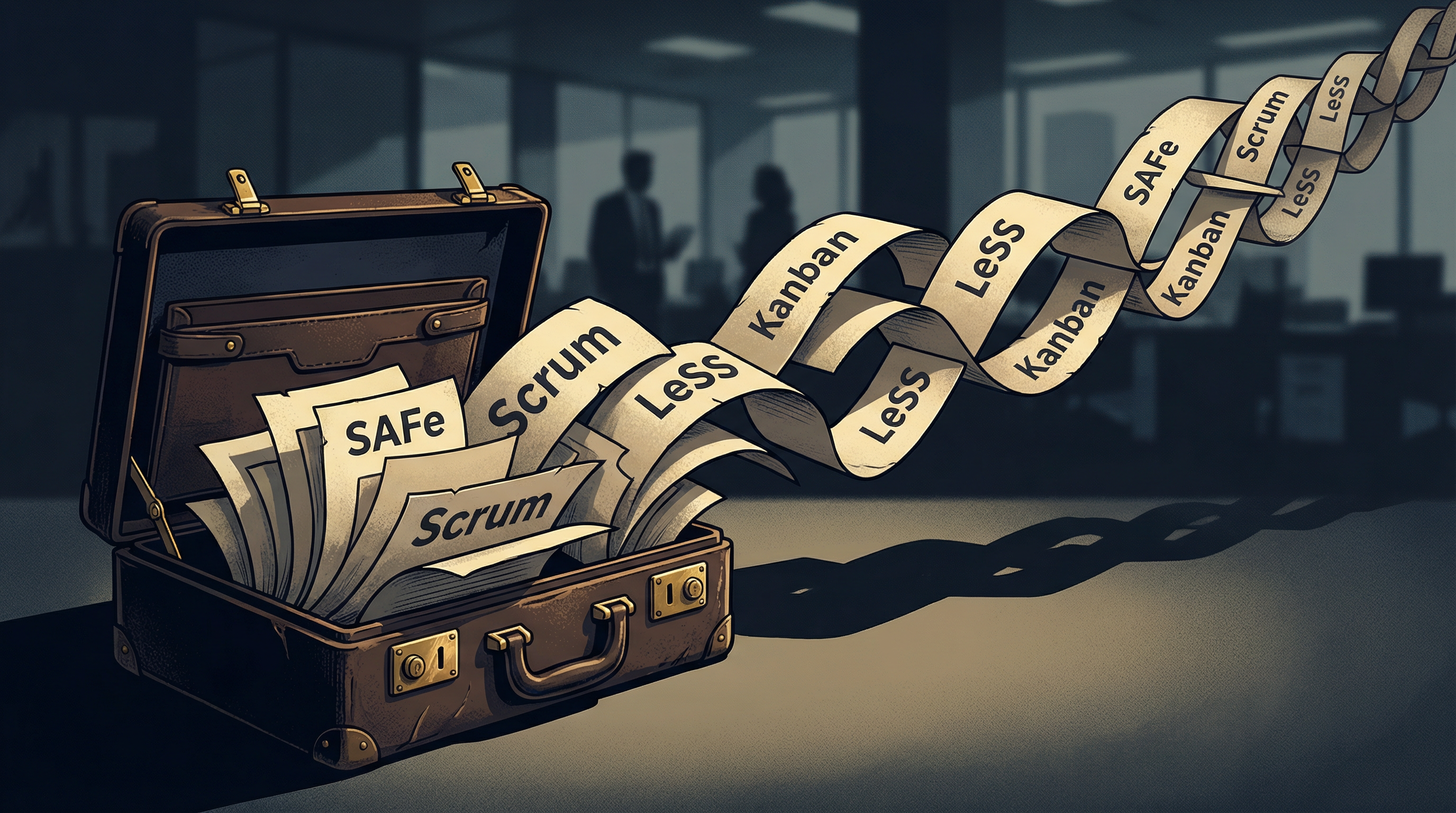
The Consultant Industrial Complex: Why Agile Transformations Never End
Agile consulting thrives by sustaining dysfunction, not eliminating it. Transformation theater is more profitable than actual improvement. Here`s how to spot the game.
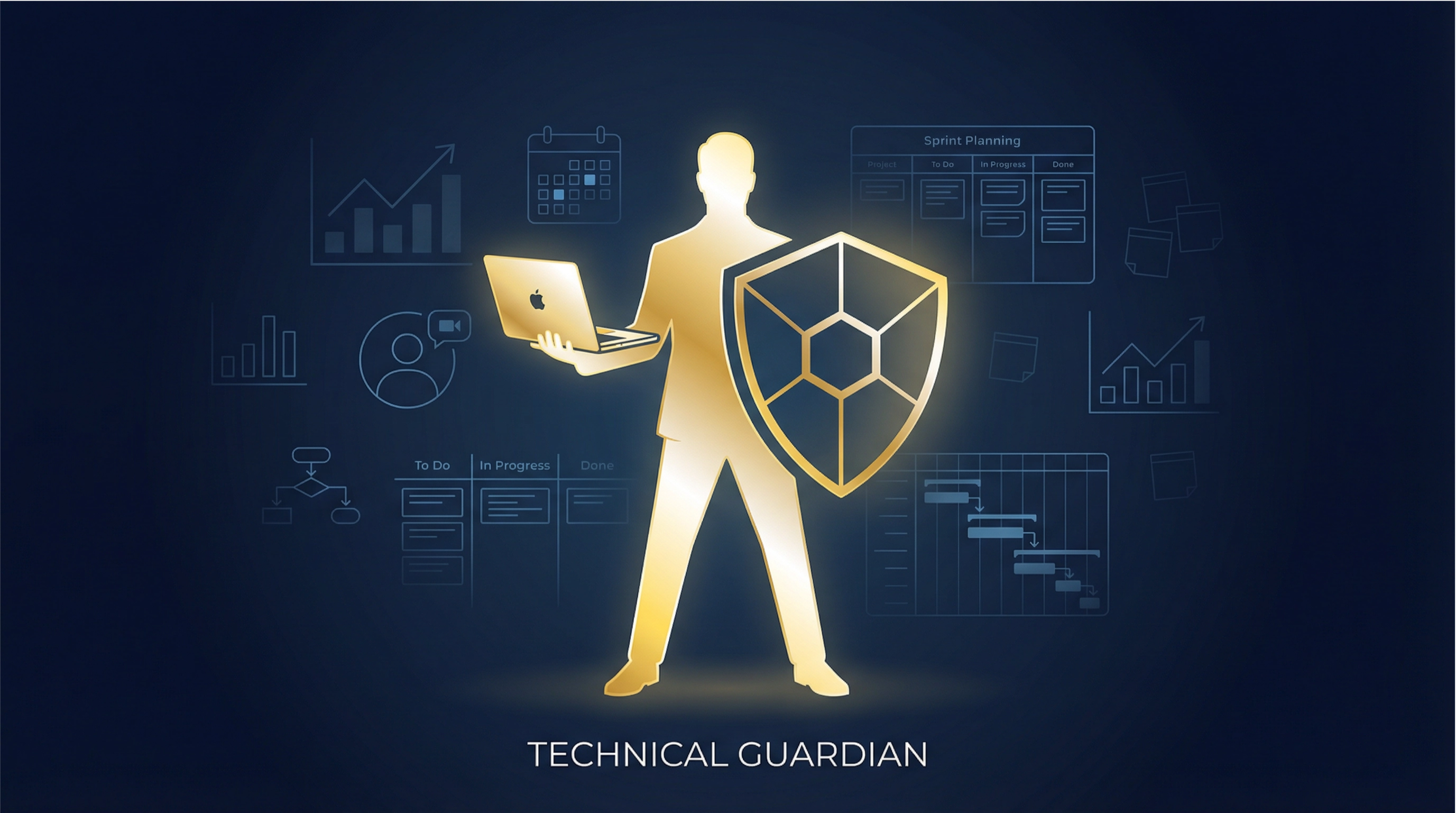
How to Change Your Team's Process Without Getting Fired
A strategic guide for engineers on changing broken team processes without getting fired. Use data, find allies, run experiments, and speak the right language.

When a Product Backlog Becomes an Archive
A practical test for separating active product decisions from historical requests without deleting useful context or inventing a universal aging rule.
Get the next war story in your inbox
Independent essays and practical models about what the process claims versus what actually ships. Published under a protected pen name. Free, no spam, unsubscribe anytime.
No certifications sold. No process religion. Unsubscribe anytime.