
Kanban vs Scrum: Why Flow Beats Theater for Real Delivery
Tuesday morning, 9:47 AM. Eight engineers crammed around a monitor, debating whether "Update user preferences" deserves a 5 or an 8. Someone floats a 13 because "we don't know what we don't know." The product owner checks his phone. The Scrum Master asks if anyone wants to explain their reasoning.
Silence.
Forty minutes gone. Nothing shipped. Nothing will ship today either.
I've watched this scene play out across different organizations. Different logos on the walls, same ritual futility. Teams going through Agile motions while their actual ability to deliver software slowly dies.
Here's what nobody in the certification industry wants you to hear: for most teams trapped in Scrum theater, Kanban isn't just an alternative. It's an escape hatch.
What's the real difference between Kanban and Scrum?
Before I tear into what goes wrong, let me be fair about what these frameworks actually are.
Scrum gives you time-boxed sprints (usually two weeks), prescribed roles (Scrum Master, Product Owner, Development Team), and mandatory ceremonies (sprint planning, daily standups, reviews, retrospectives). Work gets estimated in story points. Progress gets measured in velocity. Everything orbits around the sprint cycle.
Kanban gives you... less. A board that visualizes your work. Limits on how much you can have in progress at once. Metrics focused on how fast things actually finish (cycle time) rather than how much you start (velocity).
No sprints. No prescribed roles. No estimation poker.
That's not a weakness. That's the entire point.
The Scrum vs Kanban debate usually gets framed as "structure vs flexibility" or "predictability vs adaptability." That framing is wrong. The real question is simpler: do you want to optimize for visible activity or actual throughput?
The Scrum theater epidemic
I need to be precise here. I'm not attacking Scrum as Ken Schwaber designed it. I'm attacking what Scrum becomes in 90% of organizations that adopt it.
Scrum theater looks like this:
Daily standups where people recite yesterday's Jira tickets instead of actually coordinating. Sprint planning that burns half a day producing estimates everyone knows are fiction. Burndown charts that flatline for twelve days then miraculously complete on day fourteen. Retrospectives where the same three problems surface every two weeks while nothing changes.
The ceremonies happen. The artifacts exist. The roles are filled.
Software delivery? That remains stubbornly unachieved.
I worked with a fintech team last year that exemplified this. Sprint velocity: 34 points. Product backlog: 50 points prioritized. Everyone knew they'd finish neither 50 nor 34. The Scrum Master facilitated anyway. "What can we commit to?"
Senior dev says 30 to be safe. Product owner pushes for 40. They split the difference at 36.
Two weeks later: 28 points completed. Work magically finished in the final two days. Several tickets marked "done" with known bugs quietly deferred to tech debt stories that will never get prioritized.
Retrospective diagnosis: "unclear requirements."
Same diagnosis as last sprint. And the one before that.
Why does Scrum keep failing?
Scrum's design contains the seeds of its own corruption. This isn't controversial if you think structurally.
Time-boxing creates fake deadlines without real accountability. Sprints generate pressure, but it's internal pressure. You're measuring whether you finished what you promised to finish, not whether customers got value. Teams learn to optimize for sprint completion. Actual delivery becomes secondary.
Estimation rituals reward gaming over honesty. Planning poker turns into political theater within a few months. Senior developers pad estimates because they've been burned. Junior developers defer to whoever talks loudest. Story points lose any connection to reality—they become negotiation currency.
Velocity becomes Goodhart's Law incarnate. The moment velocity turns into a performance metric (and it always does), it stops being useful. Teams inflate estimates, split work into more tickets, soften "done" definitions. Velocity climbs. Delivery stays flat.
I've seen teams double their velocity over six months while shipping less customer value. The numbers looked great. The product stagnated.
What Kanban actually gives you
Kanban doesn't solve your problems. Nothing solves your problems except fixing your problems. But Kanban makes problems harder to hide.
You get three things:
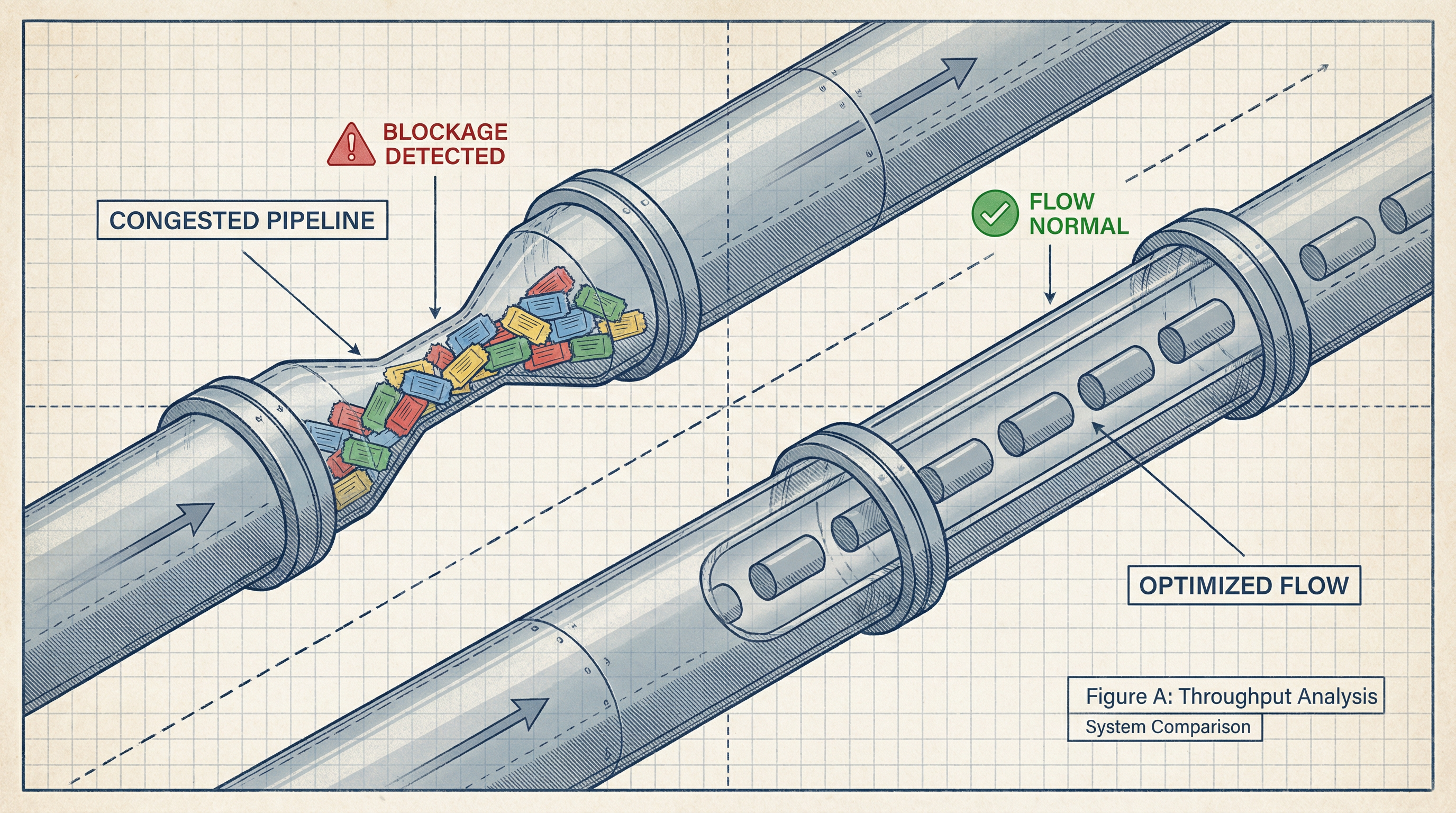
Visible work. Everything in progress sits on a board. You can't hide blocked items. You can't pretend that story isn't stuck in code review for the eighth day. The dysfunction is right there, staring at everyone.
Work-in-progress limits. You can't start new work until current work finishes. This sounds restrictive. In practice, it creates natural pull toward completion instead of artificial push toward starting more stuff.
Flow metrics. Instead of velocity (how much we claim to start), you measure cycle time (how fast things actually finish) and throughput (how many things complete per time period).
No ceremonies prescribed. No roles mandated. No estimation theater required.
The migration scenario: code review hell
A mid-sized SaaS company I consulted with had a chronic problem. Stories got stuck in code review for days. Under Scrum, this was invisible—stories showed "in progress" during sprints, then either completed in a last-minute rush or rolled over.
They moved to Kanban with explicit WIP limits. The "In Review" column had a limit of 3.
Within two days, that column was full. New work couldn't move forward because the review bottleneck was now undeniable.
Suddenly code review became everyone's problem, not just whoever happened to notice.
Within a week: pair programming for complex stories, review rotation schedule, "review-first" morning routine. Cycle time dropped from 8 days average to 3. Not because anyone worked harder. Because they stopped hiding the bottleneck behind sprint boundaries.
Should you switch from Scrum to Kanban?
Depends on why you're asking.
If your Scrum implementation actually works—genuine self-organization, sprint commitments treated as forecasts rather than contracts, retrospectives that drive real change, velocity used only for internal planning—then keep it. You're in the lucky minority.
But if you're reading this article, you probably aren't in that minority.
Switch to Kanban when:
Your team spends more time in ceremonies than in flow states. Sprints feel like performance theater for stakeholders. The same retrospective items appear month after month. Velocity keeps climbing but customers keep waiting. You're exhausted by the ritual overhead and want to just build things again.
Stay with Scrum when:
Your organization genuinely respects sprint boundaries and won't inject work mid-sprint. Your team holds each other accountable without needing a Scrum Master referee. Estimation has stayed honest rather than gamified. Ceremonies still feel valuable rather than obligatory.
I've seen few organizations where Scrum works as intended. The rest are doing theater. Expensive, exhausting theater.
The predictability myth
"We need sprints for planning. Stakeholders need to know what's shipping when."
I hear this constantly. It reveals a misunderstanding of what predictability actually means.
Sprint commitments aren't predictable—they're promises you'll probably break. Velocity is calculated from estimated story points that get gamed and inflated. "We committed to it for Sprint 12" isn't a prediction. It's hope dressed up as planning.
Kanban done right offers better predictability. Cycle time and throughput are measured from actual completions, not estimates. Over time, you build real data: "50% of our stories finish in 3 days or less. 85% finish within 7 days."
When a stakeholder asks "when will this be done?", a mature Kanban team can say: "Based on our throughput data, there's an 85% probability this feature ships by March 15th." That's math, not ceremony.
A VP of Product I worked with resisted Kanban initially. "I need to tell the CEO what's shipping each quarter. Sprints give me that."
Except they didn't. Sprint commitments missed constantly. Q2 features slipped to Q3.
Six months into Kanban with rigorous cycle time tracking, she could run Monte Carlo simulations on delivery probability. She could see throughput trends in real-time. When something slipped, she knew in week 4, not at the end of Sprint 6.
"I have more visibility now than I ever did with sprints."
How to escape Scrum theater
If you're stuck in ceremony hell and want to move toward flow-based delivery, here's a realistic transition path. Not overnight—gradual enough that nobody panics.
Weeks 1-2: Make reality visible.
Map your actual workflow. Not your theoretical process—the real one. Visualize everything in progress: stories, bugs, spikes, tech debt. Add explicit columns for waiting states. "Waiting for review." "Waiting for decision." "Waiting for that one guy who's on vacation."
Start measuring cycle time for everything that completes. Don't change anything else yet. Just observe.
Weeks 3-6: Introduce WIP limits.
Start loose. If your team typically juggles 12 things, set the limit at 10. When the limit gets hit, swarm on completions before starting new work.
Track how often limits get violated and why. Tighten gradually as flow improves.
Weeks 7-10: Decouple from sprint boundaries.
Keep running sprints nominally—don't scare the stakeholders. But stop making sprint commitments. Replace sprint planning with lightweight queue replenishment. Replace sprint reviews with continuous demos. Replace velocity tracking with throughput tracking.
Week 11 onward: Drop the pretense.
Eliminate sprint planning as a formal ceremony. Transform standups from status reports to flow coordination: "What's blocked? What's aging? Where do we swarm?"
Keep retrospectives, but focus on flow metrics. Celebrate throughput and cycle time improvements instead of velocity theater.
Kanban won't save you
Full disclosure: Kanban can become theater too. Boards nobody updates. WIP limits nobody respects. Cycle times nobody tracks.
But Kanban's simplicity makes dysfunction harder to hide. When your board shows 47 items "in progress" with no limits, everyone can see the chaos. Scrum's complexity creates cover for dysfunction. All those ceremonies and artifacts provide plausible deniability.
The question isn't really "Scrum or Kanban?" It's: what are you actually optimizing for?
If you want the appearance of process maturity—the certifications, the consultant-approved terminology, the impressive-sounding ceremonies—keep doing Scrum. Your Scrum Alliance membership will remain valid.
If you want to ship software, examine what's actually happening. Where does work get stuck? What would change if you stopped batching into sprints and started flowing continuously?
Most teams don't have a framework problem. They have a delivery problem that framework theater is obscuring.
The Agile Manifesto promised "working software over comprehensive documentation." Somehow we replaced comprehensive documentation with comprehensive ceremony. The outcome is identical: process serving itself rather than delivery.
Look at what you're measuring. Look at what you're delivering. The gap between those numbers contains everything you need to know about whether your methodology is helping or hiding.
Benjamim Castell writes about the distance between process as promised and delivery as practiced.
Most of them were trapped in what I call Risk Management Theater and didn't even know
Keep reading
Moving Cards is not Definition of Progress
Task boards reward visible motion over real customer impact. Flow metrics become theater when detached from outcomes. Here`s why card movement isn`t progress.
Why Agile Estimation Is Theater: The Case Against Story Points
Story points and estimation ceremonies waste 1,600+ hours per team annually. Stop training developers to predict the unpredictable and embrace uncertainty.
Risk Management Theater
There`s a specific moment every software developer knows. It`s not the deploy that fails at 5:58 PM on a Friday, or the sprint planning meeting that devours an entire morning. It`s subtler.
Get the next war story in your inbox
Independent essays and practical models about what the process claims versus what actually ships. Published under a protected pen name. Free, no spam, unsubscribe anytime.
No certifications sold. No process religion. Unsubscribe anytime.