
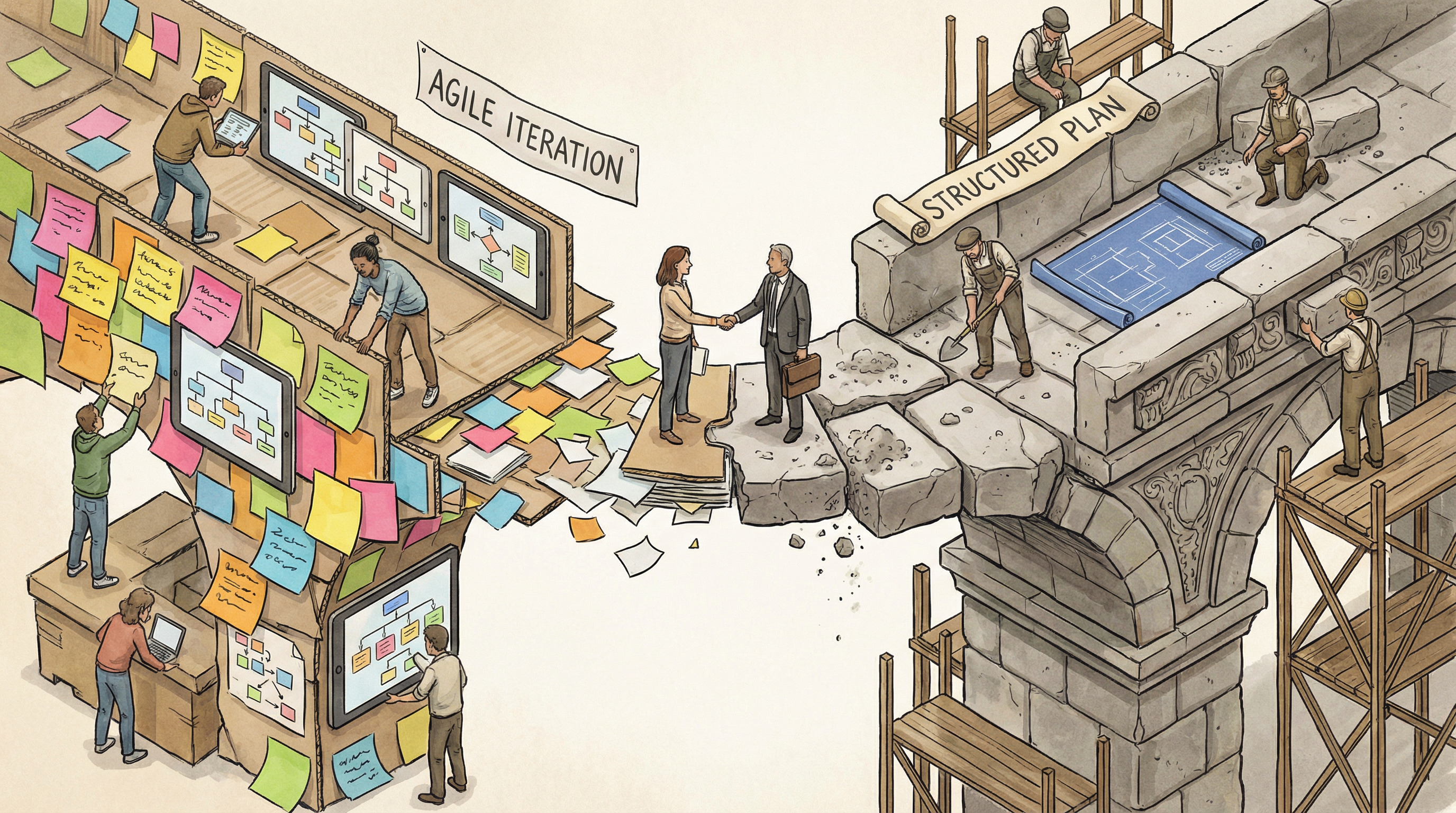
Post-Agile Development: Why Smart Teams Are Looking Backward to Move Forward
Right now, a developer is sitting in their third meeting of the day. A product owner drags sticky notes across a Miro board, explaining why the sprint commitment needs to change. Again. The developer runs math in their head: how many hours of actual coding will happen this week? The number isn't encouraging.
This isn't a failure of that particular team. It's where an entire industry ends up when it adopts a methodology as religion instead of tooling.
The conversation is shifting. Developers are increasingly vocal about their exhaustion with what Agile has become. The question is no longer "how do we do Agile better?" It's "what comes after Agile?"
Here's the contrarian take: the answer might involve looking backward, not forward. While consultants scramble to invent the next framework with a catchy acronym, the real innovation may come from selectively reviving practices we threw away twenty years ago.
The Exhaustion with Agile Ceremonies
Let's be honest about what Agile has become in most organizations.
It's not the lightweight, developer-empowering methodology described in the original manifesto. It's a bureaucratic overlay that combines the worst aspects of rigid planning and chaotic improvisation.
The Planning Poker Theater
Monday morning. Eight engineers in a conference room, each holding cards with Fibonacci numbers. The scrum master reads a user story that marketing wrote last Thursday.
"As a user, I want improved performance so that my experience is better."
Developer A holds up a 5. Developer B shows a 13. Developer C, who actually knows the codebase, holds up a 21 while sighing audibly.
Now comes the "discussion." Developer C explains that the story touches three legacy services, requires database migration, and involves an API that nobody has documentation for. Developer A admits they thought it was just a frontend change. Developer B was thinking of a completely different feature.
Thirty minutes later, they "agree" on an 8. Everyone knows the number is meaningless. The story will take however long it takes. The estimate exists solely to populate a velocity chart that management uses to make promises to stakeholders.
This is not planning. This is performance art.
The Stand-up That Won't Die
Daily stand-ups were designed to be fifteen-minute coordination meetings.
In practice, they've become mandatory attendance rituals where developers recite what they did yesterday using carefully crafted language that sounds productive regardless of actual output.
"Yesterday I continued working on the authentication refactor. Today I'll continue working on the authentication refactor. No blockers."
Repeat fourteen times. Twenty-five minutes gone. Nobody learned anything they couldn't have gotten from a Slack message.
The Retrospective Loop
Every two weeks, the team gathers to discuss what went well, what didn't, and what they'll improve. Every two weeks, they identify the same problems: too many meetings, unclear requirements, technical debt. Every two weeks, they create action items that quietly disappear before the next retrospective.
The ceremony continues because stopping it would be "not Agile." The irony of rigidly adhering to a process that was supposed to embrace change is lost on nobody.
Pre-Agile Practices Worth Reconsidering
The Agile movement didn't emerge from nothing. It was a reaction against specific practices that were genuinely problematic in the 1990s. But in our rush to reject everything associated with "waterfall," we discarded practices that actually worked.
Upfront Design Isn't Evil
Agile orthodoxy treats "Big Design Up Front" as a cardinal sin. The reasoning made sense: spending six months on detailed specifications before writing code often produced documents that were obsolete by implementation time.
But we overcorrected.
There's a vast middle ground between six-month specification marathons and "we'll figure it out as we go." Some problems genuinely benefit from architectural thinking before code gets written.
Complex integrations. Data migration projects. Security-critical systems. These aren't well-served by emergent design. When you're connecting to seven external APIs and three legacy databases, spending two weeks on architecture diagrams and interface contracts isn't waste. It's the only way to avoid building something that needs to be torn down and rebuilt.
The pre-Agile world understood that different problems require different approaches. We should reclaim that nuance.
Written Specifications Have Value
The Agile preference for "working software over comprehensive documentation" has been weaponized into "documentation is waste." User stories replaced specifications. Conversations replaced written requirements.
The result? Knowledge trapped in individuals' heads. Context lost when people leave. New team members spending weeks piecing together system behavior from code archaeology.
Well-written specifications aren't bureaucratic artifacts. They're knowledge capture. They force clarity of thought before implementation begins. They create shared understanding that survives personnel changes.
You don't need hundred-page documents. But a few pages describing what a feature should do, why it matters, and how it interacts with existing systems? That's not overhead. That's professionalism.
Distinct Project Phases Provide Clarity
Continuous delivery is great when it works. But not everything benefits from perpetual motion.
Some projects have natural phases: research, design, implementation, stabilization. Forcing these into identical two-week sprints creates artificial pressure and obscures actual progress.
The pre-Agile approach of defining project phases—each with clear entry criteria, activities, and exit criteria—provided something valuable: legibility. You could answer "where are we?" without consulting a burndown chart.
Phases don't mean waterfall. They don't mean no iteration. They mean acknowledging that discovery work and production hardening are fundamentally different activities that benefit from different structures.
Dedicated Roles Create Accountability
Agile's emphasis on cross-functional teams has devolved in many organizations into "everyone does everything." The senior architect also writes unit tests. The junior developer also makes architectural decisions. Nobody is specifically responsible for security, performance, or operational readiness.
Pre-Agile projects often had dedicated roles: technical lead, architect, QA lead, build engineer. These weren't silos preventing collaboration. They were named individuals accountable for specific aspects of project success.
When everyone is responsible, nobody is responsible.
Hybrid Approaches: Combining Old and New
The path forward isn't abandoning everything Agile taught us. It's building hybrid approaches that take what works from both eras.
The Phased-Agile Model
Phase 1: Foundation (2-4 weeks)
- Requirements gathering with actual documentation
- Architecture decisions made and recorded
- Interface contracts defined for external dependencies
- Technical spikes to validate assumptions
Phase 2: Construction (Agile-ish)
- Iterative development in time-boxed periods
- Regular demonstrations to stakeholders
- Flexible scope within bounded architecture
- Minimal ceremony, maximum coding
Phase 3: Hardening (2-3 weeks)
- Dedicated stabilization time
- Performance testing and optimization
- Security review
- Documentation completion
- No new features, full stop
This isn't waterfall. Requirements can still change. But it acknowledges that different phases benefit from different approaches.
Scenario: The Integration Project
Consider a team integrating their application with a partner's API. The partner has fixed deadlines and limited bandwidth for questions.
The pure Agile approach: start a sprint, begin coding against the API documentation, discover problems incrementally, iterate.
The hybrid approach: spend a week upfront building a complete understanding of the integration points. Create sequence diagrams. Identify every data transformation required. Write interface tests against mocked responses. Then implement with clarity.
One approach treats uncertainty as inevitable. The other treats it as a problem to be reduced through deliberate effort.
For integration work, reducing uncertainty upfront is almost always the right choice.
Case Studies of Teams Abandoning Agile
The movement away from Agile isn't theoretical. Teams are actively experimenting with alternatives.
The Documentation-First Team
A backend team at a mid-size fintech company made a radical change: they now require written technical specifications before any implementation begins.
Not user stories. Not acceptance criteria bullet points. Actual documents explaining the problem, proposed solution, alternative approaches considered, and integration impacts.
Initial reaction from leadership: this seems slow.
Result after six months: fewer mid-sprint surprises, faster onboarding, significantly reduced defect rate, and—counterintuitively—faster overall delivery.
The specifications took time to write. But they eliminated entire categories of problems that previously consumed sprint capacity.
The Meeting-Purge Experiment
An infrastructure team audited their Agile ceremonies with one question: "What decision does this meeting enable that couldn't happen otherwise?"
Daily stand-ups: eliminated. Replaced with async updates in Slack.
Sprint planning: kept, but restructured. Monthly instead of biweekly.
Retrospectives: kept, but quarterly.
Grooming/refinement: eliminated. Product owner and tech lead have weekly one-on-ones instead.
Meeting hours reclaimed: approximately 12 per developer per month.
Velocity impact: increased roughly 20%, attributed primarily to uninterrupted focus time.
The Phase-Gate Revival
A platform team working on a critical rewrite adopted explicit phase gates:
- Architecture review required before implementation starts
- Security review required before external testing begins
- Operations readiness review required before production deployment
Each gate has a specific owner, specific criteria, and actual authority to block progress if criteria aren't met.
This felt "un-Agile" initially. But it also meant security issues were caught before weeks of development went into insecure patterns. It meant operations concerns were addressed before the 2 AM pages started.
The team ships less frequently but with significantly higher quality. For a platform other teams depend on, this tradeoff makes sense.
Building a Post-Agile Development Culture
Step 1: Audit Your Current Ceremonies
For each recurring meeting, document:
- Time spent (including preparation and context-switching costs)
- Decisions that emerged in the last month
- Information shared that couldn't be written
- What would happen if you skipped it
Be honest. Most teams find that 50-70% of their ceremony time produces no unique value.
Step 2: Identify Your Actual Pain Points
Agile was supposed to solve problems. What problems does your team actually have?
- Requirements ambiguity?
- Cross-team coordination failures?
- Technical debt accumulation?
- Stakeholder expectation mismatches?
- Insufficient planning leading to rework?
Map your problems. Then ask: which of these does our current process actually address?
Step 3: Run Small Experiments
Don't announce "we're abandoning Agile." That conversation never goes well.
Instead, run experiments:
- "For this quarter, let's try written specs for large features"
- "Let's experiment with async standups for one month"
- "Let's add a design phase before our next big project"
Measure outcomes. Let results drive larger changes.
Step 4: Rebuild Your Process from First Principles
Create a process checklist based on your team's specific needs:
- Define what "done" means for your context
- Identify which work benefits from upfront design vs. emergent design
- Establish minimum documentation standards for knowledge preservation
- Create explicit roles and accountability for cross-cutting concerns
- Design coordination mechanisms that respect focus time
- Build feedback loops that actually drive improvement
Step 5: Create a Team Working Agreement
Document your hybrid approach explicitly:
We will:
- Write technical specifications for features touching more than two services
- Maintain architecture decision records for significant technical choices
- Conduct async daily updates unless explicit synchronization is needed
- Have monthly planning sessions with quarterly roadmap reviews
- Use phases (discovery, implementation, stabilization) for projects over 4 weeks
We won't:
- Estimate individual stories (we'll use historical throughput instead)
- Hold meetings that could be documents
- Add process without removing process
- Treat velocity as a performance metric
Write it down. Review it quarterly. Evolve it deliberately.
The Path Forward
The Agile Manifesto was written in 2001. Software development has changed dramatically since then. Our tools, deployment capabilities, team structures, business contexts—all fundamentally different.
It would be strange if a methodology designed for 2001's challenges was perfectly suited to 2025's reality.
The post-Agile movement isn't about returning to 1995. It's about recognizing that we overcorrected, that we threw away useful practices along with genuinely harmful ones, and that we've accumulated two decades of experience we can now apply.
The best teams are pragmatic rather than dogmatic. They use standups when standups help and skip them when they don't. They write detailed specs when complexity demands it and use lightweight user stories when simplicity allows. They iterate quickly when learning is needed and plan thoroughly when predictability matters.
They don't ask "is this Agile?" They ask "does this work?"
That's the only question that matters.
The frameworks, the certifications, the consulting methodologies—these are tools, not religions. Use what works. Discard what doesn't. Stop feeling guilty about it.
Tools have prices, though, and the certifications have a stranger one than most: the same job title costs anywhere from $69 to $2,495 depending only on who you buy it from. A tool whose price varies by a factor of thirty six is telling you something about what you are actually paying for.
The post-Agile era isn't about finding the next perfect methodology. It's about accepting that software development is too complex for any single approach to dominate.
The innovation isn't a new framework. It's permission to think for yourself.
Benjamim Castell writes about the distance between process as promised and delivery as practiced.
Most of them were trapped in what I call Risk Management Theater and didn't even know
Keep reading
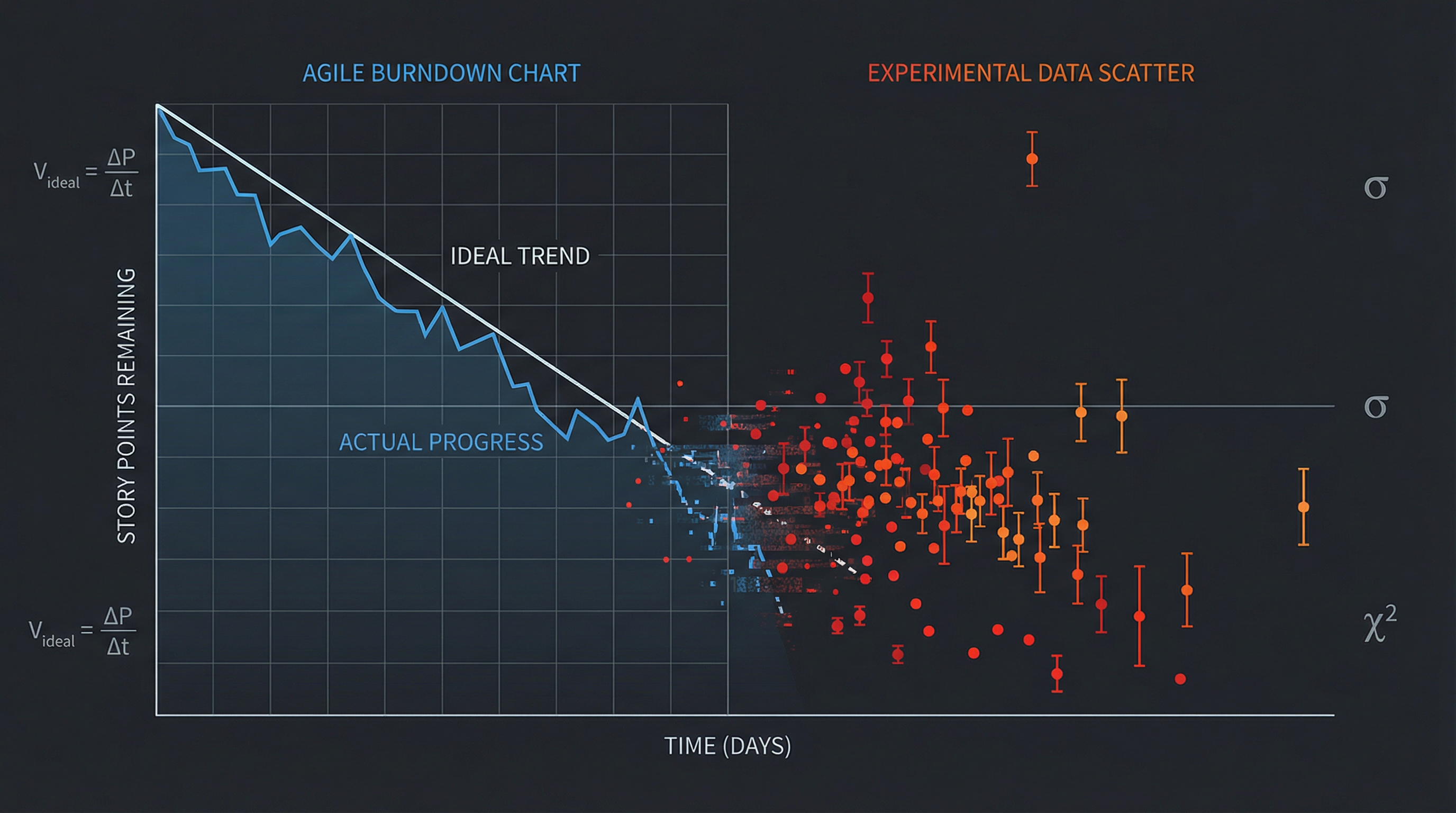
Stop Forcing AI Development Into Agile, It`s Killing Your Projects
Traditional Agile methodologies fundamentally conflict with AI development`s experimental nature. Why smart teams are abandoning sprint planning for research-driven approaches.
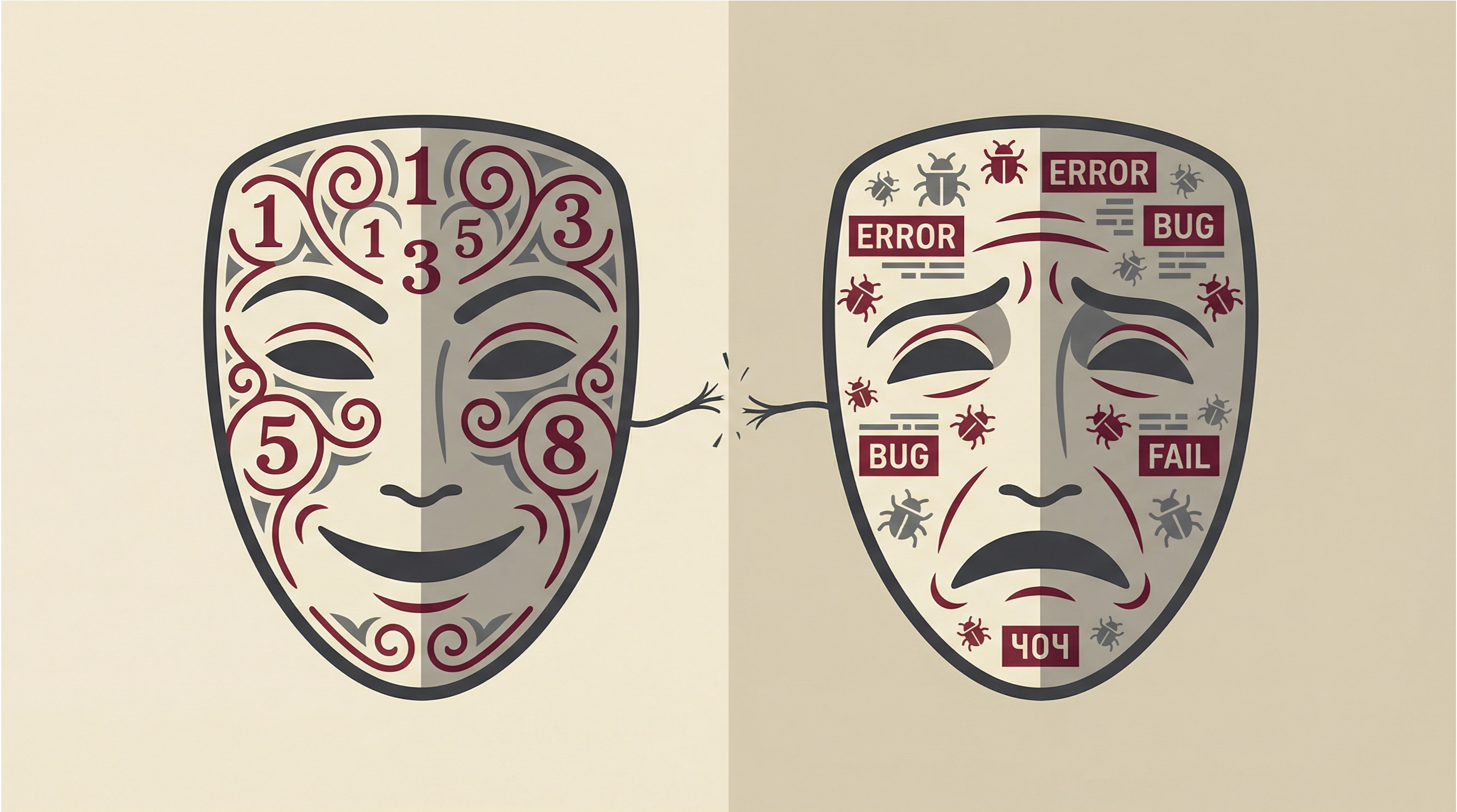
Why Agile Estimation Is Theater: The Case Against Story Points
Story points and estimation ceremonies waste 1,600+ hours per team annually. Stop training developers to predict the unpredictable and embrace uncertainty.
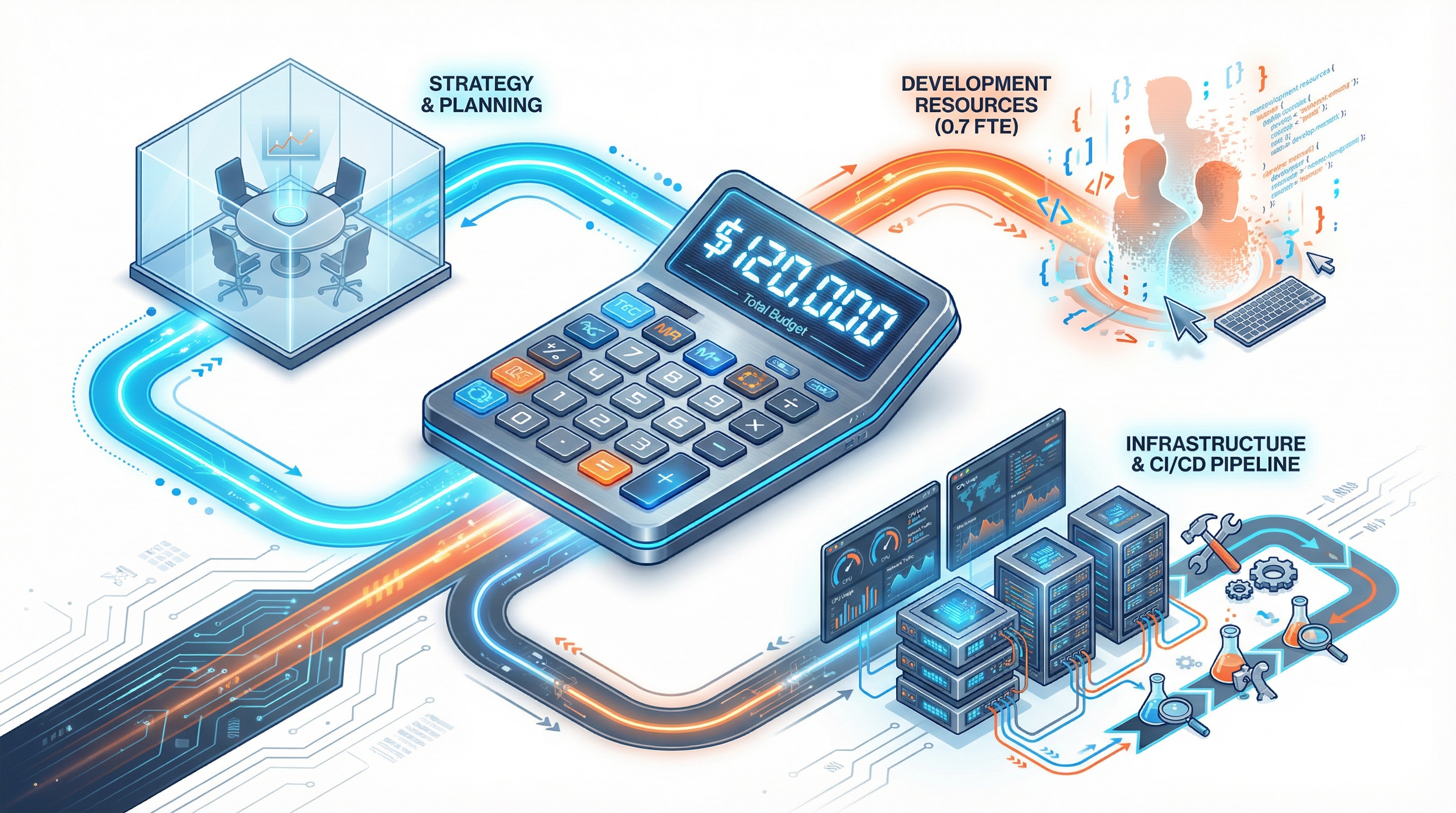
Scrum Master Salary Data 2026: Is $120K Justified When Developers Do The Real Work?
2026 Scrum Master salary data across US/Europe reveals $80K-$140K for non-coding roles. Are these positions worth it? Engineering managers share the truth.
Get the next war story in your inbox
Independent essays and practical models about what the process claims versus what actually ships. Published under a protected pen name. Free, no spam, unsubscribe anytime.
No certifications sold. No process religion. Unsubscribe anytime.