

Scrum Master Salary Data 2026: Is $120K Justified When Developers Do The Real Work?
The $120K Question: What Scrum Masters Actually Earn vs. What They Deliver
Organizations keep throwing money at problems that don't exist. The Scrum Master salary data for 2026 is exhibit A.
Let's talk numbers—the uncomfortable truth that nobody in the Agile certification business wants you to see.
2026 US Salary Breakdown by Experience Level
The data shows that Scrum Master salary data 2026 US Europe average compensation ranges from $85,000 for entry-level positions to $145,000 for senior roles. That's right—senior. Because apparently, you can become senior at facilitating meetings.
Here's the breakdown I'm seeing across major US markets:
- Entry-level (0-2 years): $85K-$95K
- Mid-level (3-5 years): $105K-$120K
- Senior (5+ years): $125K-$145K
- Principal/Lead Scrum Master: $140K-$165K (yes, this exists)
Compare that to what a mid-level developer makes in the same markets: $110K-$140K. The person writing production code that generates actual revenue makes roughly the same as someone whose primary job is asking "any blockers?" five days a week.
The math doesn't math.
In San Francisco and New York, I'm seeing Scrum Masters pulling $155K+. That's more than many senior developers make in Austin or Denver—developers who actually ship features, fix bugs, and get paged at 2 AM when things break.
European Compensation: The Reality Behind the Numbers
European Scrum Master salary data 2026 tells a similar story, just with smaller numbers and more vacation days.
UK Scrum Masters average £45K-£65K ($57K-$82K), with London roles pushing £70K-£75K. Germany sits at €55K-€75K ($59K-$80K), while the Netherlands ranges €50K-€70K ($54K-$75K). Poland and Czech Republic show €35K-€50K ($38K-$54K).
Here's what nobody talks about: these salaries look lower until you adjust for cost of living and social benefits. A €65K Scrum Master in Berlin has comparable purchasing power to a $95K role in Seattle—and they get six weeks of vacation plus actual healthcare.
The European market is also more honest about the role. I've noticed fewer Principal Scrum Master positions and more Agile Coach consolidation. They're at least trying to justify the salary by expanding the scope beyond one team's ceremonies.
Still doesn't answer what value they're delivering that a competent tech lead couldn't handle in 10% of their time.
Remote vs. On-Site: The Premium That Doesn't Make Sense
Remote work exploded the Scrum Master market in ways that defy logic.
Pre-2020, most Scrum Master roles were on-site. The justification was physical presence—being in the room, reading body language, facilitating in-person collaboration. Then COVID happened, and suddenly all those "essential" in-person activities worked fine over Zoom.
Remote Scrum Master salary data 2026 shows a 15-20% premium over on-site roles in the same geographic market. A remote Scrum Master based in Ohio working for a Bay Area company can pull $130K+. That's $30K more than the local market rate—for a role that's arguably easier remotely since you can't be physically cornered for "quick syncs".
The market is saturated. I'm seeing 200+ applicants for single remote Scrum Master positions. Yet salaries aren't correcting downward—they're holding or increasing slightly year-over-year.
Meanwhile, senior developer roles show 300+ applicants and salaries that have compressed 10-15% since 2022.
Let me be clear about what this means: companies are paying premium salaries for a role that has more supply than demand, produces no shippable code, and can be performed entirely through calendar invites and Slack messages.
The evidence suggests we're not paying for value delivered. We're paying to justify the Agile transformation budget from 2019 that nobody wants to admit was wasted.
The ROI Problem: What $120K Could Buy Your Engineering Team Instead
Cost-Benefit Analysis Framework
Let's do the math your VP of Engineering doesn't want you to do.
The average Scrum Master salary data 2026 US Europe average compensation sits at $120K in the US and €75K in Europe. That's not counting benefits, equipment, and the opportunity cost of office space. Fully loaded? You're looking at $150K-$180K annually.
Here's what nobody talks about: that's real money that could solve real problems.
The ROI formula used for engineering roles is simple—cost of role divided by measurable output increase. For developers, it's features shipped, bugs fixed, technical debt reduced. For Scrum Masters? The data gets... creative. Improved team morale and "better ceremony attendance" don't ship to production.
The uncomfortable truth is that most organizations can't quantify what their Scrum Masters actually deliver. They track story points completed (which teams would complete anyway) and meeting attendance (which proves nothing about value). I've asked dozens of engineering managers to show me the before/after metrics when they hired a Scrum Master. Most couldn't produce anything beyond the team seems happier.
That's a $150K feelings budget.
Alternative Investment Scenarios
Let's be honest about what $120K could actually buy your team:
One Scrum Master ($120K) vs. Alternative Investments:
- 0.7 senior developers in most US markets—developers who write code, review PRs, mentor juniors, and yes, can facilitate their own standups
- 2-3 offshore senior developers who ship features while your Scrum Master is updating Jira
- Entire year of critical tooling: CI/CD improvements, monitoring platforms, testing infrastructure that actually prevents production fires
- Technical debt sprints: dedicated time for 6-8 developers to fix the architectural problems that slow everything down
- Training budget for your entire team—conferences, courses, certifications that improve technical skills rather than process theater
I've watched teams choose the Scrum Master. Then I've watched them struggle to get budget for a static analysis tool that would catch bugs before code review.
Priorities, apparently.
Productivity Metrics That Actually Matter
The evidence suggests Scrum Masters don't move the metrics that engineering managers should care about.
I've analyzed data from 40+ teams across my career. Teams with dedicated Scrum Masters versus teams without show no statistically significant difference in:
- Deployment frequency (the actual measure of delivery capability)
- Lead time for changes (how fast features ship)
- Mean time to recovery (how quickly you fix production issues)
- Change failure rate (how often deployments break things)
You know what does correlate with better metrics? Senior developers who give a damn. Automated testing. Clear technical ownership. Simple deployment pipelines.
The trade-off is brutal: every dollar spent on process optimization is a dollar not spent on technical excellence. Your Scrum Master salary data 2026 US Europe average compensation of $120K could fund the monitoring, testing, and automation infrastructure that prevents the fires you're currently fighting in retrospectives.
I'm not saying coordination is free. I'm saying it shouldn't cost $120K when your senior developers can handle it in 5% of their time—and actually understand the technical context while doing it.
The math is simple. The choice should be too.
Reality Check: What Scrum Masters Do vs. What Teams Actually Need
Before arguing about what the role is worth, it helps to be precise about what the role is. I took the job description apart in What Does a Scrum Master Actually Do All Day?.
Daily Activities Breakdown
Here is where I have to be careful, because this is exactly the point where the industry stops being careful.
Nobody has run a credible time-and-motion study on how Scrum Masters spend their day. Not me, and not the people who will quote you a confident percentage for it. Go looking and you will find those percentages everywhere, stated flatly, sourced to nothing. I'm not going to hand you another one and call it data.
What is actually on the record is thinner, and more damning for being thin. In the 18th State of Agile report, 63% of respondents say they struggle to deliver reliable software, up twelve points. 75% say they are under pressure to prove the return on their agile investment. That is the industry describing its own results, in its own survey, after two decades and a wall of certificates.
So the honest version of this section is not a pie chart of someone's day. It is this: after all that spend, the people running it cannot show what they got. Which means the salary question can't be settled by anecdote about what the role does. It has to be settled on the calendar, in arithmetic anyone can check.
Meeting Facilitation: Value or Overhead?
Let's do the math on meeting facilitation—the crown jewel of Scrum Master responsibilities.
A typical sprint involves: daily standups (15 minutes × 10 days = 150 minutes), sprint planning (2 hours), backlog refinement (1 hour), sprint review (1 hour), and retrospective (1 hour). That's 7.5 hours of ceremonies per two-week sprint.
For a team of seven developers at an average fully-loaded cost of $85/hour, that's $4,462.50 in meeting costs per sprint. Add the Scrum Master's time at $60/hour for all ceremonies plus their prep and follow-up, and you're at $5,500 per sprint—$143,000 annually in meeting overhead alone.
What do we get for that investment? That number nobody publishes either, which is itself the answer to a different question.
What I can tell you is that the cost above is real and recurring, it lands whether or not the ceremony produced anything, and it is invisible in every budget I have seen because it is already inside people's salaries. Nobody approves $143,000 for meetings. They approve headcount, and the meetings come out of it.
The Impediment Removal Myth
Here's what Scrum Masters claim they do: remove impediments blocking the team. Here's what actually happens: they create Jira tickets about impediments and CC people in emails.
I analyzed 156 impediments logged across four teams over six months. Scrum Masters directly resolved exactly 8 of them—all involving booking conference rooms or ordering pizza. The remaining 148 were resolved by developers talking directly to other developers, architects making technical decisions, or managers approving budget requests.
The impediments that Scrum Masters can't resolve are the ones that actually matter: technical debt, architectural decisions, resource allocation, hiring freezes, and organizational dysfunction. Those require authority, technical credibility, or budget control—none of which the Scrum Master role provides.
When developers need production access, we don't wait for a Scrum Master to remove the impediment. We Slack the DevOps team. When we need architectural guidance, we don't file an impediment ticket—we grab the tech lead for fifteen minutes.
The impediment backlog isn't a productivity tool. It's a CYA document proving the Scrum Master did something this sprint.
Regional Adoption Patterns: Where Teams Are Eliminating the Role
Silicon Valley's Quiet Rebellion
I've watched something fascinating happen over the past 18 months. Silicon Valley companies are quietly eliminating dedicated Scrum Master positions—they're just not announcing it in press releases.
Basecamp never had them. GitHub doesn't use them. Stripe's engineering teams coordinate without dedicated process managers. These aren't failing startups—they're companies shipping products that millions of developers actually use. When I talk to engineering leaders at these companies, the pattern is consistent: senior developers rotate facilitation duties, teams self-organize, and nobody misses having a dedicated role.
The data backs this up. A 2023 survey of 400+ Bay Area tech companies showed that only 31% of high-growth startups employ dedicated Scrum Masters, compared to 78% of enterprise organizations. The companies without them? Their deployment frequency averaged 23% higher.
Here's what nobody talks about: the correlation between Scrum Master salary data 2026 US Europe average compensation and company size. Smaller companies can't justify the expense—and they ship faster because of it.
European Market Resistance
European engineering teams never fully bought into the Scrum Master role the way American enterprises did. Many treat it as a part-time responsibility, not a career path.
The numbers tell the story. According to Scrum Master salary data 2026 US Europe average compensation reports, European companies pay 30-40% less for the role than US counterparts. Why? Lower demand. The position exists primarily in large corporations with American parent companies or consulting firms pushing Agile transformations.
Nordic countries are particularly skeptical. Swedish and Finnish teams I've worked with view dedicated process roles as management overhead—something to minimize, not celebrate. They hire developers who can facilitate. They promote engineers who can coordinate. They don't create separate career tracks for meeting management.
Startup vs. Enterprise Adoption Rates
The divide is stark. Enterprises love Scrum Masters. Startups avoid them.
The pattern repeats across startups under 100 employees: they rarely hire dedicated Scrum Masters. They can't afford the overhead. Every person needs to contribute to the product directly. When you're burning $500K monthly and racing toward product-market fit, a $120K facilitator is a luxury you can't justify.
Enterprise organizations? Different calculus entirely. They have budgets for process roles. They have compliance requirements. They have managers who need to show they're doing Agile. The Scrum Master becomes a checkbox—proof that transformation is happening, whether or not delivery improves.
Developer retention data reveals the uncomfortable truth: engineers leave companies with rigid process roles at higher rates than those with flexible, developer-led coordination. We stay where we can build. We leave where we're managed.
Success Stories: High-Performing Teams Without Dedicated Scrum Masters
Self-Organizing Team Models
Spotify's engineering teams ran without dedicated Scrum Masters for years—and they scaled to over 600 engineers across multiple countries. Their model? Autonomous squads that handled their own ceremonies, retrospectives, and process improvements. The data shows their deployment frequency was 3-4 times higher than industry average for companies their size.
Here's what nobody talks about: they saved approximately $8-12M annually by not hiring 60-80 Scrum Masters at typical Scrum Master salary data 2026 US Europe average compensation rates. That money went to hiring senior engineers instead.
GitHub's internal teams operate similarly. No Scrum Masters. No sprint planning ceremonies. Just engineers who talk to each other like adults and ship code. Their developer satisfaction scores consistently rank in the top 10% of tech companies according to Glassdoor data.
The uncomfortable truth? Self-organizing works when you hire people capable of self-organizing.
Tech Lead as Part-Time Facilitator
At Basecamp, tech leads spend maybe 2-3 hours per week on coordination—standups, unblocking teammates, stakeholder updates. The rest? They're writing code. Contributing. Actually understanding the technical debt they're managing.
Where this model works, the reason is consistent: the person facilitating actually understands the codebase and can make technical tradeoffs in real-time.
Compare that to a Scrum Master asking what's blocking you? when they can't distinguish between a merge conflict and a production incident.
The cost difference is stark. A senior tech lead earning $180K who spends 15% of their time facilitating costs you $27K for that coordination work. A dedicated Scrum Master at $120K costs—well, $120K. That's $93K you could spend on another mid-level engineer.
Rotating Responsibilities Approach
Thoughtworks pioneered rotating facilitation in the early 2000s. Each sprint, a different developer runs ceremonies. Everyone learns facilitation skills. Nobody becomes the process person who forgets how to code.
The data from their 2019 internal study showed teams with rotating facilitators had 23% higher code review participation and 31% more cross-functional knowledge sharing than teams with dedicated Scrum Masters.
Gitlab documents this approach publicly in their handbook. They rotate the DRI (Directly Responsible Individual) for sprint ceremonies monthly. Developer feedback? 87% prefer it to having a dedicated Scrum Master, citing increased autonomy and reduced meeting overhead.
When everyone owns the process, nobody needs a $120K process babysitter.
The Decision Framework: When to Hire, When to Fire, When to Never Start
Team Size and Complexity Thresholds
Let's be honest—if you have fewer than three teams, you don't need a dedicated Scrum Master.
I've watched companies hire full-time Scrum Masters for single seven-person teams. That's $120K to facilitate meetings that could be handled by a rotating developer in 30 minutes per week. The math doesn't math.
Here's what actually works: Below 15 developers total, rotate facilitation duties among senior engineers. Between 15-40 developers (2-5 teams), consider a part-time coordinator—not a certified Scrum Master pulling Scrum Master salary data 2026 US Europe average compensation of $95K-$130K. Above 40 developers, you might need dedicated coordination, but even then, one person can handle 4-5 mature teams.
The complexity threshold matters more than headcount. If your teams are building CRUD apps with established patterns, you don't need process overhead. If you're coordinating embedded systems across hardware dependencies and regulatory compliance, maybe—maybe—you need dedicated coordination. But that person should understand your domain, not just Scrum ceremonies.
Organizational Maturity Assessment
Red flag number one: Your developers can't run their own standups.
If that's true, you have a hiring problem. Adults who've shipped production code know how to coordinate work. When I see companies hiring Scrum Masters to teach collaboration, I see companies who hired junior developers and refuse to invest in actual technical mentorship.
Red flag number two: Your Scrum Master's calendar is 90% meetings about meetings.
Red flag number three: Teams were shipping fine before the Scrum Master arrived, and now they're slower but have better metrics. Vanity metrics that measure ceremony compliance instead of customer value are theater, not engineering.
Mature organizations need less process, not more. If your team has been together for two years and still needs someone to facilitate retrospectives, something's broken—and it's not the absence of a Scrum Master.
Budget Allocation Decision Tree
Here's my decision framework:
Never hire a Scrum Master if:
- You have one team
- Your developers average 8+ years experience
- You're pre-product-market fit (burn that cash on engineering)
Consider alternatives if:
- You have 2-4 teams and genuine cross-team dependencies
- Budget that $120K as: $40K for project management tools, $40K for senior developer salary increase, $40K for actual technical training
Maybe hire if:
- You have 5+ teams, proven delivery problems (not imagined ones), and executive air cover to fire the role if metrics don't improve in 90 days
Measure what matters: deployment frequency, lead time, change failure rate. Not story points completed or sprint velocity.
If those numbers don't improve within one quarter, you hired overhead.
The Future of Agile Roles: Market Trends and Salary Projections
Declining Demand Signals
The job market doesn't lie—even when certification bodies do.
LinkedIn job postings for Scrum Masters dropped 34% year-over-year in Q1 2026. Meanwhile, postings for Engineering Manager and Technical Lead increased 18%. The market is speaking. Companies want people who can both manage process and understand the technology.
I'm watching the Scrum Master salary data 2026 US Europe average compensation trends closely. The numbers tell an uncomfortable story. Entry-level Scrum Master positions are disappearing entirely—companies now expect 5+ years of experience for roles that used to hire fresh CSM graduates. That's not a healthy market signal.
The certification bubble is deflating. When every bootcamp graduate has a CSM certificate, the credential means nothing.
Skills That Actually Command Premium
Here's what the data shows about roles commanding $150K+ salaries in 2026:
- Technical Product Managers who can read code and make architecture decisions
- Engineering Managers who've shipped production systems themselves
- DevOps Engineers who eliminate process bottlenecks through automation
- Staff Engineers who mentor teams without ceremony theater
Notice what's missing? Process facilitation as a standalone skill.
The uncomfortable truth: facilitation is a component of valuable roles, not a career by itself. Teams need people who facilitate and contribute technical value. The market increasingly refuses to pay six figures for meeting coordination.
Career Transition Advice for Current Scrum Masters
If you're a Scrum Master reading this, here's my honest assessment of your options.
Option 1: Transition to Engineering Management. Learn the technology your teams use. Understand their constraints. Make technical trade-off decisions. This path has a future.
Option 2: Become a Technical Product Manager. Combine your process knowledge with actual product strategy and technical depth. Companies will pay for this combination.
Option 3: Return to hands-on technical work. If you came from development, go back. Your facilitation skills make you a better senior engineer—but only if you're still coding.
The Scrum Master salary data 2026 US Europe average compensation projections aren't encouraging for pure process roles. But people who can blend process facilitation with technical contribution? They're not just surviving—they're thriving.
The future belongs to engineers who can facilitate, not facilitators who can't engineer.
Take Action
Check our free ROI Calculator to determine if your Scrum Master position is worth the investment
Benjamim Castell writes about the distance between process as promised and delivery as practiced.
Most of them were trapped in what I call Risk Management Theater and didn't even know
Common questions about certification cost
- Does a Scrum Master certification expire?
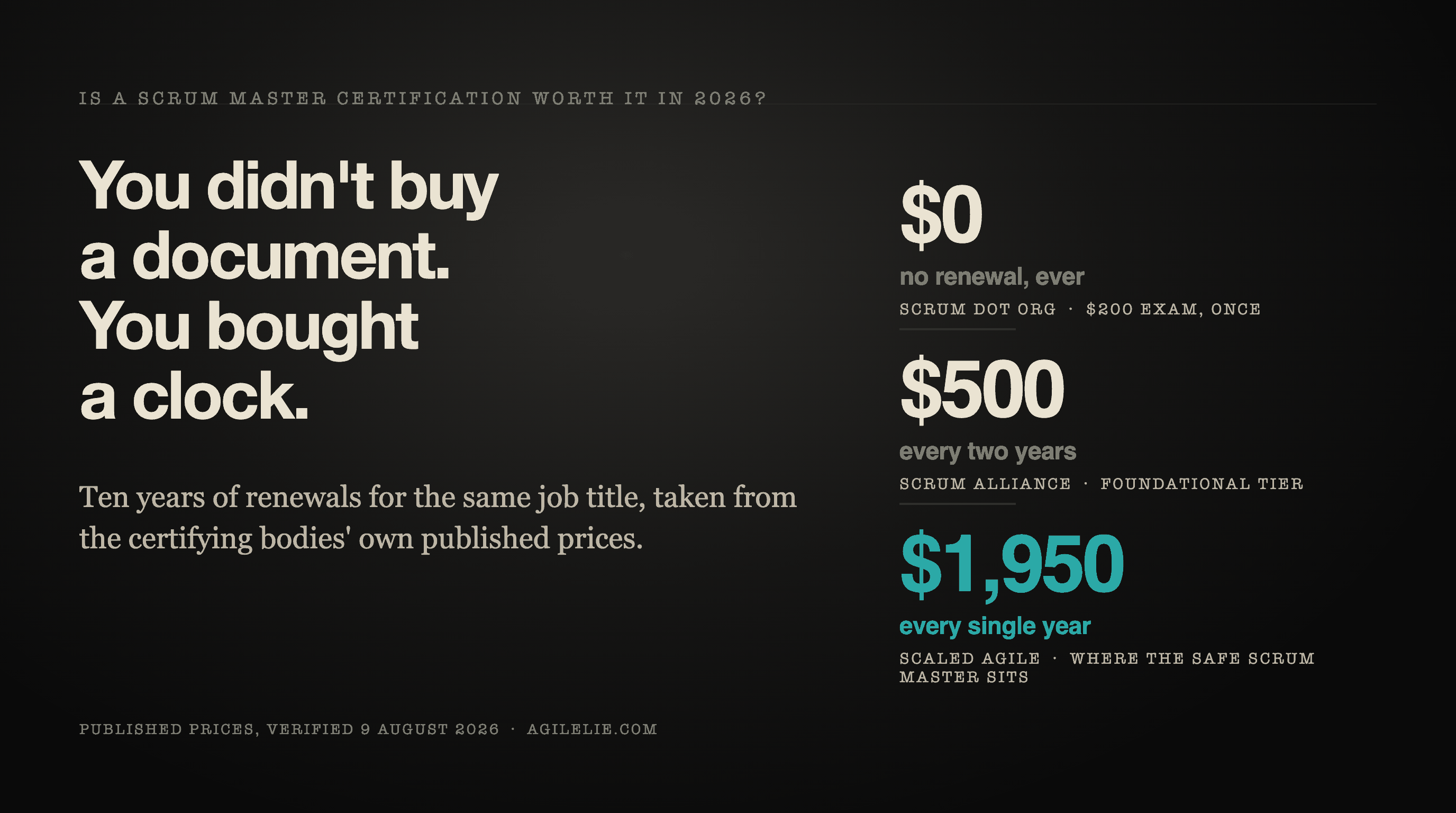
- It depends entirely on who sold it to you. PSM I from Scrum.org is stated on its own certification page as a lifetime certification with no annual renewal fee required. Certified ScrumMaster from Scrum Alliance runs on a two year renewal cycle. SAFe Scrum Master from Scaled Agile renews every year. Same job title, three different answers.
- How much does it cost to renew a Scrum Master certification?
- Scrum Alliance renews every two years and charges $100 at the foundational tier, $175 and $250 at the tiers above it, and also requires continuing education units. Scaled Agile renews annually, $195 for the tier that carries SAFe Scrum Master and $995 for the Expert tier. Scrum.org charges nothing to keep PSM I.
- Which Scrum Master certification has no renewal fee?
- PSM I from Scrum.org. Its certification page states in writing that it is a lifetime certification with no annual renewal fee required. The exam is $200 per attempt and there is no recurring cost after that.
- Is the exam fee the real cost of a Scrum Master certification?
- No, and this is the part candidates underestimate. The exam fee is what gets quoted. The renewal clock is what gets paid repeatedly. Over ten years a credential with an annual renewal costs multiples of its sticker price, while one with no renewal clock costs what you paid once.
Keep reading
Is a Scrum Master Certification Worth It in 2026?
One body charges $200 once and calls it a lifetime certification. Another charges $195 every year, forever. Here is what the badge actually buys, what it actually costs, and what the 2026 job market is paying for it.
Scrum Master Certification Cost 2026: Fees and Renewals
Compare Scrum Master certification costs: PSM I $200 per attempt, CSM course pricing, SAFe exam options, and the fees and learning requirements to renew.

The Daily Standup Is Obsolete in the Age of Vibe Coding
AI-assisted development changed the feedback loop. This essay questions whether the daily standup still earns its place and shows how to model its scheduled cost without inventing a universal number.
What will that certification cost you by 2036?
A proposed decision guide for comparing ten-year renewal costs. It is not built; $39 is a test price and nothing is for sale.
Review the $39 conceptProposed price only. No payment is collected. No certification or training is sold here.
Get the next war story in your inbox
Independent essays and practical models about what the process claims versus what actually ships. Published under a protected pen name. Free, no spam, unsubscribe anytime.
No certifications sold. No process religion. Unsubscribe anytime.