
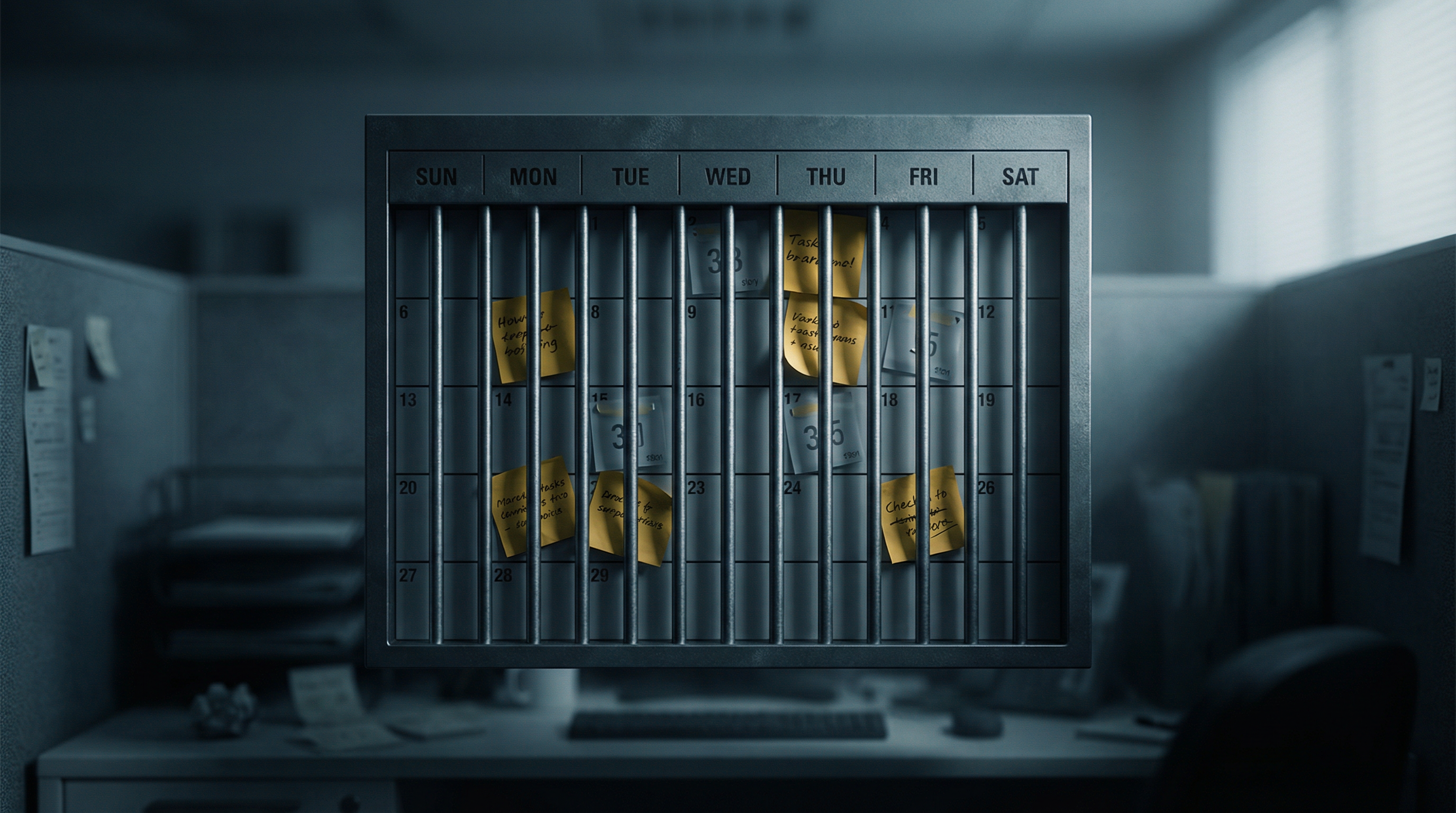
Waterfall in Disguise: How Fixed Sprints Recreate the Planning Trap
You escaped waterfall. You adopted Agile. Two-week sprints, all the ceremonies—planning, standups, reviews, retros. Backlog, story points, velocity charts.
You've built waterfall with better marketing.
Agile was supposed to free us from rigid planning cycles. Most teams now operate in fixed-length boxes that demand upfront estimation, scope commitment, and inflexible timelines. The sprint—originally a feedback loop—has become a planning constraint as rigid as any waterfall phase.
Fixed sprints don't enable adaptability. They enforce a cadence that makes real adaptation nearly impossible.
The Planning Ceremony That Ate Tuesday
It's Tuesday morning. Sprint planning. Twelve engineers in a conference room. The product owner has twenty stories ready, meticulously groomed, acceptance criteria complete. Sprint goal on the whiteboard: "Complete user authentication improvements."
Planning poker cards come out. First story: "Implement OAuth2 refresh token rotation."
"Five," says one developer.
"Eight," says another.
"Thirteen," says the tech lead. "This touches three services. We'll need to update the client library, migrate existing tokens, coordinate deployment."
Debate. Can they defer the migration? No—security audit requires it this sprint. Fifteen minutes later, they settle on eight points.
Eleven stories to go. It's 10:47 AM.
By noon, they've committed to 34 points. Velocity says they usually complete 32. Someone jokes about "stretch goals." Everyone knows what happens next: late nights Thursday to finish everything, or an awkward sprint review about why story #8 didn't get done.
What just happened: the team committed to fixed scope for fixed duration based on estimates made before writing a single line of code. They front-loaded all planning decisions into one ceremony. They created a mini-deadline that will govern the next ten working days.
Waterfall planning. Just smaller.
The Cadence Trap
The original insight behind iterations was simple: deliver working software frequently to enable learning and course correction.
Notice what's missing: nothing about iteration length being sacred.
Yet somehow, the two-week sprint became dogma. Not a tool. Not a starting point. Dogma.
Watch teams contort themselves to preserve sprint boundaries:
- Deferring critical bug fixes until "next sprint" because the current sprint is "locked"
- Splitting three-day tasks across two sprints because it's Wednesday of week two
- Holding incomplete work in "code review limbo" because merging after Friday would "mess up velocity metrics"
- Rushing half-tested code Thursday night to "meet sprint commitment"
The cadence becomes more important than the work. The ceremony becomes more important than the outcome.
Process worship. The sprint transformed from feedback mechanism to compliance requirement.
Why Fixed Boxes Kill Adaptability
The Agile Manifesto: "responding to change over following a plan." Fixed-length sprints undermine this structurally.
Priorities shift mid-sprint. A customer-facing bug appears. A strategic opportunity emerges. A dependency suddenly becomes available.
In a truly adaptive system, you'd pivot immediately. Swarm the critical issue. Reorganize around new information.
But you can't. You're in a sprint.
The product owner says, "Let's discuss it at sprint planning." The scrum master reminds everyone about "protecting the team from disruption." Sprint commitment is sacred. The box must not be broken.
So you wait. You defer important work until the arbitrary boundary passes. You continue executing Tuesday's plan, even though it's Thursday and the world has changed.
You are following the plan over responding to change.
Waterfall didn't die. It shrunk to two weeks and learned the vocabulary.
The Scope Negotiation Dance
Friday afternoon, sprint review. The team demos what they finished.
OAuth work: done. Password reset flow: done. Session timeout improvement: not done.
"We got blocked on the Redis cluster upgrade," the tech lead explains. "Infrastructure needed two more days. The story is about 80% complete."
The product owner's face tightens. "Can we ship it?"
"Not without the cache layer. Users would get logged out randomly."
Silence.
Someone suggests carrying it over. Someone else suggests counting partial points. The scrum master asks about "lessons learned" on estimation.
Here's what nobody says: this entire conversation is absurd.
The work will finish. Probably takes three more days. Whether those three days fall within this sprint box or the next is cosmetically irrelevant to the customer. The feature ships when it ships.
But the sprint boundary makes this a negotiation. Did we succeed or fail? Count the points or not? Is velocity up or down?
The fixed timebox created an artificial accounting problem that has nothing to do with delivering value. We're measuring schedule compliance instead of progress toward outcomes.
Same dysfunction that plagued waterfall projects. Same milestone pressure. Same theater of reporting "on track" or "behind schedule" based on arbitrary phase boundaries.
The sprint didn't eliminate project management overhead. It increased the frequency.
The Estimation Industrial Complex
Fixed-length sprints require upfront estimation. You can't commit to a sprint's worth of work without estimating how much that is.
So teams estimate. Story points. T-shirt sizes. Ideal days. Hours. Fibonacci sequences. Planning poker. Affinity mapping.
I've seen teams spend six hours per sprint planning and grooming stories. That's 15% of available time spent planning the sprint. For a ten-person team, that's sixty person-hours of estimation labor every two weeks.
Waste.
Not because estimation is worthless—rough prioritization requires rough sizing. But sprint-driven estimation demands precision that doesn't exist. You're estimating implementation details before implementation, predicting blockers before discovery, committing to scope before learning.
The estimation theater exists to feed the sprint commitment. The commitment exists to measure velocity. Velocity exists to forecast delivery dates.
You've recreated the entire waterfall planning apparatus. You've just automated it into a biweekly ritual.
The Date Promise
Mid-sprint Wednesday. A VP drops into Slack: "Do we have a date for the analytics dashboard? Customer success needs it for Q1 planning."
The product owner checks the roadmap. Analytics work is spread across four epics. Some stories in the current sprint. Some in the backlog. Some still being groomed.
"We'll need to roll it up," the product owner says in the team channel.
What follows is a planning exercise that would make any waterfall PM proud:
- Count unfinished story points across all analytics epics: 89 points
- Check team velocity: 32 points per sprint
- Divide: 89 / 32 = 2.78 sprints
- Round up: 3 sprints
- Count calendar weeks: 6 weeks
- Add buffer: "8 weeks to be safe"
The VP gets a date: March 15th.
Now the team has a deadline. Sprint commitments are no longer just internal planning—they're linked to an external promise. Pressure increases. Scope negotiation becomes fraught. The "sprint goal" is now tied to a date-driven roadmap.
Exactly how waterfall operated. Requirements up front. Estimate the effort. Build the schedule. Promise the date. Execute the plan.
The sprint became the unit of measurement in a deterministic planning model.
Why This Happened
Fixed-length sprints were meant to solve real problems:
- Feedback loops: Regularly deliver working software for review
- Predictability: Give stakeholders a cadence they can depend on
- Focus: Protect teams from constant priority whiplash
- Improvement: Create natural reflection points for retrospectives
Valid goals. But the implementation created new dysfunctions:
- Feedback loops became demonstration ceremonies where "done" matters more than "useful"
- Predictability became velocity tracking and date promises based on estimation
- Focus became rigidity where adaptation is treated as disruption
- Improvement retrospectives became therapy sessions about why the team didn't hit their points
The tool became the goal.
The sprint structure, instead of enabling agility, became the thing we're agile within—but not agile about.
Cargo culting. Scrum gave us sprints, so we do sprints. Two weeks. Always two weeks. With all the ceremonies. Because that's Agile™.
Process compliance. Bureaucracy with standups.
Recognizing Waterfall Cosplaying as Agile
How do you know if your sprints have become mini-waterfalls?
Planning symptoms:
- Sprint planning regularly takes 3+ hours
- The team debates story point values for more than five minutes per story
- Estimation happens before technical investigation
- "Sprint commitment" is treated as a contract
- Stories are rejected from the sprint because "we don't have capacity"
Execution symptoms:
- Mid-sprint priority changes are called "disruptions"
- Work is held back from production because "the sprint isn't over"
- Developers rush code Thursday evening to "meet commitment"
- Incomplete work is a source of team stress
- The sprint burndown chart is reviewed more than the actual software
Cultural symptoms:
- Velocity is measured sprint-over-sprint and used for performance evaluation
- Failed sprint commitments require explanation to management
- The team is praised for "delivering on commitment" more than delivering value
- Retrospective action items are about improving estimation accuracy
- The question "when will it be done?" is answered by counting sprints
Three or more of these? You're not doing Agile. You're doing waterfall in two-week increments.
What To Do Instead
The solution isn't to eliminate structure. It's to subordinate structure to purpose.
Treat sprint length as a variable, not a constant
Different work needs different planning horizons. A bug fix needs hours, not weeks. A platform migration needs months. Stop forcing both into the same two-week box.
Experiment. One-week sprints. Three-week sprints. No sprints—just continuous delivery with weekly demos.
Ask: "What cadence enables the fastest learning?" Not: "What cadence does the Scrum Guide prescribe?"
Break the commitment model
Stop treating the sprint plan as a promise. Treat it as a forecast that updates daily.
At standup, don't ask "are you on track?" Ask "what did we learn yesterday that changes our plan?"
When priorities shift mid-sprint, shift. Immediately. Don't wait for the ceremony.
Measure outcomes delivered, not points completed. Sprint review should answer "did we improve the product?" not "did we finish the list?"
Kill estimation theater
Estimate less, deliver more.
Small work? Don't estimate. Just do it. You'll finish before the estimation meeting ends.
Large work? Break it down until pieces are small enough to start without detailed estimation.
Everything else? Use coarse buckets: "less than a week," "one to two weeks," "more than two weeks—let's break it down further."
Time spent estimating is time not spent delivering.
Decouple demos from sprint boundaries
Demo work when it's ready. Not when the calendar says "sprint review."
Finish something valuable on Tuesday? Show it Tuesday. Get feedback Tuesday. Ship it Tuesday.
The feedback loop matters. The ceremony schedule doesn't.
Make retrospectives about the work, not the process
Stop asking "how can we improve our velocity?"
Start asking:
- "What slowed us down?"
- "What did we learn about the problem?"
- "What would we do differently?"
- "What should we stop doing?"
Improve the work system, not sprint compliance.
The Uncomfortable Truth
Fixed sprints feel professional. They give management predictability. They create metrics. They make chaos look controlled.
Admitting that sprints have become a planning crutch means admitting you don't know exactly when things will be done. It means telling stakeholders "we'll ship it when it's ready, and we'll keep you updated." It means trusting the team to manage their own work without a two-week accountability checkpoint.
That's uncomfortable.
For managers. For product owners. For teams that have internalized sprint commitment as identity.
But discomfort isn't a reason to preserve dysfunction.
Waterfall felt professional too. Gantt charts, phase gates, status reports. It gave executives the illusion of control.
It also failed. Repeatedly. Expensively.
Agile was supposed to be the alternative. Not the same disease with different symptoms.
The Sprint Is a Tool, Not a Religion
When it enables faster feedback and better decisions, use it.
When it creates artificial constraints and planning overhead, change it.
The Agile Manifesto doesn't mention sprints. It mentions individuals and interactions, working software, customer collaboration, and responding to change.
If your sprints are getting in the way of those things, your sprints are the problem.
Waterfall failed because it optimized for plan compliance over value delivery.
Don't let your sprints make the same mistake.
Benjamim Castell writes about the distance between process as promised and delivery as practiced.
Most of them were trapped in what I call Risk Management Theater and didn't even know
Keep reading
The False Promise of Agile Over Waterfall: When Sequential Wins
The industry`s dogmatic shift to Agile sacrificed architectural coherence for the illusion of progress. Why Waterfall`s sequential approach still beats sprints.
What Is SAFe? The Honest Definition of the Scaled Agile Framework
SAFe is the most adopted framework for "scaling agile" in large enterprises, and the most profitable. Here`s what it actually is, how it`s supposed to work, and what it becomes inside real companies.
Kanban vs Scrum: Why Flow Beats Theater for Real Delivery
After watching teams drown in sprint ceremonies while shipping nothing, I can tell you: most Scrum implementations are expensive theater. Kanban offers an escape.
Get the next war story in your inbox
Independent essays and practical models about what the process claims versus what actually ships. Published under a protected pen name. Free, no spam, unsubscribe anytime.
No certifications sold. No process religion. Unsubscribe anytime.