
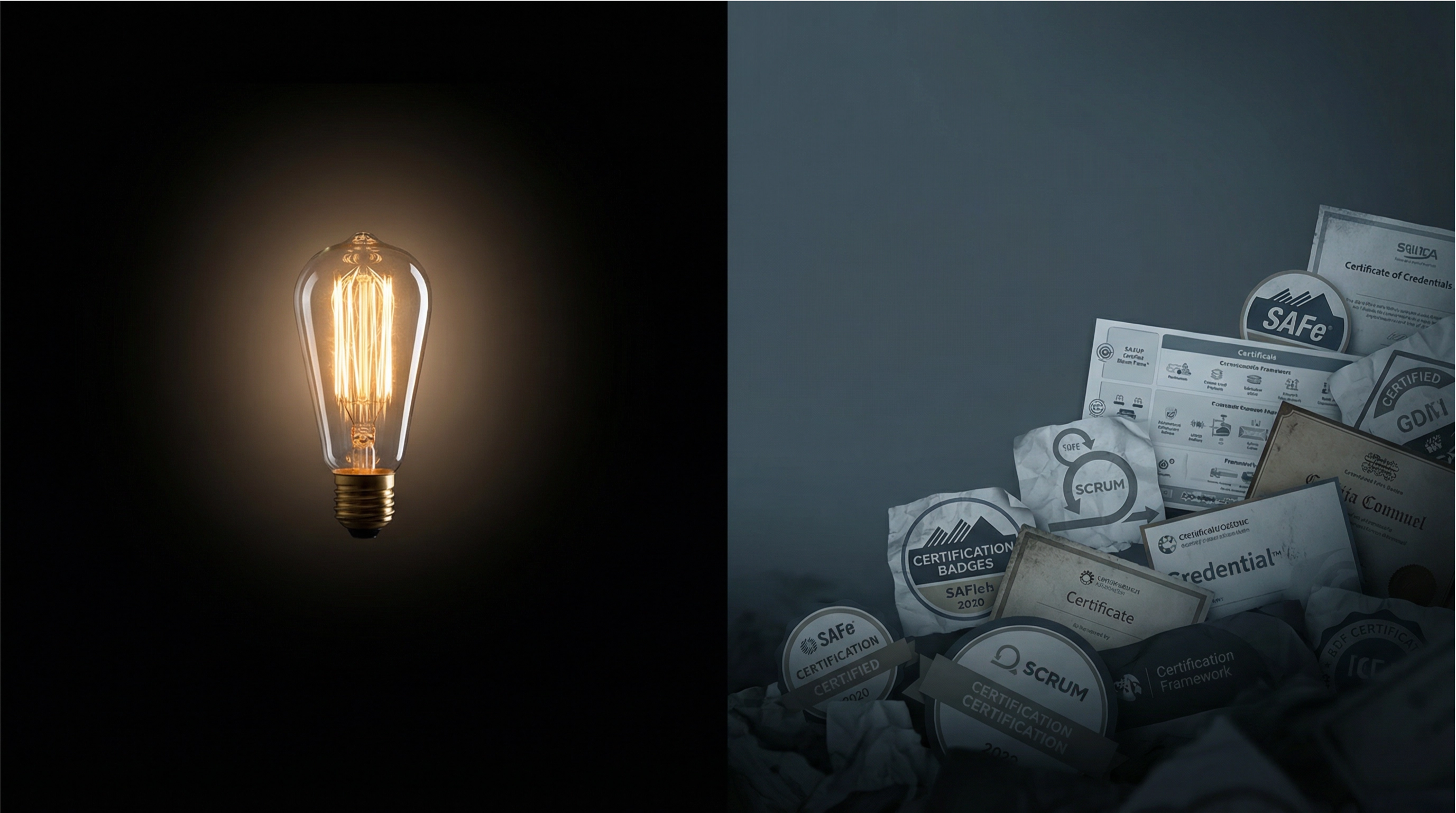
What Actually Ships Software
There's a conversation I've been having more than any other this year. It starts the same way every time.
Someone reads the numbers — $49 billion, 65% failure rate, certifications built on a fourteen-page pamphlet and then asks the question I respect most: If not this, then what?
Not a dismissal. Not a defense of the status quo. An honest question from someone who's tired of the dysfunction and doesn't have a replacement.
I don't have a framework. I don't have an acronym. I definitely don't have a certification to sell you. What I have is experience building complex systems where failures carry real consequences. The kind of work where a bad deploy affects people, operations, and trust, not just a funny error page.
I've watched teams ship and teams drown. The ones that shipped had things in common. None of those things came from a two-day workshop.
The Architect Who Can Say No
Every team I've seen ship well had someone with the technical authority to kill complexity before it spread. Not suggest. Not raise concerns in a retro that gets noted and ignored. Kill.
At one company I worked with, the lead architect could walk into a planning session and say "this is too complex, we're not doing it this way," and it stuck. The product owner could argue. The stakeholders could push. If the architect said the technical cost was too high, the conversation changed direction. Not because he was difficult, because he'd been right enough times that people learned to listen.
At another shop, same industry, similar product, the architects were "advisory." They could recommend. They could document concerns in Confluence pages nobody read. But the Product Owner had final say on everything, including technical decisions they didn't understand. The backlog grew. Complexity compounded. Every sprint delivered less. The team kept getting bigger, which made it worse.
Scrum doesn't have this role. The Product Owner prioritizes the backlog. The Scrum Master facilitates ceremonies. Nobody has a mandate to simplify. Nobody has the authority to say "we're not adding that because it will make everything else harder." The backlog is a democracy, and democracy in the backlog is like democracy in the cockpit. Everyone gets a voice, nobody gets to land the plane.
The first thing that's present when software actually ships: someone who can say no and be heard.
The Phone Number Test
Here's a test I've been running informally for years. I ask the product person on a team: "Can you name three actual users of this system? Not personas. Not segments. Humans. With names. Could you call one of them right now if I asked?"
The teams that ship? The product person pulls out their phone. Sometimes literally. They talked to a customer last Tuesday. They know what's broken because someone told them, in plain language, while frustrated.
On one customer-facing platform, I had the direct numbers of three frontline managers saved in my phone. When we shipped something, I'd call on Monday morning and ask if it worked. Not a survey. Not an NPS score aggregated into a quarterly deck. A phone call. "Hey, did the new workflow confuse anyone this weekend?"
That feedback loop was worth more than every retrospective I've ever sat through. Combined.
The Agile framework formalizes the distance between who builds and who uses. The Product Owner is supposed to represent the customer, but representing isn't the same as knowing. User stories written by someone who's never watched a real user struggle with the interface aren't requirements. They're fiction.
When the feedback loop is a ceremony instead of a conversation, you're not iterating. You're guessing on a schedule.
The 2 AM Test
If you need a sprint review to find out whether your code works, your infrastructure is the problem, not your process.
Every team I've seen deliver consistently had invested in their pipeline before they invested in their process. CI/CD that runs on every commit. Automated quality gates that catch regressions before a human wakes up. Deploy frequency measured in hours, not sprints.
I watched a six-person team ship a complex compliance module in eleven weeks. When I asked their lead what made it work, he didn't mention any methodology. He talked about their deployment pipeline. They could push a fix and have it in production in under an hour. Problems got caught by automated tests at 2 AM. By the time the team showed up in the morning, the alert was already resolved or flagged with enough context to fix in minutes.
The team running SAFe in the same building? They deployed every two weeks. At the end of a sprint. With a ceremony. Problems found in sprint review took another sprint to fix. Two weeks to discover a bug, two more weeks to ship the fix. A month for something the other team handled overnight.
The difference wasn't talent. The difference was that one team invested in automation and the other invested in process. Automation compounds. Process just repeats.
If your team is spending more time in refinement meetings than in improving their deployment pipeline, the math doesn't work. And it never will.
The Shield
The best engineering manager I ever worked with barely showed up to our team meetings. I didn't understand it at first. Felt like he didn't care.
Then I realized where he was instead. He was in the leadership meetings. The steering committees. The executive reviews. The "alignment sessions" and "stakeholder syncs" that, without him absorbing them, would have rained down on us as interruptions, status requests, priority changes, and fire drills. In one month he blocked three separate requests from a director who wanted to "just quickly sync" with the team about a feature that wasn't in scope. We found out about one of them. He absorbed the other two without telling us. That's how a shield works.
His job, as he understood it, was to block organizational noise from reaching the people doing the work. When a VP wanted a status update, he gave it, so we didn't have to build a deck. When priorities shifted at the top, he filtered it, so we got a clear redirect instead of three conflicting Slack messages.
The Scrum Master is supposed to do this. In theory, they "remove impediments." In practice, most Scrum Masters I've seen are facilitators of ceremonies, not shields against the organization. They make sure the standup happens on time. They don't intercept the director who wants to "just quickly check in" with your team three times a day.
Protecting a team from noise is the most valuable thing a manager can do. It's also the least visible, which is why it almost never gets rewarded, and why most managers default to the opposite: generating noise, requesting updates, creating the very interruptions their teams need protection from.
The best manager doesn't run better standups. The best manager makes standups unnecessary because the team already has everything they need to work.
Six People, Closed Scope
There's a number that comes up over and over when I look at teams that deliver. It's somewhere between four and seven. Not a squad of twelve. Not a "release train" of a hundred and twenty-five. A small group that can hold the entire system in their collective heads.
Every time I've seen a team grow from six to fifteen, throughput dropped. Every single time. It's not a theory. It's not something I read in a management book. It's Monday morning. The communication paths grow geometrically. The shared context dilutes. The meetings multiply to compensate for the lost coherence. And the meetings themselves become the reason coherence keeps declining.
Brooks wrote about this in 1975. Fifty years ago. Adding people to a late project makes it later. The industry read it, cited it in blog posts, and then built an entire scaling framework that does exactly what Brooks said not to do.
SAFe's answer to "our team is struggling" is to add more teams and coordinate them with more ceremony. Release trains. Program increments. Scrum of Scrums. Layers of synchronization to manage the complexity created by having too many people, which was created by the assumption that more people means more output.
The small team I keep coming back to had six people. They shipped in eleven weeks what a larger team across the hall couldn't ship in a quarter. Not because they were smarter. Because they were small enough that a conversation at someone's desk replaced a meeting. A whiteboard sketch replaced a Confluence page. A Slack message replaced a "sync."
Small teams don't need coordination frameworks because they don't have coordination problems. The coordination problem is the framework's reason for existing. Solving it would make the framework unnecessary.
The Pattern Behind The Pattern
Five things. An architect who can say no. A product person who talks to real humans. A pipeline that catches problems while you sleep. A manager who shields instead of interrupts. A team small enough to not need meetings about meetings.
None of these require a certification. None of them expire annually. None of them need Scrum Education Units to remain valid. None of them generate recurring revenue for anyone.
That's not a coincidence. That's the business model.
There's no margin in "hire experienced people and get out of their way." You can't package it. You can't build a renewal cycle around it. You can't sell a two-day workshop on it and charge $2,495. It doesn't generate a Phase 2 engagement when the first phase doesn't work — because it either works or it's immediately visible that something structural needs to change.
The teams I've seen ship didn't need badges or frameworks or coaches or manifestos. They needed someone who could say no, someone who knew the user's actual name, infrastructure that caught problems at 2 AM, a manager willing to take meetings so the team didn't have to, and enough people to fill a minibus but not a conference hall.
It doesn't fit on a poster. It won't trend on LinkedIn. But it ships.
Benjamim Castell writes about the distance between process as promised and delivery as practiced.
Most of them were trapped in what I call Risk Management Theater and didn't even know
Keep reading

The Daily Standup Is Obsolete in the Age of Vibe Coding
AI-assisted development changed the feedback loop. This essay questions whether the daily standup still earns its place and shows how to model its scheduled cost without inventing a universal number.
I Delivered Three Major Projects and Got Fired Anyway
Shipping software won't save your career. Here's what I learned after five years of being right about the technology and wrong about everything else.
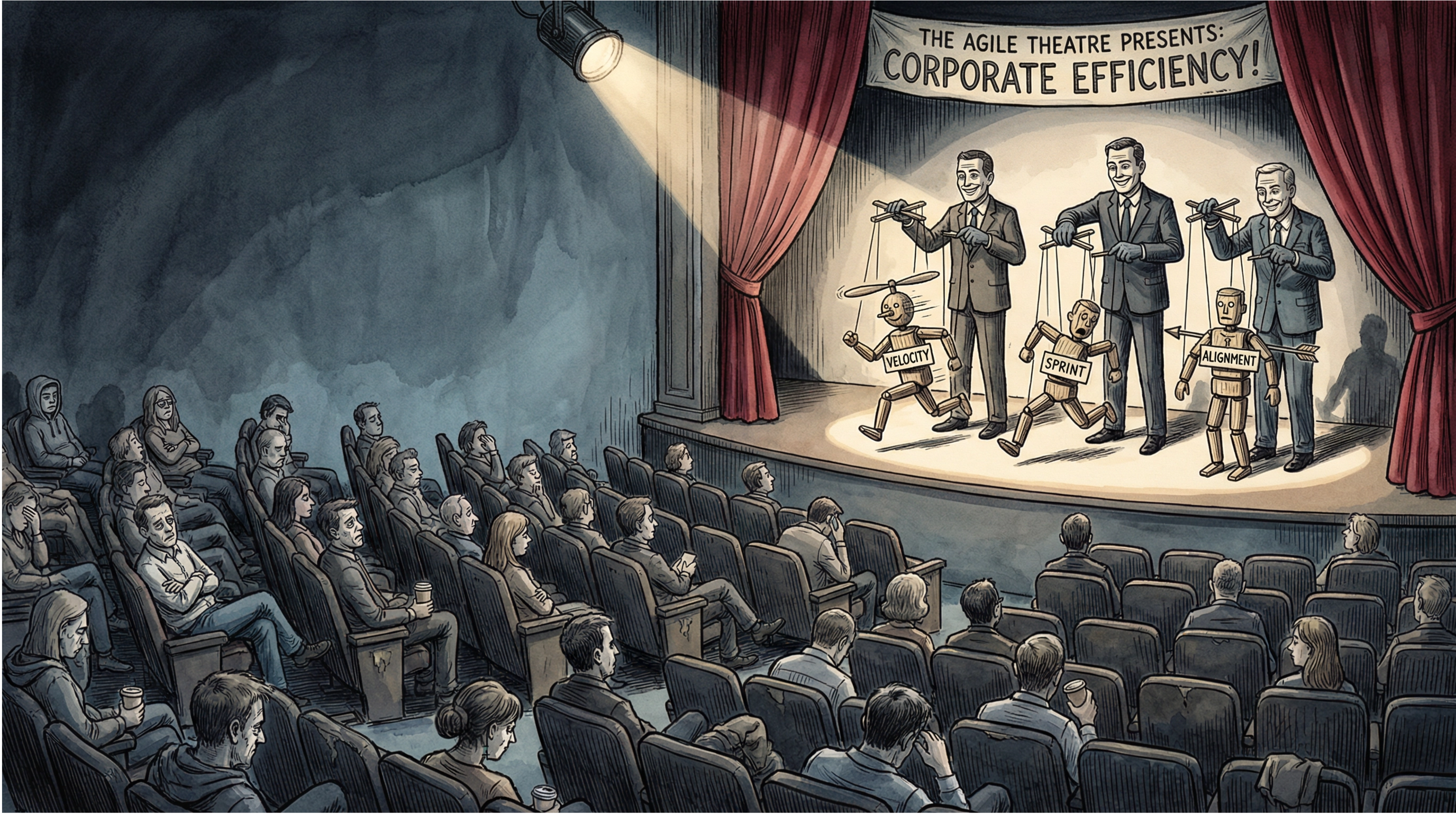
Risk Management Theater
There`s a specific moment every software developer knows. It`s not the deploy that fails at 5:58 PM on a Friday, or the sprint planning meeting that devours an entire morning. It`s subtler.
Get the next war story in your inbox
Independent essays and practical models about what the process claims versus what actually ships. Published under a protected pen name. Free, no spam, unsubscribe anytime.
No certifications sold. No process religion. Unsubscribe anytime.