Is a Scrum Master Certification Worth It in 2026?
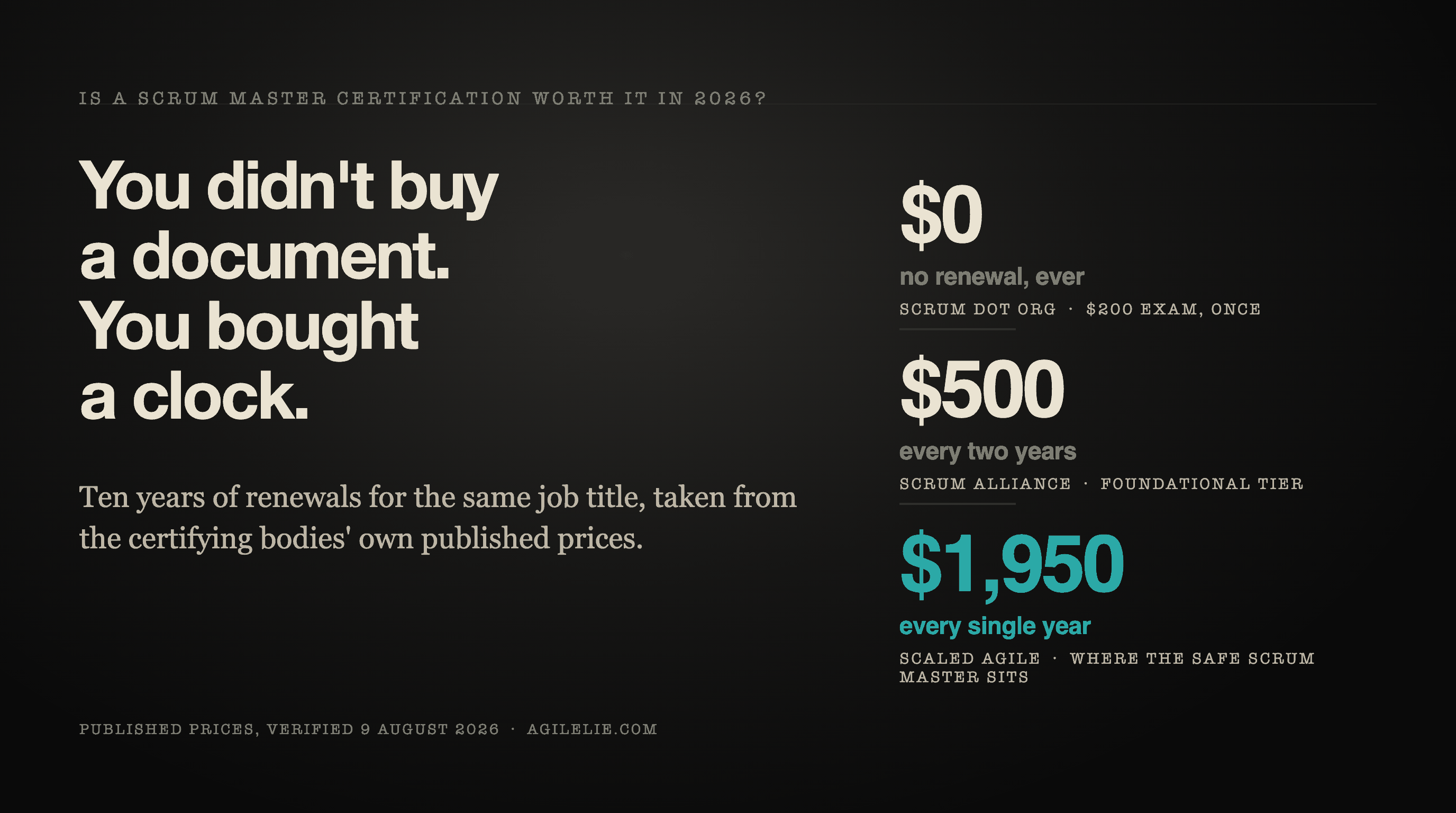
A Scrum Master certification is worth about one thing: clearing the keyword filter on a job application. It's a multiple choice exam, sometimes with a short course attached, not a demonstration of competence, and nobody can tell from the badge whether you can actually do the work. The 2026 prices, taken from the certifying bodies' own pages: Scrum.org charges $200 for the PSM I exam and states plainly on the page that it's a "Lifetime certification - no annual renewal fee required." Scrum Alliance certifications expire every two years, and renewal costs $100, $175, or $250 depending on the tier. Scaled Agile's expire every year, at $195 for the tier that holds the SAFe Scrum Master. So the real question isn't the sticker price. It's whether you bought a document or a subscription, and whether the market you're buying into is still hiring.
Everything after this is the part the people selling it can't put on their own page.
Almost Everyone Answering This Question Sells the Answer
Type "is a Scrum Master certification worth it" into a search bar and look at who's talking. The certifying bodies. Training partners whose entire revenue line is the two-day course. Consultancies that need certified bodies to staff engagements. Then a layer of forum threads and career posts, many written by people who paid for it recently and would rather it have been worth it.
None of that is dishonest. It's just that an organization whose income is the course is not a neutral witness about the course, and it never will be. The incentive doesn't need anyone to lie. It only needs the question to be answered by the seller.
I don't sell training. The only thing this article is selling you is arithmetic.
What You're Actually Buying: a Document or a Clock
The certification market looks like one product with different logos on it. It isn't. There are two completely different business models sitting under the same job title, and the difference costs you real money.
The one-time model. Scrum.org sells the exam directly. PSM I is $200 per attempt, PSM II is $250, PSM III is $500. The certification page says it outright: lifetime, no annual renewal fee. You pay once, you pass, you're done. You can buy training if you want it, but you're not required to.
The recurring model. (The full sticker-price table, from $69 to $2,495, is its own piece. This one is only about what happens after you pay it.) Scrum Alliance certifications run on a two-year cycle, renewed at $100, $175, or $250 by tier. Scaled Agile runs on a one-year cycle, in three tiers: $195 a year for the foundational tier where the SAFe Scrum Master sits, $295 for advanced, $995 for expert.
Put ten years on the calendar. Renewals only, one per cycle, counting the one that lands on the ten-year mark: five renewals on a two-year cycle, ten on an annual one. No course fees, no exam fee.
- Scrum.org: nothing. There is no renewal.
- Scrum Alliance, foundational: $500. Advanced and professional, $875 and $1,250.
- Scaled Agile, foundational: $1,950.
Put the exam back in and Scrum.org's whole decade is $200, paid once. Scaled Agile's renewals alone are almost ten times that, and that's before whatever it cost to get certified in the first place. Same role, same market, decided entirely by which logo you happened to walk into. If a credential's value came from what it certifies, that spread would be impossible. It comes from the renewal schedule, which is a different thing, and the longer version of that argument is the certification economy itself.
2026's Tell: They Repriced the Same Clock and Called It AI
Here's what happened this year, and it's the cleanest evidence I've seen that the clock is the product.
All three bodies now sell an AI course to the exact same audience. Scrum.org has PSM-AI Essentials, and the page says in plain words that it's for "Scrum Masters and Agile Coaches." Scrum Alliance sells AI for Scrum Masters at $75. Scaled Agile sells an AI-Empowered version of its certifications, including the SSM.
Read Scaled Agile's own FAQ on that upgrade. It's about 45 minutes of e-learning. It costs nothing if you already hold SSM 6. And the part worth reading twice: "you will only need to renew the AI-Empowered SSM certification going forward."
So the upgrade takes 45 minutes, costs zero, and moves you onto a renewal clock that ticks at the same rate for the same fee. The money didn't move and neither did the schedule. What changed is the noun printed on the badge.
If 45 minutes of e-learning is genuinely enough to make a certification "AI-empowered," then the AI content is thin. If it isn't enough, then the certification was already thin enough that 45 minutes could meaningfully change it. There's no third reading that helps the person paying.
Notice also what the offer reveals about who the customer is. Nobody builds a free, 45-minute, zero-friction upgrade to attract new buyers. You build that to keep existing subscribers from letting the clock run out. This is a retention product, and you are the subscription. It's the same mechanic that makes SAFe's business model work regardless of whether SAFe works.
They Can't Agree on How Many of You There Are
While checking the market size, I ran into something I didn't expect.
Scrum Alliance's About Us page says the organization represents "nearly 1.5 million professionals." Its 2025 annual report page says "nearly 1.8 million." Both pages were live at the same time when I checked on 9 August 2026. That's a 300,000 person gap in the single number an organization has the most reason to keep straight, published by that organization about itself.
I'm not going to pretend I know which one is right, and I'd be careful about anyone who claims to. But for your decision, the disagreement doesn't matter, because both answers point the same way. Read the wording, though. Neither page says how many people hold a certificate. They say how many professionals the organization represents, which is a different claim, and nobody in this industry publishes a certificate count you can audit. What the seller is willing to put in writing is a community in the millions, and it prints that number in order to look large. So take the seller at its word and follow it where it goes: whatever you're buying here, you are not buying scarcity. It's not a way to stand out in a stack of resumes. It's a way to not be filtered out of one, which is a much smaller thing, and it should be priced like a much smaller thing.
The Market You'd Be Buying Into
The strongest argument against paying for this in 2026 isn't philosophical. It's the demand side.
The title itself is thin on the ground. I.T. Jobs Watch, which tracks UK job ads by actual job title, recorded 15 permanent Agile Coach roles in the six months to August 2026. Fifteen, in half a year, across its whole UK sample. It's a sample and not a census, and I'll say that before someone says it for me. It's also a sample wide enough that the same tracker publishes a median salary off it, and that median is £80,000, which is doing much less work than it looks like it's doing: a healthy median across fifteen postings tells you what the surviving roles pay, not what your odds are of getting one. Coach is the senior title, not the entry one, but that's exactly the point. It's the rung the certification track is supposed to lead to.
The neighbouring category is down hard. Indeed's Hiring Lab tracks postings by sector, and UK "Project Management" postings sit about 59% below their March 2022 peak. I want to be precise about this one, because a lot of posts aren't: Indeed defines that sector in its own taxonomy as "project manager, program manager," and the words "scrum" and "agile" appear nowhere in that taxonomy. It's the adjacent title, not ours. It's a weather report for the coordination layer, not a measurement of your job. The bigger concession, which anyone checking my work finds in ten minutes: the whole UK market fell. Software development postings fell harder than project management did, and against every other sector in that dataset this one sits mid-pack. So if you came here for "they finally came for the Scrum Masters," the postings data doesn't say that and I won't pretend it does. It's a clock, not a census. What it tells you is when the money left this kind of work.
And the timeline doesn't fit the story you've been told. The convenient explanation for all of this is AI. But on the day ChatGPT launched, 30 November 2022, the American line in that same dataset was already 18.1% off its peak. Whatever started eating this class of work started before the thing everyone blames.
One company closed the category outright instead of shrinking it, and put the reason in writing. In January 2023, Capital One cut roughly 1,100 positions in its technology segment and eliminated what it called its "Agile job family," folding agile delivery into core engineering (Reuters). No reputable source breaks that number down by job title, so I won't either, and the public record stops at the decision. It doesn't say what happened to delivery afterwards, and I'd be making it up if I told you. What the bank wrote down is the shape of it. It didn't shrink the job family. It wrote the job family out. I went through that story in detail in the first long video on the channel, including why the AI explanation doesn't survive the dates.
Certification bodies sell you a credential for a role. They are not on the hook for whether the role is being hired. Nobody who sells you the badge is exposed to the market for it.
When It Is Actually Worth It
Three situations where the answer is yes.
Someone else is paying and it costs you two days. Take it. An employer-funded certification is free optionality. There is no argument against it, and anyone who tells you otherwise is performing.
You're coming in from outside and need to clear a filter once. This is the legitimate use case, and it's real. Plenty of recruiters and applicant tracking systems screen on the acronym. If that's your situation, buy the cheapest one that never expires, pass the exam, put it on the CV and stop. Under the numbers above, that's $200 and an afternoon. Don't buy a $2,000 course to sit a $200 exam unless you actually want the classroom.
Your employer or a client contract requires it. Then it's a procurement line item, not a career investment, and it should be argued about in a budget meeting rather than in your head at 11pm.
It is not worth it when you're funding it yourself as a career strategy, when you're stacking certifications as a signal, or when you're paying an annual fee to keep a badge alive for a title a national vacancy tracker found fifteen times in six months. And the certification will not fix the structural problem with the role, which is that it assigns responsibility for a team's effectiveness without granting any of the authority that affects it. No exam covers that. Whether the title is worth what it pays is its own separate question.
A useful test before you buy: name one decision from your last quarter that would have gone differently if you'd held the certificate. Not "I'd have understood the framework better." A decision, with a different outcome. If nothing comes, you're buying a filter key, and a filter key should cost filter-key money.
If You Already Have One
None of this is an argument about you.
Most people holding a CSM or a PSM got it because a manager asked, or a job ad demanded it, or it was the cheapest available door into a role they wanted. That's a rational response to how hiring works, and paying $200 to pass an exam isn't a character flaw. I've worked alongside excellent Scrum Masters with certifications and mediocre ones with the same certifications, which is the whole point: the badge doesn't predict either way, and it was never designed to.
My argument is with the pricing model, not the people paying it. Specifically with a design where the credential expires on a schedule the seller sets, renewal routes through the seller's own catalogue, and when a new technology arrives the response is a 45-minute module that changes the name on the certificate and leaves the invoice exactly where it was.
FAQ
Is a Scrum Master certification worth it in 2026? For clearing recruiter and ATS keyword filters, yes, and it's cheap if you buy a one-time certification and skip the optional course. As a career investment funded out of your own pocket, mostly no: the certifying bodies advertise communities in the millions, so it signals nothing scarce, and the roles it points to are contracting. If an employer pays, take it.
How much does a Scrum Master certification cost? The exam itself is the small number. Scrum.org charges $200 for PSM I, $250 for PSM II and $500 for PSM III, with no renewal fee. Scrum Alliance renews every two years at $100, $175 or $250 by tier. Scaled Agile renews annually at $195, $295 or $995 by tier, with the SAFe Scrum Master in the $195 band. Courses are extra and usually cost several times the exam.
Do Scrum Master certifications expire? It depends entirely on the body. Scrum.org states its certifications are lifetime with no annual renewal fee. Scrum Alliance runs a two-year renewal cycle. Scaled Agile runs an annual one. Over ten years that difference is worth roughly $200 versus roughly $1,950 in renewal fees alone.
Can you get a Scrum Master job without a certification? Yes, and it happens constantly, especially for internal moves where people already know your work. The certification matters most at the cold-application stage, where a screen or a system is filtering on keywords and nobody has any other information about you.
Do employers actually care about Scrum Master certification? Recruiters and screening systems care, because they need a filter. Hiring managers and teams mostly care about whether you can remove a real obstacle, hold a difficult conversation with a stakeholder, and follow a technical discussion without stalling it. No exam tests any of those.
Is the AI-Empowered certification worth it? Scaled Agile's AI-Empowered SSM upgrade is about 45 minutes of e-learning and costs nothing if you already hold SSM 6, so there's no financial reason to skip it. Just be clear about what it is. Per Scaled Agile's own FAQ, you then renew the AI-Empowered certification instead of the old one, on the same schedule at the same price. It's a rename with a module attached, not a new qualification.
Which Scrum Master certification should I get? The two mainstream options run on genuinely different money models, one lifetime and one renewing, which matters more over ten years than any difference in the syllabus. That comparison deserves its own article and it's coming.
Benjamim Castell writes about the distance between process as promised and delivery as practiced.
If you want the long version of who profits from all this, and how a 14-page framework became a subscription, it's in The Certification Economy.
I publish the pricing math and the market data behind pieces like this at benjamimcastell.substack.com. No course, nothing to buy.
Common questions about certification cost
- Does a Scrum Master certification expire?
- It depends entirely on who sold it to you. PSM I from Scrum.org is stated on its own certification page as a lifetime certification with no annual renewal fee required. Certified ScrumMaster from Scrum Alliance runs on a two year renewal cycle. SAFe Scrum Master from Scaled Agile renews every year. Same job title, three different answers.
- How much does it cost to renew a Scrum Master certification?
- Scrum Alliance renews every two years and charges $100 at the foundational tier, $175 and $250 at the tiers above it, and also requires continuing education units. Scaled Agile renews annually, $195 for the tier that carries SAFe Scrum Master and $995 for the Expert tier. Scrum.org charges nothing to keep PSM I.
- Which Scrum Master certification has no renewal fee?
- PSM I from Scrum.org. Its certification page states in writing that it is a lifetime certification with no annual renewal fee required. The exam is $200 per attempt and there is no recurring cost after that.
- Is the exam fee the real cost of a Scrum Master certification?
- No, and this is the part candidates underestimate. The exam fee is what gets quoted. The renewal clock is what gets paid repeatedly. Over ten years a credential with an annual renewal costs multiples of its sticker price, while one with no renewal clock costs what you paid once.
Keep reading
Scrum Master Certification Cost 2026: Fees and Renewals
Compare Scrum Master certification costs: PSM I $200 per attempt, CSM course pricing, SAFe exam options, and the fees and learning requirements to renew.

Scrum Master Salary Data 2026: Is $120K Justified When Developers Do The Real Work?
2026 Scrum Master salary data across US/Europe reveals $80K-$140K for non-coding roles. Are these positions worth it? Engineering managers share the truth.

SAFe Doesn`t Need to Work: The Business Model Behind Agile`s Most Profitable Framework
Private equity paid ~$300M for Scaled Agile Inc. PE doesn`t buy methodologies, it buys recurring revenue. Follow the incentives and SAFe`s failure rate stops being a mystery.
What will that certification cost you by 2036?
A proposed decision guide for comparing ten-year renewal costs. It is not built; $39 is a test price and nothing is for sale.
Review the $39 conceptProposed price only. No payment is collected. No certification or training is sold here.
Get the next war story in your inbox
Independent essays and practical models about what the process claims versus what actually ships. Published under a protected pen name. Free, no spam, unsubscribe anytime.
No certifications sold. No process religion. Unsubscribe anytime.