
SAFe Doesn`t Need to Work: The Business Model Behind Agile`s Most Profitable Framework
I've seen SAFe rollouts across large organizations. Different consultants. Identical launch: a rented conference hall, a hundred people, two days of catered lunches, and colored string connecting sticky notes on a wall the RTE photographed for the leadership deck.
Three rollouts. And at the end of year two, the same question, asked quietly, in three different buildings: are we shipping faster than before?
Nobody could answer it. Not the consultants. Not the RTE. Not the VP who bought the whole thing. There were dashboards everywhere, Program Predictability charts, PI burn-downs, but nobody could point at a customer and say "they got working software sooner because of this."
For years I assumed that was a bug. Then I found the number that reframed everything.
In November 2021, the private equity firm Eurazeo and its partners invested roughly $300 million to acquire Scaled Agile, Inc., the company behind SAFe.
Private equity does not pay nine figures for a methodology. It pays nine figures for recurring revenue. Predictable, growing, defensible cash flow.
So stop asking "does SAFe work?" Ask the question the deal answers: what recurs?
Private Equity Doesn't Buy Methodologies
Not your agility. Your agility, if it ever arrived, would end the engagement.
What recurs is the annual certification renewal, $195 at the foundational tier where the Scrum Master sits, $295 above it, $995 at the top. Per person. Per year. Across a catalog of more than 20 certification tracks, a catalog that grows every time a new role gets invented. What recurs is the next course when your "transformation" stalls. The SAFe Program Consultants who pay for the license to teach. The tooling partnerships wired into your Jira instance. The new framework version on a reliable cadence, resetting the training clock for everyone already holding a certificate.
By recent industry estimates, roughly 37% of large enterprises running an agile transformation use SAFe. That's not a community of practice. That's an installed base. And installed bases are what you sell to private equity.
None of this is hidden. The renewal pricing is on Scaled Agile's own membership page. The deal was in the press releases. The only thing missing is anyone in the sales meeting connecting it to the question you actually care about: will this make us better at shipping software?
It doesn't have to. That's the point.
The Only Framework Whose Buyer Isn't Its User
Here's the feature of SAFe nobody audits: it's the only agile framework whose primary customer is not the people who will live inside it.
Scrum, for all its problems, and I've cataloged plenty, was at least pitched at teams. SAFe is pitched at the enterprise program office. Look at the Big Picture diagram, the famous one with the trains, the epics, the portfolio level, the lean budgets. It is not a picture of how software gets built. It's a picture of how an org chart wishes software got built: every existing layer of management mapped onto new vocabulary, nobody's authority actually threatened.
That's not a design flaw. That's the value proposition.
An executive can buy "agile transformation" complete with roadmaps, governance layers, and quarterly planning while changing almost nothing about who decides what. Ken Schwaber, Scrum's co-creator, saw it coming in 2013 and wrote a post titled "unSAFe at any speed," calling the framework a repackaging of the old process industry. Jeff Gothelf later published the blunter version: "SAFe is not agile."
The insiders said it first. The market didn't care, because the market for SAFe was never the people reading Schwaber and Gothelf.
Adaptability threatens hierarchies. SAFe sells the version of adaptability a hierarchy can approve. Once you see that, its dominance stops being confusing and starts being obvious.
The PI Planning Tax
Regular readers know I like to price the ceremonies. So let's price SAFe's flagship ritual, the one repeated across SAFe implementations.
PI Planning: a two-day, all-hands planning event for an Agile Release Train, typically 50 to 125 people, every 8 to 12 weeks. Take a conservative mid-size train:
| Input | Conservative estimate |
|---|---|
| People on the ART | 100 |
| Fully loaded cost per person-day | $800 |
| Days per event | 2 |
| Cost per event | $160,000 |
| Events per year | 5 |
| Direct cost per ART, per year | ~$800,000 |
That's one train. Before travel for distributed teams. Before the prep weeks, "pre-PI planning" is a real SAFe artifact, I promise. Before the ART syncs and Scrum of Scrums between events. Before the RTE salaries. A five-train enterprise burns several million dollars a year on synchronized planning before a single line of code moves.
And what does the money buy? A committed 10-week plan with dependency spreadsheets. Fixed scope, fixed dates, big up-front planning. The thing agile was invented to escape. Waterfall in disguise, now with lanyards and catered lunch.
Is coordinating 100 people a real problem? Absolutely. But watch the shape of SAFe's answer: it manages dependencies with events and roles instead of removing them with architecture and team boundaries. Managed dependencies need facilitators, trainings, and tooling forever. Removed dependencies generate no revenue for anyone.
Guess which solution comes in the box.
Show Me One Number
Strip away the case studies published by Scaled Agile itself, which are marketing assets, selected and framed by the vendor, and the independent evidence base for SAFe is startlingly thin for a framework running inside a third of large enterprises.
What independent signal exists points the other way. SAFe Delusion, a community evidence project maintained by veteran practitioners, has spent years aggregating case reports and expert analysis. Its summary: SAFe implementations consistently miss key elements of effective agile practice, reinforce pre-agile legacy behaviors, and institutionalize suboptimal approaches at scale. It also documents something the job boards confirm: experienced practitioners, including SAFe-certified ones, increasingly decline SAFe-shop roles based on prior experience.
Meanwhile the 18th State of Agile report shows 63% of organizations struggling to deliver reliable software, up 12 points in a year, and 75% under pressure to prove the ROI of their agile spend. This after a decade in which SAFe was the dominant enterprise framework.
And then there's the part no vendor puts in the deck. In January 2023, Capital One eliminated around 1,100 technology roles in what it called its agile job family, and said it was folding agile delivery into its engineering practices. What happened to delivery afterwards nobody outside the company has published, and I'm not going to pretend I know. But you don't need that number to read the decision. A bank that size does not remove a whole category of role it believes is holding up the output. The people paying for the apparatus made a judgement about what it was producing, and that is the only vote that was ever binding.
In one SAFe rollout, I asked the RTE a version of this question: which of our delivery metrics improved since launch? He showed me Program Predictability. Whether teams hit the PI objectives they wrote themselves, in a room, under pressure to fill the board. Motion, measured beautifully. Not one number about customers, lead time, or quality.
That wasn't his fault. It's all the framework gave him to show.
Failure Is the Growth Engine
Now the standard defense arrives, and you already know it, because it's the same one Sutherland gave for Scrum's 65% failure rate: you implemented it wrong.
Notice what this defense does. It makes the framework unfalsifiable. Success proves SAFe works. Failure proves you need more SAFe, another course, a proper SPC, a relaunch of the trains, a Phase 2. There is no observable outcome, none, that counts as evidence against the product.
In science, that's called pseudoscience. In business, it's called a genius revenue model.
Every failed adoption is a qualified lead.
This is the deepest structural fact about SAFe-the-business, and it's the one the $300 million understood perfectly: the framework's revenue is positively correlated with its own dysfunction. A team that becomes adaptive stops buying courses. An organization that removes its dependencies stops needing dependency-management ceremonies. Actual success shrinks the market. So the rational product strategy, the one any PE-owned training company gets pushed toward, is perpetual near-success: enough visible activity to justify renewal, never enough finality to end the engagement.
The consultant industrial complex discovered this model years ago. SAFe industrialized it and put trains on it.
Let me be fair, because the people deserve it even when the model doesn't. The SAFe trainers and RTEs I've worked with were sincere professionals. And buried in the framework are real ideas: planning on a cadence, making dependencies visible, giving a 5,000-person company some shared vocabulary. The critique isn't of individuals, and it isn't even of every practice. It's of a commercial structure in which nobody with pricing power benefits from you graduating.
The Four Questions I'd Ask Before Signing
If SAFe is being pitched to your organization this quarter, you don't need a rival framework. You need four questions.
Ask for falsifiable references. Five customers, three years post-adoption, with delivery metrics, lead time, deploy frequency, escaped defects, measured by someone the vendor doesn't pay. Watch what happens. If the pitch retreats to testimonials and maturity models, you have your answer.
Price the ceremony budget first. Run the PI Planning Tax on your own headcount before you sign anything. Then ask what that money buys as platform engineering, as paying down the integration debt that created the coordination problem, or as smaller, fully staffed teams that don't need synchronized planning at all.
Fix the dependency graph, not the meeting calendar. Most "we need to scale agile" pain is actually "our architecture forces twelve teams to touch one release." That's an engineering problem. It has engineering solutions. SAFe charges rent to manage the symptom.
Descale before you scale. The truth the scaling market cannot say out loud: you can't scale a team practice. You can only shrink the number of people who must agree before value ships. Every large-org delivery success I've seen, and I've written about what they have in common, was a descaling story wearing different clothes.
SAFe will keep growing for a while regardless. Frameworks with $300 million behind them don't die because the evidence is thin. They die when executives stop getting promoted for buying them. That day is closer than it was: 74% of organizations now report hybrid or homegrown approaches, which is the industry's polite way of admitting the boxed frameworks didn't deliver.
Until then, hold on to the only question no Big Picture diagram answers, the one nobody in those rollouts could answer:
After all the trains, ceremonies, and certifications — did working software reach a customer faster?
If nobody can show you that number, you didn't buy agility. You bought the appearance of it. On an annual renewal.
Benjamim Castell writes about the distance between process as promised and delivery as practiced.
Most of them were trapped in what I call Risk Management Theater and didn't even know
Keep reading

Agile Certification Economy: Follow the Money
The Agile certification industry generates $49B annually, yet Scrum`s inventor admits a 65% failure rate. Follow the money and see why the system extracts revenue, not value.
What Is SAFe? The Honest Definition of the Scaled Agile Framework
SAFe is the most adopted framework for "scaling agile" in large enterprises, and the most profitable. Here`s what it actually is, how it`s supposed to work, and what it becomes inside real companies.
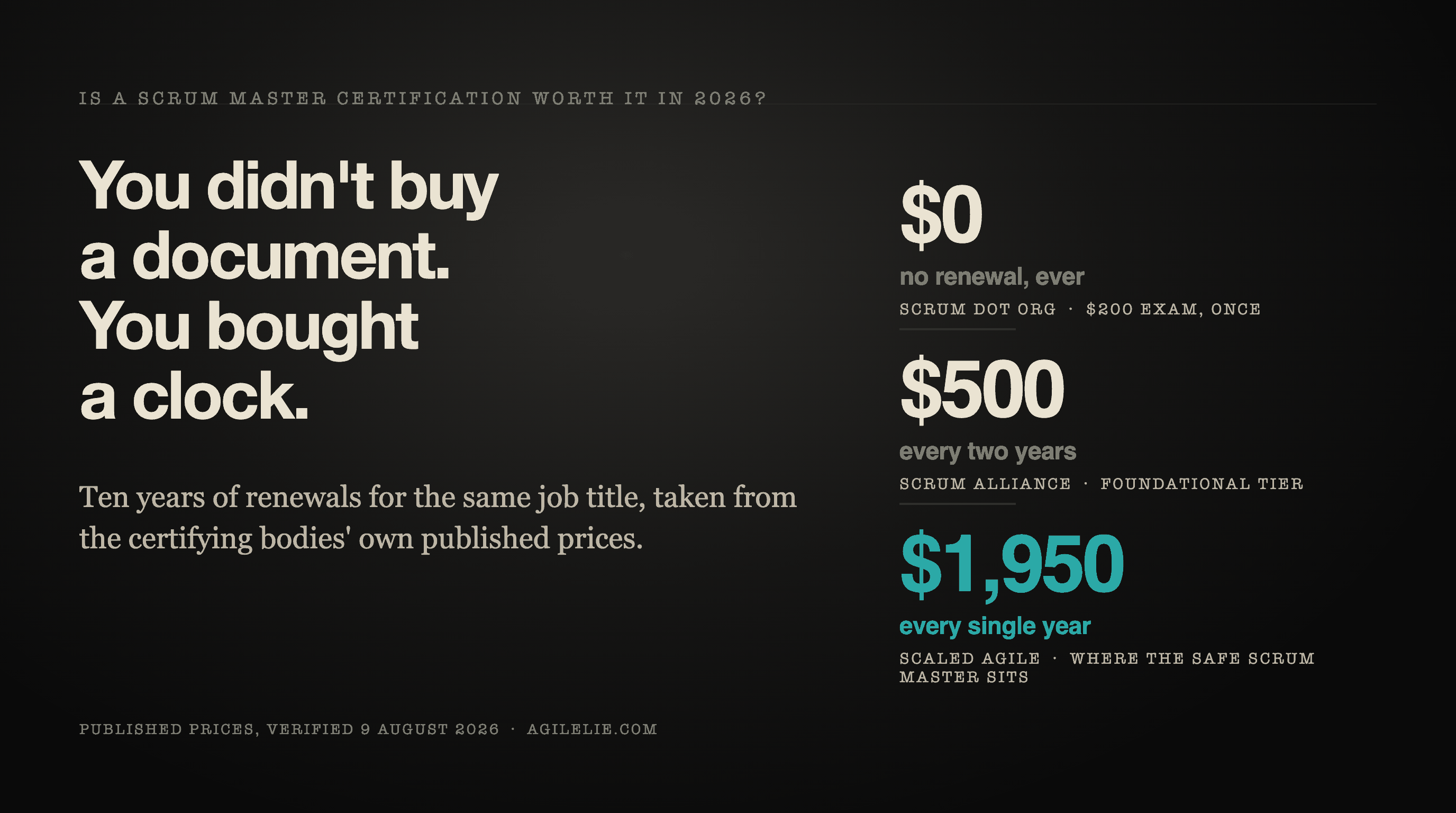
Is a Scrum Master Certification Worth It in 2026?
One body charges $200 once and calls it a lifetime certification. Another charges $195 every year, forever. Here is what the badge actually buys, what it actually costs, and what the 2026 job market is paying for it.
Get the next war story in your inbox
Independent essays and practical models about what the process claims versus what actually ships. Published under a protected pen name. Free, no spam, unsubscribe anytime.
No certifications sold. No process religion. Unsubscribe anytime.