Scrum Master Certification Cost 2026: Fees and Renewals
PSM I costs $200 per attempt. CSM requires a separately priced course. SAFe Scrum Master has a $495 proctored-exam option plus tax, without a mandatory course. International Scrum Institute advertises SMAC at $69. Those are different routes, not interchangeable qualifications.
The entrance price is only the first question. The second is what you must pay and do to keep the credential active. A course invoice, an exam attempt and a renewal bill should not share one misleading “certification cost.”
Prices and policies checked September 7, 2026, against the issuing bodies' pages linked below. Amounts are in USD. Taxes, currency conversion, optional study materials and travel can change your total. Recheck the relevant offer before paying.
How Much Does a Scrum Master Certification Cost?
| Credential | Getting it | Keeping it |
|---|---|---|
| PSM I — Scrum.org | $200 per exam attempt; course optional | Lifetime credential; no annual renewal fee |
| CSM — Scrum Alliance | Required course; trainer sets the price | $100 and 20 SEUs every 2 years at the foundational tier |
| SAFe Scrum Master — Scaled Agile | $495 plus tax for the proctored-exam route; course-route prices vary | Studio tier page lists $195/year plus tax for foundational credentials including SSM; check the cycle note below |
| SMAC — International Scrum Institute | $69 for exam and certification; no mandatory classroom course | Issuer states lifetime validity and no renewal fees |
These are selected credentials, not a complete market ranking. The sources establish what the issuers charge or claim. They do not establish equal employer recognition or a salary return.
PSM I: $200 per attempt, not an unlimited exam subscription
Scrum.org's PSM I page lists the exam fee, says course attendance is optional, and describes the credential as lifetime with no annual renewal fee. A purchased test password is valid for one attempt.
For a self-study candidate who passes first time, the exam charge is $200 before applicable taxes. A paid class or another attempt changes that calculation. No renewal fee does not mean no time spent learning.
CSM: get a course quote, not a recycled price range
Scrum Alliance says its independent trainers set their own course prices. Its CSM overview still displays a $250–$2,495 range, but explicitly dates that range to October 2023. That is not a verified September 2026 market range.
The organization also announced minimum advertised pricing changes effective September 1, 2026. An advertised-price policy is not a quote for your course.
The CSM test policy requires an approved 16-hour course. It includes two test attempts within 90 days of the welcome email; after two failures or that deadline, further attempts cost $25 each.
For renewal, CSM is foundational: 20 Scrum Education Units and $100 every two years. The $175 and $250 renewal fees belong to higher certification levels, not three alternative prices for the same CSM.
SAFe Scrum Master: distinguish the exam route from the course route
The SSM certification page offers a proctored exam without mandatory training. Scaled Agile's proctored-exam FAQ lists $495 plus tax, including two attempts within 60 days. If you choose a class, the provider sets its price.
For ongoing costs, the Studio tier page, dated June 23, 2026, places SSM in the $195/year foundational tier, plus applicable tax.
Check the certification cycle separately. The SSM page describes 24 CEUs over a two-year certification cycle, or 12 annually. The renewal CEU FAQ lists 12 CEUs for SSM. Do not turn an annual Studio price into an assumed expiration date for every credential version. Confirm your expiry and renewal terms with Scaled Agile.
There is also a mismatch in the published proctored-retake prices: the SSM exam details show $450, while the proctored-exam FAQ says another $495 purchase. Get confirmation before budgeting a third attempt. This comparison does not resolve contradictory vendor pages by choosing the cheaper number.
What Is the Cheapest Scrum Master Certification?
Among the options listed here, International Scrum Institute's SMAC has the lowest advertised initial charge: $69. The issuer says it requires no classroom course and has no renewal fee.
That is a price comparison, not proof that SMAC clears a job requirement naming CSM or PSM I. Ask which credential is actually accepted before buying a cheaper acronym.
The same issuer advertises a 98% exam success rate. Without a disclosed cohort and methodology, that number does not tell us how well the exam predicts performance at work. A high pass rate alone proves neither competence nor fraud.
What You Are Actually Buying
A class can teach something useful. An exam can test knowledge. Renewal can include access to resources and continuing education. None of those is the same thing as evidence that your organization will make better decisions.
My objection is to the substitution: a company funds a badge, calls the team empowered, and leaves budget, scope and deadlines beyond that team's authority. The team gets responsibility for delivery. The people controlling the constraints remain outside the measurement.
That is where Agile can become executive cover. The certificate is visible. The decision that made the commitment impossible is not.
Renewal fees are a recurring cost for the holder and revenue for the issuer. That does not, by itself, prove the training is worthless. It does mean the buyer should ask what continuing value justifies the next payment. The broader argument sits in Why SAFe Fails and The Agile Certification Economy.
When Paying for a Certification Makes Sense
Start with a concrete requirement, not a promise of career protection.
- If a role names a credential, confirm the exact issuer and level accepted.
- Ask whether an employer will reimburse the course, exam, retakes and renewals.
- Separate the learning you want from the credential you need.
- Compare the full cost over the period you expect to keep it active, including your time.
- Ask what authority comes with the role: who can change scope, capacity or the delivery date?
A certificate cannot answer that last question for you. Neither can a delivery dashboard. The Moving Card Is Not Value Delivery examines that substitution; What Actually Ships Software develops the alternative.
Whether buying a badge is worthwhile is a separate argument in Is a Scrum Master Certification Worth It?. For a discussion of compensation, see Scrum Master Salary Data 2026; do not treat a role's salary as the return caused by its certificate.
The useful question is not just “How cheaply can I get certified?” It is “What does this payment buy, what continues to cost me, and what problem will still be mine afterwards?”
Common questions about certification cost
- How much does a Scrum Master certification cost in 2026?
- PSM I is $200 per attempt before applicable taxes. CSM requires a course whose price is set by the trainer. SAFe offers a $495 proctored-exam route plus tax without mandatory training. International Scrum Institute advertises SMAC at $69. These are selected options, not interchangeable credentials. Sources were checked September 7, 2026 and are linked in the article.
- How much does it cost to renew a Scrum Master certification?
- CSM requires $100 and 20 SEUs every two years at the foundational level. PSM I has no annual renewal fee. Scaled Agile lists SSM in its $195/year Studio tier plus tax, but the SSM page describes a two-year certification cycle and 24 CEUs. Check your credential version and expiry separately; an annual Studio fee is not a universal expiration rule.
- Which Scrum Master certifications have no renewal fee?
- Scrum.org describes PSM I as lifetime with no annual renewal fee. International Scrum Institute also states lifetime validity and no renewal fees for SMAC. That does not establish equal employer recognition or remove the cost of preparation.
- Is the lowest exam price the lowest total cost?
- Not necessarily. Compare required training, included attempts, retakes, taxes, renewal fees and learning requirements. Check which credential the employer accepts before treating a cheaper certificate as a substitute.
Keep reading
Is a Scrum Master Certification Worth It in 2026?
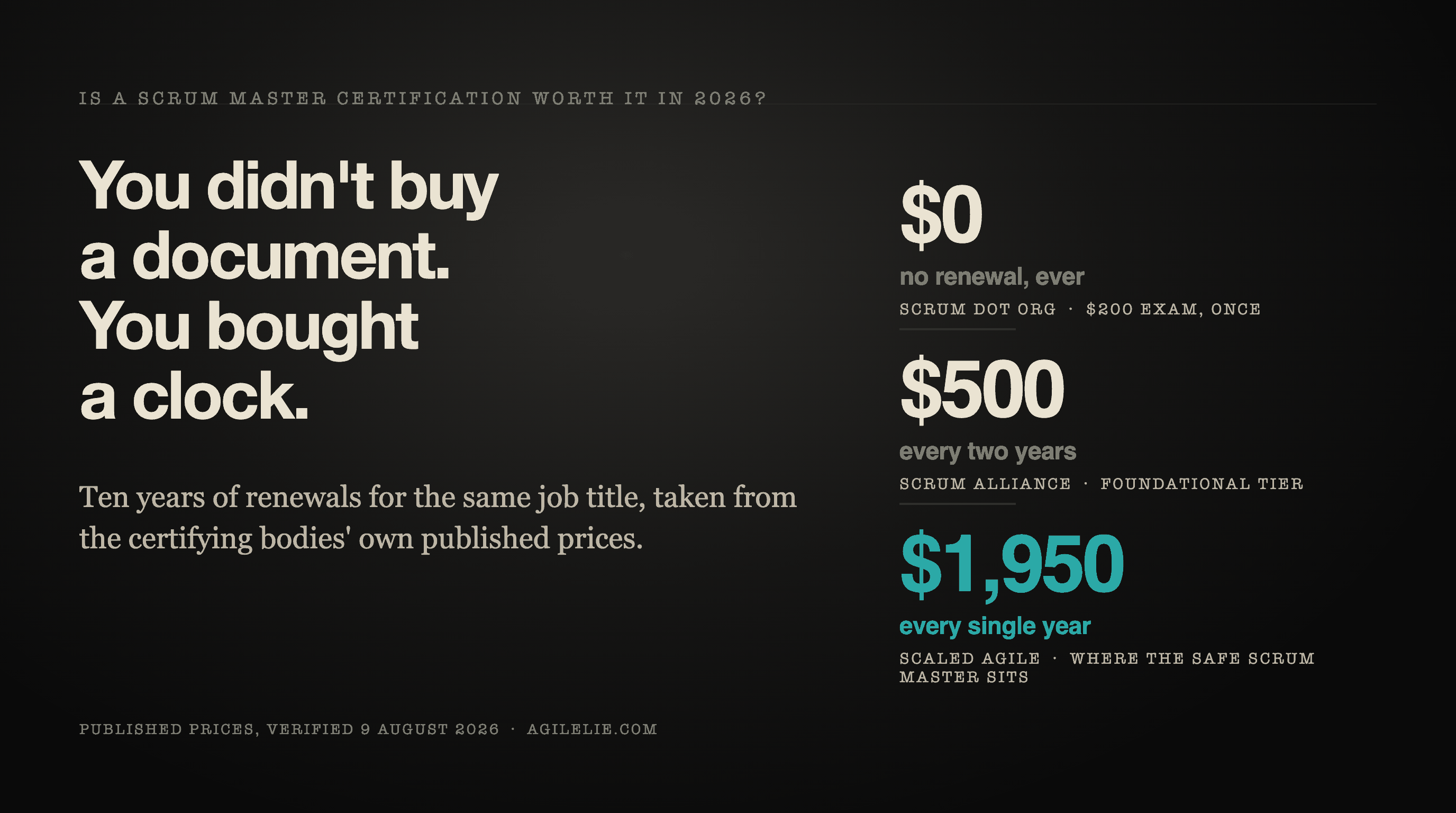
One body charges $200 once and calls it a lifetime certification. Another charges $195 every year, forever. Here is what the badge actually buys, what it actually costs, and what the 2026 job market is paying for it.

Scrum Master Salary Data 2026: Is $120K Justified When Developers Do The Real Work?
2026 Scrum Master salary data across US/Europe reveals $80K-$140K for non-coding roles. Are these positions worth it? Engineering managers share the truth.

SAFe Doesn`t Need to Work: The Business Model Behind Agile`s Most Profitable Framework
Private equity paid ~$300M for Scaled Agile Inc. PE doesn`t buy methodologies, it buys recurring revenue. Follow the incentives and SAFe`s failure rate stops being a mystery.
Compare renewal terms before you decide.
See the free, sourced table of selected certification fees and renewal terms. The proposed $39 decision guide is not built and nothing is for sale.
Compare the published renewal terms →Proposed price only. No payment is collected. No certification or training is sold here.
Get the next war story in your inbox
Independent essays and practical models about what the process claims versus what actually ships. Published under a protected pen name. Free, no spam, unsubscribe anytime.
No certifications sold. No process religion. Unsubscribe anytime.