

How to Calculate Story Points in Agile (and What the Formula Is Hiding)
Story points measure the relative size of a work item: effort, complexity, and uncertainty combined. There is no formula. You calculate them by comparison, not arithmetic. Here is the method most Scrum teams actually use:
- Pick a reference story. Find a small, well understood task the whole team has done before. Call it a 2.
- Use the Fibonacci scale: 1, 2, 3, 5, 8, 13, 21. The gaps widen on purpose, because precision falls apart as work gets bigger.
- Compare against the reference. For each backlog item, ask whether it is bigger or smaller than your baseline, and by roughly how much.
- Run planning poker. Everyone picks a number in private and reveals at the same time. The highest and lowest estimates explain their reasoning, then everyone votes again until the numbers converge.
- Derive velocity. Add up the points completed each sprint. After three or four sprints, the average becomes your planning number.
That is the whole method, and it is more honest than most of the pages ranking for this query.
Now the part those pages will not tell you. The fact that you had to search "how to calculate story points" is itself the diagnosis. The metric was designed so you would never need a formula. You need one anyway. Sit with that for a second, because everything below follows from it.
What are story points in Scrum supposed to be?
Story points were invented to escape hour estimates. The reasoning was sound. Developers are terrible at guessing absolute time and reasonably good at comparing two pieces of work. So the industry replaced "this will take three days" with "this is a 5", an abstract unit that was supposed to absorb uncertainty instead of hiding it.
The abstraction had a second job: protection. An hour estimate becomes a commitment the moment a manager hears it. A point, in theory, cannot be put in a calendar. That was the pitch. Points would keep guesses from turning into deadlines.
Experience with complex delivery taught me how long that protection lasts in a real organization. About one steering committee meeting.
Is 1 story point equal to 1 day?
No. Officially, a story point equals nothing. It is a relative unit with no time dimension, and every certified trainer will tell you exactly that.
Unofficially, every team I have ever worked with carried a conversion table in its collective head. Nobody writes it down. Everybody uses it.
| What the team says | What everyone is thinking |
|---|---|
| 1 point | An hour or two |
| 2 points | Half a day |
| 3 points | About a day |
| 5 points | Two or three days |
| 8 points | Most of a sprint week |
| 13 points | We should split this |
The table forms because the questions coming at the team are time questions. "When will it be done?" cannot be answered in points, so every developer quietly maintains the exchange rate in their head.
The moment that table exists, the abstraction is dead. You are estimating hours while wearing a costume, and you are paying twice: once to translate the work into points, and again when someone downstream translates the points back into dates.
Why is everyone trying to convert story points to hours?
Look at the search data. Google Trends, last seven days, United States: "how to calculate story points in agile" is a breakout query. "Story points in scrum" is up 90 percent. "What are story points in agile" is up 50 percent. And the questions Google surfaces next to them are "story points vs hours", "is 1 story point equal to 1 day", and "jira story points to hours".
Nobody searches for a conversion guide when an abstraction is working. There is no breakout query for "how to convert meters to real distance". A unit that needs a translation layer to be useful has already failed at its one job.
The pressure driving those searches comes from above, not from the teams. The 18th State of Agile report found 75 percent of organizations under pressure to prove ROI, and 63 percent struggling to deliver reliable software. ROI reports do not accept fantasy units. Somewhere between the sprint board and the board room, someone has to turn points into hours and dollars. That someone is googling right now.
How do Jira story points map to hours?
They do not, officially. Jira gives you a story points field and a separate time tracking field, and takes no position on their relationship.
In practice, most PMOs take a position for it. Velocity gets exported into a spreadsheet, multiplied by a "capacity factor" denominated in hours, and turned into the exact hour based plan that story points were invented to prevent. If that spreadsheet exists anywhere in your organization, you are already an hours shop. Admitting it costs nothing and saves the poker time.
What does calculating story points actually cost?
Run the ledger for a two-week sprint on an eight-person team. Ninety minutes of backlog refinement. Two hours of sprint planning with poker. Half an hour re-estimating carryover. The clarification churn every time an estimate turns out to be wrong, which is often, because estimates are guesses.
That lands at 4 to 6 hours per developer per sprint. Compound it across the team for a year and you get 1,600 to 2,500 hours. At a loaded cost of $100 an hour, a conservative planning number for senior engineers, that is $160,000 to $250,000 a year.
One full engineering salary. Spent producing numbers that a spreadsheet will convert back into hours anyway.
The daily standup has the same disease: a ritual so small per occurrence that nobody invoices it, and so frequent that it quietly eats a headcount.
Who profits when guessing needs a syllabus?
You cannot sell "count your finished work". There is no course in it. You can absolutely sell a method with special numbers, a card game, and a certificate at the end.
| Credential | Vendor | Listed price (Aug 2026) |
|---|---|---|
| CSM | Scrum Alliance, via training providers | $250 to $2,495 |
| PSM I | Scrum.org | $200 per attempt |
| Scrum Master Accredited Certification | International Scrum Institute | $69 |
That last row deserves a pause. The International Scrum Institute advertises a 98 percent pass rate and a money-back guarantee. When a professional credential is priced like a video game and guaranteed like a mattress, you are not buying knowledge. You are buying laminated permission to run estimation meetings.
Jeff Sutherland, co-creator of Scrum, has admitted a 65 percent failure rate for agile transformations. The certificate pipeline did not slow down. It never does, because the certification economy gets paid on enrollment, not on outcomes.
What happens when velocity becomes a target?
Goodhart's law: when a measure becomes a target, it stops being a measure. The instant a velocity chart appears in a steering deck, it is a target.
Then the gaming starts, and I say this with some affection, because the gaming is rational. Yesterday's 3 becomes today's 5, and velocity "improves". A 13 gets split into two 8s and the chart shows growth. Teams sandbag estimates before review season and burn the slack when nobody is watching.
Compliance work teaches one law before any other: every control you can name, you can game. Financial crime analysts have a word for deposits made to slip under a reporting threshold. They call it structuring. A 13 split into two 8s to keep the velocity trend smooth is the same move with smaller stakes, and at least the control owner knew the threshold was arbitrary.
Nobody on the team is lying, exactly. The metric taught them the exchange rate. And a board full of inflated cards sliding right on schedule is motion, not value.
Two teams, one steering committee
A war story, with the serial numbers filed off.
Two teams in the same program, reporting to the same steering committee. Team A estimated beautifully. Reference stories, calibrated poker, velocity charts with confidence intervals. Team B estimated badly and knew it, so they compensated the only way that works: they demoed running software every Friday, whatever state it was in.
Every quarter, Team A got beaten up. Their precise numbers read as commitments, so every slip read as a failure. The precision they manufactured was used against them.
Team B almost never discussed dates. The committee had watched their software grow for twelve consecutive Fridays. When Team B said "three more weeks", they got three more weeks, no chart required.
Nobody asks for story points after a demo. Trust is built by delivering, not by estimating well, and no scale, Fibonacci or otherwise, changes that.
The honest alternative: count what you finish
"We finish about 12 items every 3 weeks" is data. "Our velocity is 34" is astrology with a Jira license.
Throughput, the plain count of items your team completes per cycle, requires no ceremony and no calibration training. It is sitting in your ticket history right now. Unlike points, it does not inflate, because you cannot argue a finished item into being two finished items.
When management needs a date, give them the historical spread instead of a converted guess:
| Your last six cycles shipped | Forecast for a 60-item milestone |
|---|---|
| 9, 12, 11, 14, 10, 13 items per 3 weeks | Best case ~13 weeks, likely ~16, worst ~20 |
That is a forecast a CFO can use. It took five minutes, and it gets sharper every three weeks as new data lands.
If you suspect nobody would miss the points layer, look at what the market has been willing to cut. In January 2023, Capital One eliminated around 1,100 technology roles in what the bank called its agile job family. Nobody has published what happened to delivery afterwards, so I won't claim it. What is on the record is which class of work turned out to be negotiable, and the shipping class never is.
When do story points still make sense?
An honest concession, because the ritual does contain one real thing.
When a senior engineer says 3 and a junior says 13, that gap is information. Somebody knows about the legacy auth flow and somebody does not. The argument that follows surfaces hidden complexity better than any document, and teams that skip it ship surprises instead.
So keep the argument. Throw away the number. Discuss the work and split anything that scares you. Let the conversation end without a Fibonacci verdict. If a contract or a PMO literally requires point burndowns, fill in the field and move on. Just never mistake the costume for measurement.
The formula you searched for does not exist, and that absence is the most useful thing this page can tell you. Count what you finish and show it working every Friday. The dates will start taking care of themselves.
Every estimate I gave was wrong, and every deadline was real anyway. The teams that survived were never the ones with the prettiest numbers. They were the ones the business had watched shipping, week after week, while everyone else recalibrated.
If your sprints feel precise on paper and late in production, you are probably running waterfall in disguise.
Keep reading
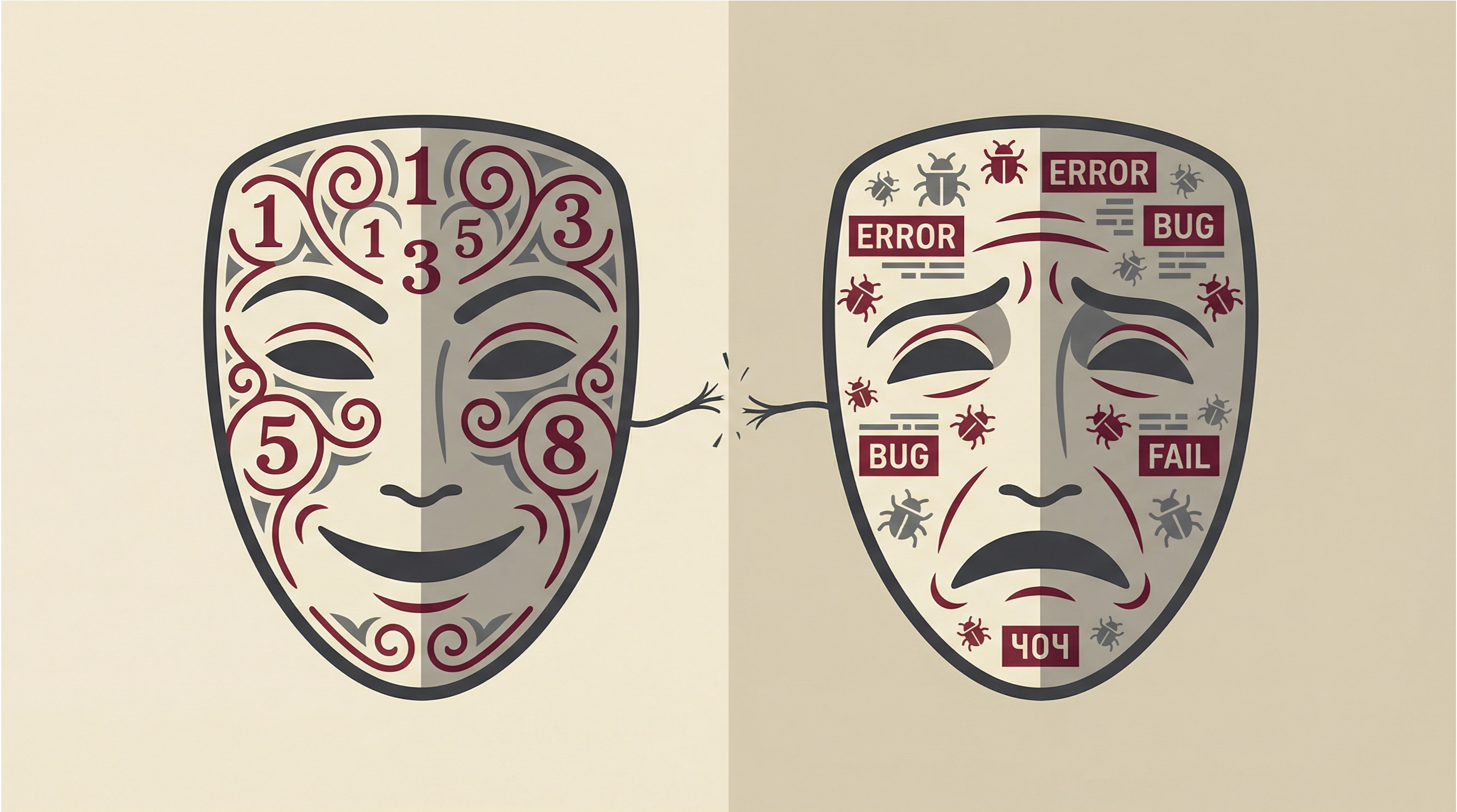
Why Agile Estimation Is Theater: The Case Against Story Points
Story points and estimation ceremonies waste 1,600+ hours per team annually. Stop training developers to predict the unpredictable and embrace uncertainty.

The Scrum Prison: When Excessive Structure Kills Creativity
Scrum`s rigid framework transforms creative engineers into mechanistic ticket processors. How excessive structure, story points, and daily standups prevent innovation.

The Psychology of the 9:00 AM Standup: Performance Theater Over Progress
Daily standups optimize for visible activity, not meaningful progress. Here`s why your 9 AM ritual is about social pressure, performance anxiety, and subtle surveillance, not alignment.
Get the next war story in your inbox
Independent essays and practical models about what the process claims versus what actually ships. Published under a protected pen name. Free, no spam, unsubscribe anytime.
No certifications sold. No process religion. Unsubscribe anytime.